


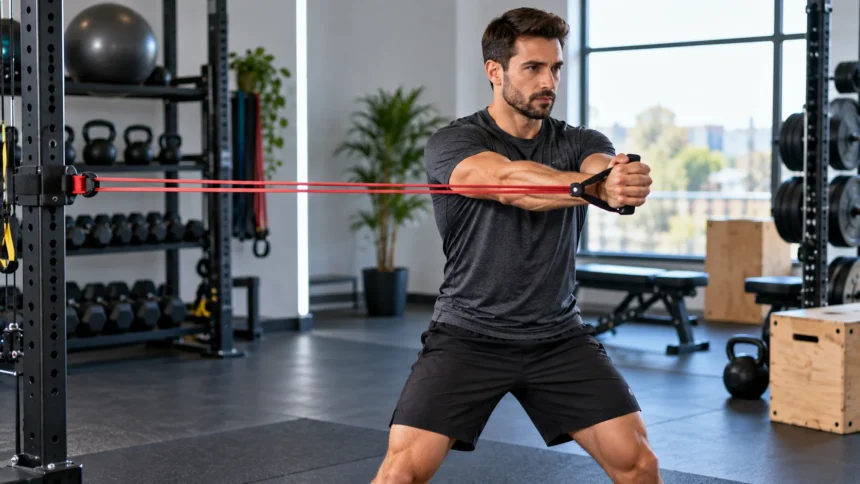
The Pallof press is a simple-looking core exercise that can be surprisingly challenging when performed correctly. Instead of bending or twisting your torso, you resist rotation while pressing a cable or resistance band away from your chest. This makes the movement useful for building stability rather than simply creating visible abdominal muscle.
Because the Pallof press trains your core to stay steady under sideways resistance, it can support lifting, sports, posture, and everyday movement. It also requires very little equipment and can be adjusted for beginners or more advanced exercisers. Learning proper form is important because small mistakes can reduce the amount of tension placed on the intended muscles.
What Is the Pallof Press?
The Pallof press is an anti-rotation core exercise typically performed with a cable machine or resistance band. You stand or kneel sideways to the resistance source, hold the handle near your chest, and press your hands straight forward. The resistance tries to pull your torso into rotation while your core works to keep you facing forward.
Unlike crunches or sit-ups, the Pallof press does not involve repeated spinal bending. The challenge comes from maintaining a stable rib cage, pelvis, and torso while your arms move away from your body. This is why the exercise is often used in strength training, athletic programs, rehabilitation, and general core workouts.
The movement can be performed from several positions, including standing, half-kneeling, tall-kneeling, or split stance. Each variation changes the stability demand slightly without changing the basic goal. The exercise remains focused on resisting unwanted rotation and maintaining controlled posture against an external force.
What Muscles Does the Pallof Press Work?
The Pallof press primarily works the muscles that help stabilize your trunk. Your obliques, transverse abdominis, rectus abdominis, and deeper core muscles all contribute to preventing your torso from rotating toward the cable or band. These muscles work together rather than acting as isolated parts during the movement.
Your glutes also help maintain pelvic stability, especially when you perform the standing variation. Muscles around the hips, lower back, and pelvis contribute to keeping your body aligned while the resistance pulls sideways. This makes the Pallof press more of a whole-body stability exercise than a simple abdominal isolation movement.
Your shoulders, chest, and arms also work as you press the handle away from your body. However, these muscles are not the main focus of the exercise. Their job is mostly to move and control the arms while the core prevents the rest of your body from twisting or leaning.
What Are the Main Benefits of the Pallof Press?
One of the biggest benefits of the Pallof press is improved anti-rotation strength. Your core often needs to resist unwanted movement during sports, lifting, walking, and carrying objects. Training this ability can help your torso remain more stable when forces come from different directions.
The exercise can also improve awareness of core positioning. Because the movement is slow and controlled, you can easily feel when your ribs flare, hips rotate, or shoulders twist. Learning to recognize these changes can carry over to squats, deadlifts, lunges, presses, and other strength exercises.
Another advantage is that the Pallof press is highly adaptable. You can make it easier or harder by changing band tension, cable weight, stance width, arm position, or distance from the anchor point. This makes the exercise appropriate for many fitness levels without requiring complicated equipment.
How to Do the Pallof Press Correctly
Start by attaching a resistance band or cable handle at approximately chest height. Stand sideways to the anchor point and hold the handle with both hands close to your chest. Step away until you feel steady tension, then place your feet about shoulder-width apart and soften your knees.
Brace your midsection as if you are preparing to receive a gentle push. Keep your ribs stacked over your pelvis and avoid leaning toward or away from the resistance. Press your hands straight out from your chest until your arms are extended without allowing your torso to rotate.
Pause briefly with your arms extended, then slowly bring the handle back toward your chest. Maintain control throughout the entire repetition instead of allowing the band or cable to pull you quickly. Complete the desired number of repetitions before turning around and training the opposite side.
Proper Pallof Press Form
Good Pallof press form begins with a stable stance. Your feet should stay firmly planted while your knees remain slightly bent rather than locked. Keep your weight balanced between both legs so you are not leaning excessively toward one side as the resistance increases.
Your spine should remain neutral, and your shoulders should stay relaxed rather than shrugging upward. Avoid arching your lower back when your arms move forward. If you notice your ribs lifting or pelvis tipping forward, reduce the resistance and focus on maintaining a stronger core position.
Your hands should travel directly away from the center of your chest. Do not allow them to drift toward the anchor point, because this reduces the anti-rotation challenge. Moving slowly and keeping your torso square generally makes the exercise more effective than using heavy resistance with poor positioning.
Common Pallof Press Mistakes
Allowing the torso to rotate is the most common Pallof press mistake. The entire purpose of the exercise is to resist the sideways force created by the cable or band. If your shoulders or hips turn toward the anchor, the resistance is likely too strong or your stance is not stable enough.
Another mistake is using momentum. Quickly pressing the handle forward and pulling it back can reduce the amount of time your core spends resisting rotation. Slow, controlled repetitions make it easier to maintain alignment and feel the abdominal muscles working throughout the movement.
Some people also stand too close to the anchor point and create very little resistance. Others move too far away and struggle to maintain posture. Choose a distance that creates noticeable tension while still allowing you to complete each repetition with stable hips, shoulders, and breathing.
How Many Pallof Press Reps Should You Do?
Beginners can start with about 8 to 12 controlled repetitions on each side. One to three sets is usually enough to learn the movement and build basic core stability. The goal should be maintaining excellent alignment rather than trying to complete a large number of repetitions.
More experienced exercisers can increase the challenge through additional repetitions, stronger resistance, longer pauses, or more difficult positions. Holding the arms extended for several seconds makes the core work harder without requiring heavier weight. This can be useful when you want to increase difficulty while protecting good technique.
You can also perform the exercise based on time rather than repetitions. Holding the extended position for 10 to 20 seconds can create a strong anti-rotation challenge. Progress gradually because fatigue can quickly cause the hips, shoulders, or spine to begin compensating.
Pallof Press Variations to Try
The standing Pallof press is the most common version and provides a strong foundation for learning the exercise. Once you are comfortable, you can try a half-kneeling variation with one knee on the floor. This reduces help from the legs and increases the stability demand placed on your hips and core.
A tall-kneeling Pallof press is another useful variation. Kneeling on both knees removes some lower-body assistance and makes pelvic control more important. Keep your glutes gently engaged so your lower back does not arch as you extend your arms.
You can also try a split-stance Pallof press, overhead Pallof press, or Pallof press with a slow rotation after establishing good control. These variations change the movement demands without losing the core-stability focus. Choose progressions that match your current strength rather than jumping directly into advanced versions.
Pallof Press vs Other Core Exercises
Traditional crunches mainly train trunk flexion, while the Pallof press focuses on resisting rotation. Both movements challenge the abdominal muscles, but they train them in different ways. Including several movement patterns can create a more balanced core routine than depending on only one type of exercise.
Planks also train core stability, but the force direction is different. A standard plank requires your trunk to resist extension, while the Pallof press creates a sideways rotational pull. Combining planks and Pallof presses can therefore challenge your core through different stability demands.
Exercises such as Russian twists involve active rotation, while the Pallof press asks you not to rotate. This distinction is important because the core must both produce movement and prevent unwanted movement in daily life. A balanced program can include both types depending on your goals and training experience.
When Should You Add the Pallof Press to Your Workout?
The Pallof press can work well near the beginning of a workout as part of a core activation routine. Using light to moderate resistance may help you practice abdominal bracing before squats, deadlifts, presses, or other compound exercises. Keep the volume moderate so you do not fatigue your core before heavier movements.
You can also perform the exercise later in the session as dedicated core work. At this point, you can use slightly more resistance or longer holds because your main lifts are already complete. This is a practical way to add focused stability training without extending your workout significantly.
The movement can also be included in short home or mobility sessions. A resistance band attached to a secure point is enough to perform the exercise outside a gym. Consistency matters more than choosing one perfect time, so place it wherever it fits naturally into your training plan.
Who Should Be Careful With the Pallof Press?
The Pallof press should create controlled muscular tension, not sharp pain. If you feel discomfort in your lower back, hip, groin, shoulder, or knee, reduce the resistance and check your alignment. Pain that continues despite modification may be a reason to stop and seek appropriate professional guidance.
People with recent abdominal, spinal, hip, or pelvic injuries should be cautious before adding anti-rotation exercises. The movement may need to be modified depending on the stage of recovery. If lower-body discomfort is also present, understanding issues such as gracilis muscle pain can help you recognize when groin-related symptoms may require additional attention.
Pregnant people or individuals recovering from surgery should also follow advice specific to their situation. The Pallof press can often be modified, but not every variation is appropriate for everyone. Exercise should match your current physical condition rather than being forced through discomfort.
Tips to Make the Pallof Press More Effective
Use a resistance level that challenges your core without pulling you out of position. If your body rotates every time your arms extend, reduce the weight or move closer to the anchor. Proper alignment creates a better training effect than simply increasing resistance.
Focus on breathing naturally while maintaining abdominal tension. Holding your breath excessively can make the exercise feel harder without improving control. A slow exhale as you press your hands forward can help you maintain a stable rib cage and avoid unnecessary tension through the shoulders.
Train both sides evenly because the direction of resistance changes when you turn around. You may notice that one side feels less stable than the other, which is common. Use the weaker side as a guide rather than automatically adding extra repetitions to it without a clear reason.
How to Progress the Pallof Press
Progression should begin with better control before heavier resistance. Once you can maintain a stable torso for every repetition, gradually increase cable weight or band tension. Small increases are usually enough because the exercise becomes difficult quickly when the resistance pulls farther from your center.
You can also increase the pause time while your arms are extended. Holding the position for three to five seconds forces your core to resist rotation for longer. This increases difficulty without requiring a dramatic jump in load and can help improve endurance.
More advanced progressions include narrower stances, split positions, kneeling variations, overhead presses, and controlled step-outs. Each change increases the demand on balance or core stability. Introduce only one progression at a time so you can identify whether your technique remains consistent.
Conclusion
The Pallof press is a highly effective core exercise that trains your body to resist rotation. It strengthens the abdominal muscles, obliques, glutes, and other stabilizers without requiring repeated spinal bending. This makes it useful for general fitness, strength training, sports, and movement control.
Proper form is more important than heavy resistance. Keep your torso square, ribs controlled, knees soft, and feet stable while pressing the handle straight away from your chest. If your hips or shoulders rotate, reduce the difficulty and rebuild control before progressing.
The Pallof press works best as part of a balanced core program. Combine it with exercises that train anti-extension, flexion, rotation, and overall strength. With consistent practice and sensible progression, it can become a valuable tool for developing stronger and more stable movement.
FAQs
What muscles does the Pallof press work?
The Pallof press mainly works the obliques, transverse abdominis, rectus abdominis, and deeper core muscles. The glutes, shoulders, and other stabilizers also contribute during the movement.
Is the Pallof press good for beginners?
Yes. Beginners can use a light resistance band or cable and start with a wide, stable stance. The exercise is easy to modify while learning proper core control.
How many Pallof presses should I do?
A good starting point is 8 to 12 repetitions per side for one to three sets. Focus on controlled movement and stable posture rather than high repetition numbers.
Should I feel the Pallof press in my abs?
Yes. You should feel your core working to resist rotation, especially through the abdominal and oblique muscles. Sharp pain in the back, hips, or shoulders is not normal.
Can I do Pallof presses every day?
Light Pallof presses can fit into frequent mobility or activation routines, but harder resistance work still needs recovery. Your overall training volume and intensity should determine how often you perform them.