


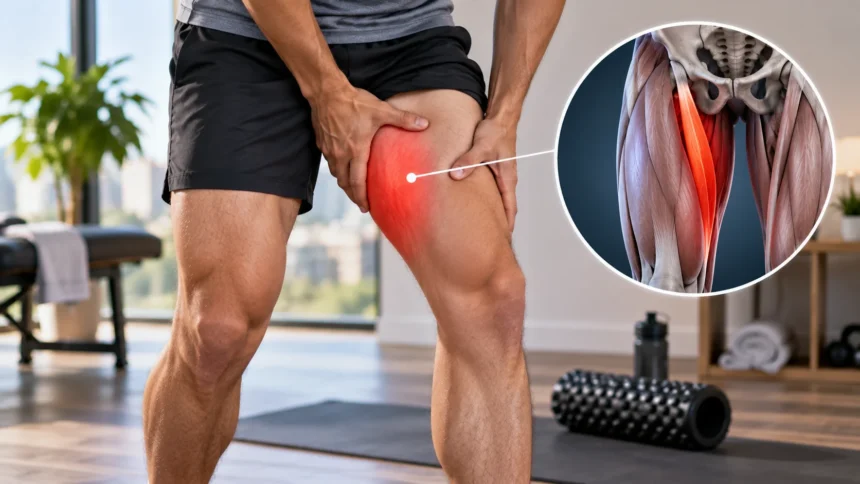
What Is the Gracilis Muscle?
The gracilis is a long, thin muscle that runs along the inner thigh from the pelvis to the upper part of the shinbone. It belongs to the hip adductor muscle group, which helps pull the leg toward the center of the body. The gracilis also contributes to knee bending and certain rotational movements.
Because the muscle crosses both the hip and knee joints, it becomes involved in many everyday and athletic movements. Walking, running, changing direction, climbing stairs, and stabilizing the legs can all recruit the gracilis. Sudden increases in activity or awkward movements may therefore leave the muscle irritated or strained.
Gracilis muscle pain is often felt along the inner thigh or near the groin, although symptoms can extend closer to the inner knee. The exact location depends on which part of the muscle is affected. Understanding the muscle’s position can help distinguish possible gracilis discomfort from pain arising in nearby structures.
What Does Gracilis Muscle Pain Feel Like?
Gracilis muscle pain can feel like aching, pulling, tenderness, or tightness along the inside of the thigh. Some people notice discomfort only during movement, while others may feel soreness when sitting or resting after activity. A strain can also produce sharper pain when the muscle is stretched or contracted strongly.
The symptoms may become more noticeable when bringing the legs together, running, kicking, or changing direction. Bending the knee against resistance can sometimes reproduce discomfort because the gracilis contributes to this movement. Tenderness may also be present when pressing gently along the inner thigh.
Pain severity can vary significantly. A mild overuse problem may feel like general tightness, while a more significant strain can make walking or exercise uncomfortable. Severe pain, major swelling, extensive bruising, or difficulty bearing weight deserves professional assessment rather than being treated as ordinary muscle soreness.
Common Causes of Gracilis Muscle Pain
Muscle strain is one of the most common causes of gracilis pain. The muscle can become overstretched during sudden direction changes, wide lunges, kicking movements, or sports requiring rapid acceleration. A strain may happen instantly or develop gradually when the muscle is repeatedly loaded without enough recovery.
Overuse can also irritate the inner thigh. Running longer distances, increasing training volume quickly, or performing repeated lower-body exercises can fatigue the adductor muscles. When workload rises faster than the body can adapt, discomfort may appear even without one obvious injury event.
Reduced hip strength, poor movement control, or limited mobility can also influence how much stress reaches the inner thigh. The gracilis rarely works alone, so problems in the hips, glutes, knees, or surrounding muscles may alter movement patterns. This is why repeated pain sometimes requires more than simply stretching the sore area.
Gracilis Strain During Exercise or Sports
Athletes involved in football, soccer, running, martial arts, and court sports can place substantial demand on the inner thigh muscles. Sprinting, cutting, kicking, and sudden lateral movement require fast changes in muscle length and tension. If the gracilis is not prepared for that workload, a strain can occur.
A mild strain may cause tightness or tenderness without significantly limiting movement. Moderate strains can produce sharper pain, weakness, or discomfort while walking, while more severe injuries may involve bruising and substantial loss of function. Continuing intense exercise immediately after a significant strain can make recovery more difficult.
Reducing the activity that caused the problem is often sensible during the early stage. That does not always mean complete inactivity, especially for mild symptoms. Comfortable walking and pain-free movement may be appropriate while more demanding movements are gradually reintroduced as the muscle becomes stronger.
Can Tight Hips Cause Inner-Thigh Pain?
Hip mobility influences how the inner-thigh muscles work during walking and exercise. If the hips move poorly in certain directions, nearby muscles may compensate by working harder. This does not mean every case of gracilis pain is caused by tight hips, but mobility can be one contributing factor.
Prolonged sitting may also make the hips and surrounding muscles feel stiff. When someone suddenly performs deep lunges, wide squats, or athletic movements after being relatively inactive, the inner thigh may experience more demand than expected. Gradual warm-ups can help prepare the area for larger ranges of movement.
Hip strength matters just as much as flexibility. Weakness around the glutes and other stabilizing muscles can affect lower-body control. If inner-thigh pain occurs alongside hip or butt pain, considering the entire hip and pelvic region may be more useful than focusing only on one muscle.
Gentle Relief Tips for Gracilis Muscle Pain
For mild muscle soreness, temporarily reducing painful activities can give the tissue time to settle. Avoid repeatedly stretching or loading the inner thigh into sharp discomfort. Gentle movement that stays within a comfortable range can help maintain mobility without continually aggravating the area.
Cold or warmth may provide temporary comfort depending on how the muscle feels. A wrapped cold pack may be soothing after a recent strain or exercise-related flare, while gentle warmth may help when the area mainly feels tight. Protect the skin and avoid using extreme temperatures for long periods.
Light massage around the inner thigh may also feel comfortable for some people, but pressure should remain gentle. Aggressive massage directly over a fresh or painful injury can increase irritation. If the muscle becomes more painful afterward, reduce the pressure or stop and use a more conservative approach.
Gracilis Stretches You Can Try
A gentle adductor stretch can be performed by sitting with the soles of the feet together and allowing the knees to move outward. Keep your back comfortable and avoid pressing the knees down aggressively. You should feel mild tension through the inner thighs rather than sharp pain near the groin or knee.
A wide-stance side shift can also stretch the inner thigh. Stand with your feet comfortably apart, bend one knee slightly, and shift your hips toward that side while keeping the opposite leg straighter. Stop as soon as you feel a gentle stretch along the inside of the straighter leg.
Stretching should never be forced during acute pain. If a movement causes sharp discomfort, reduce the range or skip it temporarily. Gentle flexibility work can be useful later in recovery, but repeatedly stretching an irritated muscle as hard as possible is unlikely to speed healing.
Strengthening the Gracilis and Inner Thigh
Gradual strengthening can help the gracilis and surrounding adductor muscles tolerate everyday and athletic demands more effectively. One simple exercise involves placing a pillow or soft ball between the knees and gently squeezing inward. Hold briefly, relax, and repeat without using enough force to cause pain.
Side-lying adduction is another option. Lie on one side with the top leg crossed in front, then slowly lift the lower leg a short distance from the floor. This movement can strengthen the inner thigh while allowing you to control the range and resistance carefully.
As strength improves, more challenging movements such as lateral lunges or resistance-band adduction may be introduced. Progress should be gradual rather than sudden. Good lower-body programs also strengthen the glutes, thighs, calves, and core so the gracilis is not expected to handle more work than necessary.
How Long Does Gracilis Muscle Pain Last?
Recovery time depends on the cause and severity of the problem. Mild soreness from overuse may improve within several days, while muscle strains can take longer. More significant injuries may require weeks of progressive rehabilitation before demanding sports or exercises feel comfortable again.
Pain should generally move toward gradual improvement. You may still notice some stiffness or weakness after resting discomfort has decreased, especially when returning to exercise. Increasing activity slowly gives the muscle time to rebuild strength and tolerate stretching without immediately becoming irritated again.
If symptoms remain unchanged for an extended period or repeatedly return whenever you resume normal activity, consider professional evaluation. Persistent inner-thigh pain can have several possible causes. A proper assessment can determine whether the gracilis is actually involved or whether another hip, groin, knee, or nerve-related problem may be responsible.
How to Prevent Gracilis Muscle Pain
Increase exercise intensity gradually, especially when beginning running, field sports, or lower-body strength training. Sudden changes in sprinting volume, lateral movement, or deep lunges can overload muscles that are not yet conditioned. Allow your body time to adapt before adding more speed, distance, or resistance.
Warm up before demanding activity with light movement and controlled exercises that involve the hips and legs. Walking, easy jogging, bodyweight squats, and gentle side movements can prepare the lower body without exhausting it. A warm-up should increase readiness rather than become a difficult workout itself.
Balanced strength training may also reduce unnecessary stress on the inner thigh. Train the glutes, quadriceps, hamstrings, calves, and core alongside the adductors. Maintaining appropriate mobility and recovery between sessions can further help the lower body handle repeated activity without one muscle becoming overloaded.
When Should Gracilis Pain Be Checked?
Seek medical attention if inner-thigh pain is severe, follows a major injury, or makes it difficult to walk or bear weight. Significant swelling, bruising, or a sudden snapping sensation also deserves evaluation. These symptoms may indicate a more serious muscle or tendon injury than ordinary post-exercise soreness.
Pain accompanied by numbness, tingling, unusual weakness, fever, or significant swelling should not automatically be treated as a gracilis strain. Similar symptoms can arise from other conditions involving nerves, joints, circulation, or nearby tissues. Professional assessment can help identify the actual source of discomfort.
You should also consider getting help when pain continues despite reasonable rest and gradual exercise modification. A physical therapist or other qualified healthcare professional can evaluate hip strength, mobility, knee function, and movement patterns. Individualized guidance is particularly useful when the same inner-thigh problem keeps returning.
Conclusion
Gracilis muscle pain usually appears along the inner thigh and may develop from strain, overuse, sudden movement, or increased exercise demands. Because the gracilis crosses both the hip and knee, discomfort may be influenced by movement at either joint. Mild symptoms often improve with appropriate activity modification and gradual recovery.
Gentle stretching, light movement, and progressive strengthening can support recovery when symptoms are muscular and uncomplicated. Avoid forcing painful stretches or returning immediately to intense running, kicking, or lateral movements. Improving strength throughout the hips and legs can also help reduce repeated overload on the inner thigh.
Severe, persistent, or unusual pain deserves professional evaluation. Significant bruising, swelling, weakness, numbness, or difficulty walking may suggest something more than temporary muscle soreness. Understanding the actual cause makes it easier to choose the right combination of rest, mobility, strengthening, and medical care.
FAQs
Where is gracilis muscle pain usually felt?
Gracilis pain is usually felt along the inner thigh, from the groin area toward the inner knee. The exact location depends on which portion of the muscle or nearby tissue is irritated.
How do you relieve gracilis muscle pain?
Reduce movements that cause sharp pain and use gentle activity, comfortable stretching, and gradual strengthening as symptoms settle. Severe or persistent pain should be evaluated before attempting aggressive rehabilitation exercises.
Can walking make gracilis pain worse?
Walking may be comfortable with a mild strain, but longer distances or faster speeds can increase symptoms. Reduce activity if your pain steadily worsens or changes your normal walking pattern.
Should you stretch a strained gracilis muscle?
Gentle stretching may be appropriate once movement is comfortable, but aggressive stretching can irritate an acute strain. Start with a small range and stop if you experience sharp or increasing pain.
How do I know if inner-thigh pain is serious?
Seek professional advice for severe pain, major swelling, extensive bruising, weakness, numbness, difficulty bearing weight, or symptoms that do not improve. Inner-thigh pain can sometimes involve structures other than the gracilis.