


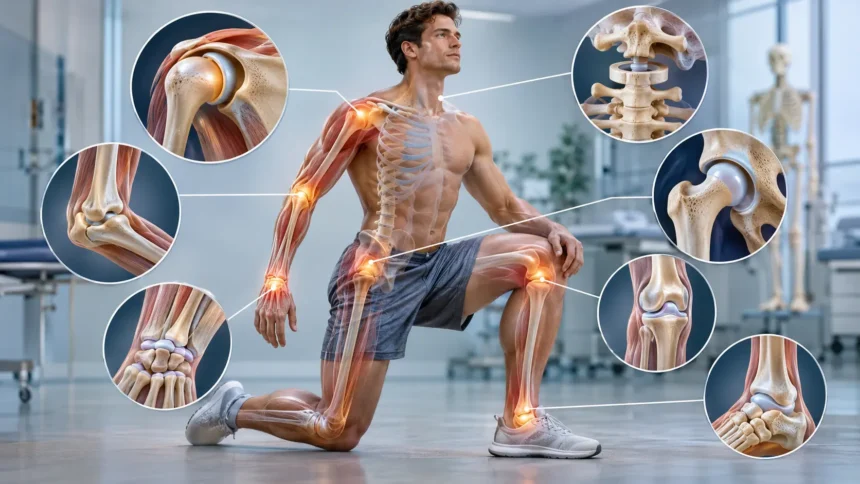
The human body contains many joints that help us move, bend, walk, run, and perform everyday activities. However, not every joint works in the same way or allows the same amount of movement. Some joints provide flexibility, while others create stability and protect important structures. Understanding the different types of joints makes it easier to learn how the skeletal system functions.
A joint is the location where two or more bones meet. Joints are classified according to their structure and the amount of movement they allow. The three main structural types are fibrous joints, cartilaginous joints, and synovial joints.
This guide explains the types of joints in the human body, their meanings, functions, and examples. You will also learn about the six types of synovial joints, how they support movement, and why maintaining healthy joints is important for everyday life.
What Are Joints in the Human Body?
Joints are connections between two or more bones in the skeletal system. They help hold the skeleton together while allowing different amounts of movement. Some joints move freely, while others remain almost completely stationary to provide stability and support important body structures.
In human anatomy, joints are also called articulations. Their structure varies depending on their location and function within the body. For example, the shoulder joint allows movement in several directions, while many joints between skull bones provide strong connections with little or no movement.
Joints work together with muscles, tendons, ligaments, and other surrounding tissues. Muscles generate the forces needed for movement, while different joint structures guide and support those movements. This coordination makes activities such as walking, lifting objects, and turning the head possible.
What Are the Main Functions of Joints?
One of the main functions of joints is to connect bones and maintain the structure of the skeleton. Without these connections, the bones could not function together as a coordinated support system. Joints provide the stability required for standing, maintaining posture, and performing everyday movements.
Another important function is allowing movement between different parts of the body. The knees bend during walking, the elbows move when lifting objects, and the shoulders allow the arms to move in several directions. Different joint designs make these movements possible while controlling their range.
Joints also help distribute forces across the skeletal system during physical activity. Supporting structures such as cartilage, ligaments, and joint capsules contribute to stability and load management. Their combined functions help the body move efficiently while reducing unnecessary stress on surrounding tissues.
How Are Joints Classified?
Joints are classified in two main ways: structural classification and functional classification. Structural classification focuses on the tissues connecting the bones and whether a joint cavity is present. Functional classification describes how much movement a joint allows during normal activities.
The three main structural categories are fibrous, cartilaginous, and synovial joints. Fibrous joints connect bones through dense connective tissue, while cartilaginous joints use cartilage to form connections. Synovial joints contain a joint cavity and generally allow greater movement than the other structural categories.
Functional classification includes synarthroses, amphiarthroses, and diarthroses. Synarthroses are essentially immovable joints, amphiarthroses permit limited movement, and diarthroses allow free movement. These categories describe function rather than tissue structure, although certain structural and functional classifications commonly occur together.
Fibrous Joints: Definition and Examples
Fibrous joints connect bones through dense fibrous connective tissue rather than a fluid-filled joint cavity. These connections generally provide strong support and allow little or no movement. Their limited flexibility helps stabilize skeletal structures that require protection or firm attachment.
A familiar example is the sutures between bones of the skull. These joints help connect skull bones and protect the brain. Another example is the syndesmosis between the tibia and fibula near the ankle, where ligaments help maintain the relationship between the two bones.
Gomphoses are another type of fibrous joint, connecting teeth to their sockets through periodontal ligaments. Although teeth may appear completely fixed, these tissues allow a small amount of controlled movement. The three main forms of fibrous joints are therefore sutures, syndesmoses, and gomphoses.
Cartilaginous Joints: Definition and Examples
Cartilaginous joints connect bones using cartilage and do not contain a typical synovial joint cavity. These joints usually provide stability while allowing little or limited movement. Their construction helps support structures that must tolerate pressure or maintain strong connections.
One example is the pubic symphysis, which connects the two pubic bones at the front of the pelvis. Another example is the joints between vertebral bodies, where intervertebral discs provide cushioning and permit controlled movement. These structures contain fibrocartilage that contributes to support and flexibility.
Cartilaginous joints are divided into synchondroses and symphyses. Synchondroses use hyaline cartilage and may be temporary, as seen in certain growth plates during development. Symphyses contain fibrocartilage and are typically designed to provide strength while permitting limited movement.
Synovial Joints: Definition and Key Features
Synovial joints are the most freely movable structural type of joint in the human body. They contain a cavity between articulating bones and are surrounded by a joint capsule. These features allow movement while providing protection and stability to the joint.
The ends of bones in many synovial joints are covered with articular cartilage, which provides smooth surfaces and helps distribute mechanical loads. The joint capsule contains a synovial membrane that produces synovial fluid. This fluid supports lubrication and contributes to the nutrition of articular cartilage.
Examples of synovial joints include the shoulders, hips, knees, elbows, and wrists. Their shapes determine the directions in which movement can occur. Anatomists commonly divide synovial joints into six types based on the form of their articulating surfaces and the movements they permit.
Hinge Joints: Meaning, Function and Examples
Hinge joints are synovial joints that mainly allow movement in one plane. Their structure resembles the basic opening and closing action of a door hinge. The primary movements are flexion, which decreases a joint angle, and extension, which increases it.
The elbow is a common example of a hinge joint because it allows the forearm to bend and straighten. The interphalangeal joints of the fingers and toes are additional examples. These movements are essential for gripping objects, walking, and performing many ordinary activities.
The knee is often described as a modified hinge joint because it mainly permits bending and straightening. However, it also allows some rotation under particular conditions. This makes the knee more complex than a simple hinge, demonstrating that anatomical classifications describe general movement patterns rather than every small motion.
Ball-and-Socket Joints: Meaning and Examples
Ball-and-socket joints are synovial joints that allow movement in several directions. They contain a rounded bone surface that fits into a cup-shaped socket. This arrangement permits flexion, extension, abduction, adduction, rotation, and circular movements known as circumduction.
The shoulder is a well-known example of a ball-and-socket joint. Its structure allows the arm to move through a wide range of positions, including reaching overhead and rotating outward. The surrounding muscles, tendons, ligaments, and joint capsule contribute to maintaining stability during these movements.
The hip is another ball-and-socket joint, connecting the femur to the pelvis. Its socket is relatively deep, providing substantial stability while supporting movement during walking and other activities. Although both joints share the same structural category, their shapes and surrounding tissues create different balances between mobility and stability.
Pivot Joints: Meaning and Examples
Pivot joints are synovial joints that primarily allow rotation around one axis. Their structure permits one bone or connected structure to turn relative to another. This movement is important for changing the direction of certain body parts without requiring large bending motions.
The atlanto-axial joint between the first and second cervical vertebrae is an example. It contributes to the side-to-side rotation of the head, such as when someone turns to look left or right. Its anatomy allows controlled rotation while surrounding structures provide support.
The proximal radioulnar joint near the elbow is another example of a pivot joint. It helps the radius rotate relative to the ulna during forearm movements called pronation and supination. These movements allow the palm to turn downward or upward and are useful for many hand-related activities.
Condyloid Joints: Meaning and Examples
Condyloid joints, also called ellipsoid joints, are synovial joints with curved articulating surfaces. They generally allow movement in two main planes, including flexion and extension as well as abduction and adduction. These combined movements can also produce circumduction.
The radiocarpal joint of the wrist is a common example of a condyloid joint. It contributes to bending the wrist forward and backward and moving it toward either side. This flexibility supports activities such as writing, using tools, and adjusting the position of the hand.
The metacarpophalangeal joints at the bases of the fingers are additional examples. They permit the fingers to bend, straighten, spread apart, and move together. However, condyloid joints do not normally allow the same degree of independent axial rotation as ball-and-socket joints.
Saddle Joints: Meaning and Examples
Saddle joints are synovial joints in which the articulating surfaces have complementary curves. Each surface is concave in one direction and convex in another, creating a shape similar to a saddle. This arrangement provides movement in two main planes while maintaining a useful degree of stability.
The carpometacarpal joint at the base of the thumb is a prominent example. It allows the thumb to move across the palm and participate in opposition, an important movement for grasping objects. This ability helps people hold pencils, button clothing, and manipulate small items.
Saddle joints generally permit flexion, extension, abduction, adduction, and circumduction. The thumb’s movement is especially complex because the joint’s orientation and surrounding structures allow combined motions. These features make it an important part of the hand’s ability to perform precise activities.
Plane Joints: Meaning and Examples
Plane joints are synovial joints that allow limited gliding or sliding movements between relatively flat or gently curved surfaces. Rather than producing large movements around a single axis, they support small adjustments between neighboring bones. These movements contribute to the overall flexibility and function of certain skeletal regions.
Examples include some intercarpal joints between the small bones of the wrist and intertarsal joints within the foot. The facet joints between vertebrae are also classified as plane synovial joints. Their orientation helps determine the movements permitted in different regions of the spine.
Although individual plane joints allow relatively small movements, several joints working together can contribute to meaningful flexibility. In the wrist and foot, these movements help accommodate changing positions and forces. Their primary role is controlled gliding rather than the extensive mobility found in the shoulder or hip.
Structural vs. Functional Classification of Joints
Structural classification describes how bones are connected, while functional classification focuses on how much movement occurs. Both systems provide useful information about joint anatomy. A complete understanding of the skeletal system often requires considering these classifications together.
For example, skull sutures are structurally fibrous joints and functionally synarthroses because they are essentially immovable. The pubic symphysis is a cartilaginous joint that generally allows limited movement, making it an amphiarthrosis. Most synovial joints are functionally classified as diarthroses because they allow free movement.
However, the relationship between structural and functional categories is not perfectly identical in every case. Some fibrous connections permit limited movement, and certain joint functions may change during development. Learning both classification systems helps explain why different joints have different structures and movement capabilities.
What Structures Support Healthy Joints?
Healthy joints depend on several tissues working together to maintain movement and stability. Articular cartilage helps create smooth contact surfaces in many synovial joints, while ligaments connect bones and limit excessive movement. The joint capsule surrounds the cavity and contributes to mechanical support.
Tendons connect muscles to bones and help transmit the forces required for movement. Muscles surrounding a joint also provide active stability by controlling its position and motion. These tissues work together so the skeleton can perform activities without relying on bone surfaces alone.
Synovial fluid plays an important role in lubricating synovial joints and supporting cartilage nutrition. Other structures, such as menisci and bursae, contribute to load distribution or reduce friction in certain areas. Understanding these components helps explain why joint health involves more than just the bones.
Common Joint Problems and Conditions
Joints can be affected by injuries, inflammation, degenerative changes, and other medical conditions. Arthritis is a general term covering several diseases that affect joints and may cause pain, swelling, or stiffness. Osteoarthritis and rheumatoid arthritis are familiar examples, although they develop through different biological processes.
Sprains occur when ligaments are stretched or injured, while dislocations involve the loss of normal alignment between articulating bones. Some joints are more vulnerable to particular injuries because of their structure and typical activities. For example, ankle sprains and shoulder dislocations are recognized musculoskeletal problems.
Persistent joint pain, unexplained swelling, or restricted movement should be evaluated by a healthcare professional. A suddenly hot, swollen, very painful joint, especially with fever, requires urgent assessment. Identifying the cause is important because treatment differs between injuries, inflammatory diseases, and infections.
How to Keep Your Joints Healthy
Regular, comfortable physical activity helps support the muscles and other tissues surrounding joints. Activities such as walking, swimming, and cycling can contribute to mobility and overall fitness. The most appropriate movement depends on individual health, comfort, and any existing joint conditions.
Strengthening exercises can help the muscles provide support during everyday activities. Appropriate technique, sufficient recovery, and gradual changes in activity can reduce unnecessary strain. Protective equipment may also be useful during sports and other activities where joint injuries are possible.
A balanced diet, adequate sleep, and suitable medical care contribute to general musculoskeletal health. Avoid ignoring persistent pain or forcing movements that cause significant discomfort. Maintaining healthy habits supports joint function, although it cannot guarantee prevention of every injury or joint disease.
Conclusion
Joints are essential structures that connect bones and allow the human body to maintain stability and perform movements. The three main structural types are fibrous, cartilaginous, and synovial joints. Each has different characteristics that influence its function and range of motion.
Synovial joints are divided into six major types: hinge, ball-and-socket, pivot, condyloid, saddle, and plane joints. These structures support different movements, including bending, rotation, sliding, and movement in several directions. Understanding their locations and functions provides a clearer picture of how the skeletal system works.
Maintaining joint health involves appropriate movement, supportive muscles, and attention to injuries or unusual symptoms. Although different joints have different mechanical roles, they work together during everyday activities. Learning about joint anatomy helps explain how the body moves and why proper care is important for long-term mobility.
Frequently Asked Questions (FAQs)
What are the three main types of joints?
The three main structural types are fibrous, cartilaginous, and synovial joints. They differ in the tissues connecting the bones, the presence of a joint cavity, and the amount of movement they allow.
What are the six types of synovial joints?
The six types are hinge, ball-and-socket, pivot, condyloid, saddle, and plane joints. Each has a characteristic structure that determines the movements it can perform.
What is the most movable type of joint?
Ball-and-socket joints allow movement in multiple directions, including rotation. The shoulder is particularly mobile, while the hip provides a different balance between movement and stability.
What is an example of an immovable joint?
The sutures connecting many bones of the adult skull are examples of essentially immovable joints. These fibrous connections provide stability and help protect the brain.
What is the difference between a ligament and a tendon?
A ligament generally connects bone to bone and helps stabilize joints. A tendon connects muscle to bone and transfers muscular force, allowing the skeleton to move during physical activities.