


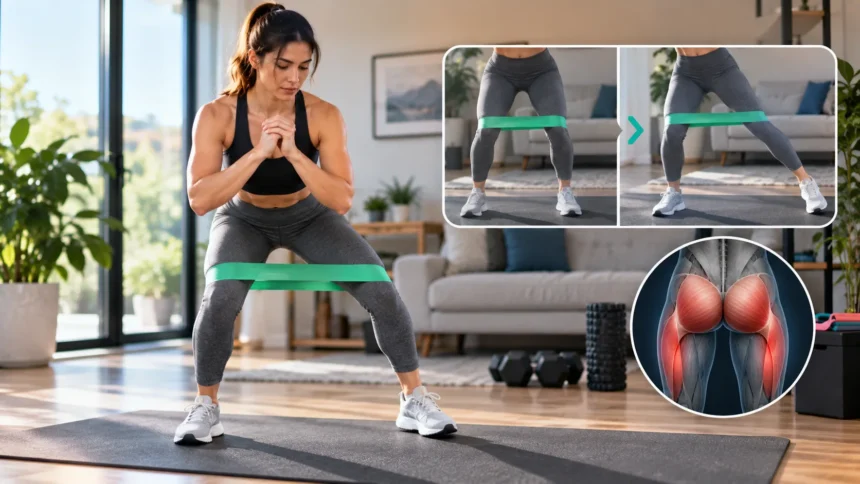
The monster walk is a resistance-band exercise that targets the glutes, hips, and smaller stabilizing muscles around the pelvis. It involves stepping forward, backward, or diagonally while keeping constant tension on a loop band. Although the movement looks simple, proper form is important because poor positioning can shift the work away from the glutes and into the knees or lower back.
Monster walks are often used during lower-body warm-ups, glute activation routines, rehabilitation-style training, and strength workouts. They can help improve hip stability, lateral control, and awareness of knee position during movements such as squats, lunges, running, and jumping. Because resistance bands are inexpensive and portable, the exercise is easy to perform at home or in a gym.
The key is to move slowly, keep the knees aligned with the toes, and maintain tension throughout the set. You do not need a very strong band to make monster walks effective. The following guide explains how to perform the exercise correctly, which muscles it works, common mistakes, benefits, variations, and practical tips for adding it to your routine.
What Is the Monster Walk Exercise?
The monster walk is a banded lower-body exercise performed by stepping in controlled directions while resisting the band’s pull. A loop resistance band is typically placed around the thighs, knees, ankles, or feet. The exact band position changes the difficulty and how strongly different hip muscles are challenged.
Unlike a normal walk, the feet are kept wider apart and the knees remain slightly bent throughout the movement. This creates continuous tension around the hips and forces the glutes to work while you step. The exercise is usually performed for distance, repetitions, or time rather than with heavy external weight.
Monster walks can be performed forward and backward, while lateral band walks focus mainly on side-to-side movement. Both exercises train hip stability, but the diagonal stepping pattern of a monster walk introduces a slightly different coordination challenge. This makes the exercise useful for adding variety to glute activation and lower-body control work.
What Muscles Do Monster Walks Work?
Monster walks primarily target the gluteus medius and gluteus maximus, while the gluteus minimus also contributes to hip stability. These muscles help control the position of the pelvis and thigh during walking, running, and single-leg movements. The outer hip muscles are especially active when resisting the inward pull of the resistance band.
The quadriceps and hamstrings also contribute because the knees remain slightly bent while you step. Your calves and ankle stabilizers help control foot placement, especially when the band is positioned around the ankles or feet. The core works isometrically to keep your trunk steady and reduce excessive side-to-side movement.
Because several muscles contribute at once, monster walks are considered a functional lower-body exercise rather than an isolated glute movement. They are particularly useful for improving coordination between the hips, knees, and feet. However, they work best when combined with larger strength exercises rather than used as the only exercise for building the lower body.
How to Do Monster Walks Correctly
Place a loop resistance band above your knees or around your ankles, depending on your experience. Stand with your feet about hip-width apart and create enough outward pressure to keep the band under tension. Slightly bend your knees and push your hips back into a small athletic stance without turning the movement into a deep squat.
Step forward and slightly outward with one foot, then bring the other foot forward while keeping space between your feet. Continue alternating steps in a diagonal pattern, making sure the knees remain aligned with the toes. Your feet should never come completely together because that removes tension from the band.
Keep your torso relatively upright and move with control rather than rushing. After several forward steps, reverse the movement and walk backward using the same diagonal pattern. Maintain consistent band tension throughout the entire set so the glutes remain active from the first repetition to the last.
Benefits of Monster Walks
One major benefit of monster walks is improved hip stability. The gluteus medius helps control the thigh and pelvis during single-leg tasks such as walking, running, climbing stairs, and lunging. Strengthening this area can improve control when the body needs to remain stable while one foot is off the ground.
Monster walks can also improve awareness of knee positioning. The resistance band pulls the thighs inward, so you must actively resist that force while stepping. This can help reinforce controlled knee alignment during squats, lunges, step-ups, and other lower-body movements where poor hip control may cause the knees to collapse inward.
Another benefit is convenience. The exercise requires only a loop resistance band and a small amount of open space. It can be used in warm-ups, home workouts, travel routines, or rehabilitation programs without machines or heavy weights, making it easy to include consistently.
How Monster Walks Help With Glute Activation
Monster walks are often included before lower-body strength training because they increase activity in the glute muscles without creating excessive fatigue. A few controlled sets can help you feel the outer hips and glutes working before exercises such as squats, deadlifts, or lunges. This may improve your awareness of hip position during the main workout.
Glute activation does not mean the muscles were previously “turned off.” Instead, the exercise gives you an opportunity to practice using them through a controlled movement pattern. This can be helpful if you tend to rely heavily on the quads or if your knees drift inward during lower-body exercises.
Keep the warm-up light enough that your glutes still feel fresh afterward. Using an extremely heavy band or doing very high repetitions can create fatigue before your main lifts. The goal is usually to prepare the muscles and improve movement control rather than completely exhaust them.
Monster Walks for Knee and Hip Control
The hips influence how the knees move during many activities. When the glute muscles cannot control the thigh effectively, the knee may drift inward during squats, running, landing, or stepping. Monster walks challenge you to resist that inward movement and maintain better alignment while the body is moving.
This makes the exercise useful for people working on lower-body coordination. However, monster walks are not a guaranteed treatment for knee pain, because discomfort can come from many different tissues and causes. They should be used as part of a broader program rather than assumed to fix every knee or hip problem.
If the exercise causes pain around the knees or hips, reduce the resistance or change the band position. A band above the knees is often easier than one around the ankles or feet. Persistent joint pain deserves assessment rather than repeatedly forcing the same movement.
Best Band Placement for Monster Walks
Placing the resistance band above the knees is usually the easiest option for beginners. This position reduces the lever length and makes it easier to keep the knees aligned during each step. It is also a good choice when you are learning how to maintain tension without allowing the feet to move too far apart.
Moving the band around the ankles increases the challenge because the hips must resist tension through a longer lever. The ankles and lower legs also contribute more strongly to control. This variation works well once you can perform the above-knee version without losing posture or allowing the knees to collapse inward.
Placing the band around the feet can create an even greater challenge and increase work around the hips and ankles. However, this position requires more control and may not be suitable for everyone. Choose the placement that allows good technique instead of assuming the lowest band position is automatically better.
Common Monster Walk Mistakes
One common mistake is allowing the knees to collapse inward as you step. This usually happens when the resistance is too strong or the feet move too close together. Keep gentle outward pressure against the band and make sure the knees continue pointing in the same general direction as the toes.
Another mistake is taking steps that are too large. Oversized steps may cause the torso to sway, the pelvis to rotate, or the knees to lose alignment. Smaller, controlled steps usually keep more consistent tension on the glutes and make it easier to maintain stable movement.
Standing completely upright can also reduce the effectiveness of the exercise. A slight bend in the knees and hips helps create a more stable athletic position. However, avoid squatting too deeply because excessive knee bend can turn the movement into a tiring squat hold instead of a controlled band walk.
How Many Monster Walks Should You Do?
For a warm-up, one to three sets of approximately 8 to 15 steps in each direction is often enough. You should feel the glutes working without significant burning or fatigue. Use a light or moderate resistance band and focus on consistent step size and knee alignment.
When monster walks are used as an accessory exercise, you can increase the total volume slightly. Two to four sets of 10 to 20 steps can provide a useful challenge, depending on band strength and training experience. The set should end when form begins to deteriorate rather than when you reach an arbitrary number.
You can also perform the exercise for time, such as 20 to 40 seconds per set. This works well during circuit training or home workouts. Regardless of the method, controlled movement matters more than accumulating as many steps as possible.
How to Include Monster Walks in a Full Workout
Monster walks fit well near the beginning of a lower-body workout. You can perform them after a general warm-up and before squats, deadlifts, step-ups, or lunges. This sequence allows you to activate the hips without significantly reducing strength for the heavier exercises that follow.
They can also be used as an accessory exercise later in the session. Pair them with glute bridges, clamshells, lateral walks, or single-leg exercises if your goal is additional hip stability work. Avoid adding so many band exercises that the routine becomes repetitive and unnecessarily long.
A balanced program should train the whole body rather than focusing only on the hips. Lower-body strength, core stability, and upper-body work all contribute to overall function. If you want to balance your routine further, adding hand strengthening exercises can support grip and upper-limb strength alongside your lower-body training.
Monster Walk Variations to Try
Forward and backward monster walks are the standard variation. Step diagonally forward while maintaining band tension, then reverse the movement for the return. Walking backward can feel more challenging because balance and coordination demands change slightly.
Lateral band walks are another useful option. Instead of moving diagonally, step directly to the side while keeping the knees bent and hips level. This variation places a strong emphasis on the outer hips and can be combined with monster walks for a more complete band-based glute routine.
You can also vary the stance height or band placement to change difficulty. A slightly lower position increases time under tension, while moving the band toward the ankles or feet generally increases resistance demands. Change only one variable at a time so you can maintain good technique.
Tips for Safer and More Effective Monster Walks
Choose a resistance band that challenges you without changing your form. If the knees cave inward, the torso leans excessively, or you cannot maintain spacing between the feet, use a lighter band. Stronger resistance is not useful if it forces poor movement.
Keep each step deliberate and controlled. Avoid bouncing, dragging the feet, or allowing the band to snap the legs inward. Slow movement increases time under tension and makes it easier to feel whether the glutes are controlling the position properly.
Inspect resistance bands regularly for tears, cracks, or worn spots. Damaged bands can break unexpectedly under tension, so replace them before they fail. Store bands away from sharp surfaces and excessive heat to help preserve their elasticity and make training safer.
Conclusion
The monster walk is a simple resistance-band exercise that strengthens the glutes, hips, and stabilizing muscles around the pelvis. It can improve hip control, reinforce knee alignment, and prepare the lower body for movements such as squats, lunges, running, and step-ups.
Good technique requires constant band tension, small controlled steps, and stable knee positioning. Avoid using resistance that causes the knees to collapse or the torso to sway. Beginners can start with the band above the knees before progressing to more challenging ankle or foot placements.
Monster walks work best as part of a complete strength routine rather than as a stand-alone solution for lower-body fitness. Combine them with squats, hinges, single-leg exercises, and general mobility work. With consistent form and gradual progression, they can become a useful addition to warm-ups and lower-body training.
FAQs
What muscles do monster walks work?
Monster walks primarily work the gluteus medius, gluteus maximus, and other hip stabilizers. The quads, hamstrings, calves, ankles, and core also contribute to maintaining position and controlling each step.
Are monster walks good for glutes?
Yes. Monster walks create continuous resistance around the hips and can help train the glutes through controlled stepping. They are especially useful for warm-ups and accessory work.
Where should the band go for monster walks?
Beginners can place the band above the knees. More advanced exercisers may use the ankles or feet, which generally increases difficulty and requires greater hip and lower-leg control.
How many monster walks should I do?
Start with one to three sets of 8 to 15 steps in each direction. Use enough resistance to challenge the hips without causing your knee alignment or posture to break down.
Should monster walks hurt your knees?
No. You may feel muscular effort around the hips and thighs, but sharp knee pain is not expected. Reduce resistance, adjust band placement, or stop the exercise if joint pain develops.