


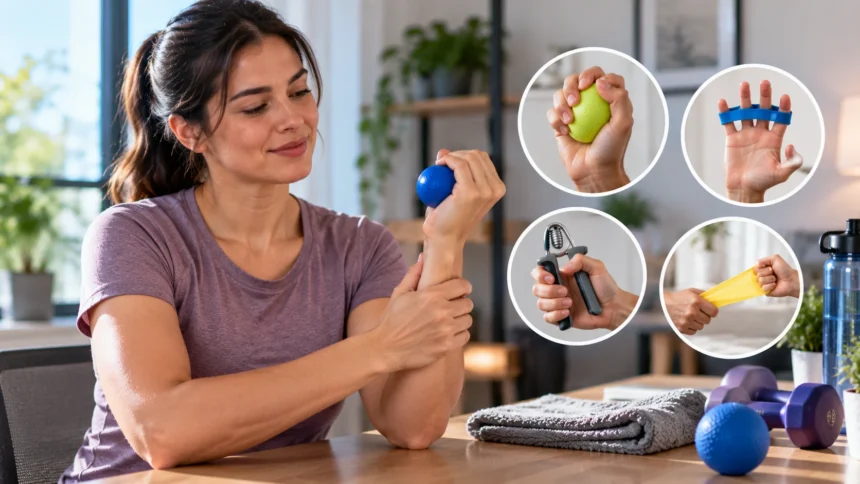
Strong hands make everyday tasks easier, from opening jars and carrying bags to typing, cooking, gardening, and lifting objects. Hand strengthening exercises can improve grip strength, finger control, wrist stability, and endurance when they are performed consistently. Many exercises require little equipment, making them easy to include in a home workout or rehabilitation-style routine.
Hand strength can decline because of inactivity, aging, repetitive strain, previous injury, or reduced use after pain. The muscles of the hands and forearms work together, so effective training usually includes gripping, pinching, finger extension, wrist movement, and coordination exercises. A balanced approach is more useful than repeatedly squeezing one object as hard as possible.
The key is to progress gradually and avoid forcing painful movements. Mild muscular effort is expected, but sharp pain, swelling, numbness, or worsening weakness should not be ignored. The exercises below explain proper form, potential benefits, and practical ways to improve hand strength without unnecessary strain.
Why Hand Strength Matters
Hand strength affects many activities people perform without thinking about them. Carrying groceries, turning keys, holding utensils, using tools, and opening containers all require coordinated force from the fingers, hands, wrists, and forearms. When grip strength is limited, simple tasks can become tiring or require more effort from other parts of the arm.
Strong hands are also useful during exercise. Dumbbells, barbells, pull-up bars, resistance bands, and kettlebells all require enough grip to hold equipment securely. If your hands fatigue before the larger muscles you are training, grip strength may limit how effectively you perform certain pulling or carrying exercises.
Hand strength is only one part of overall physical function. Lower-body strength, balance, mobility, and joint comfort also influence everyday independence and exercise performance. For example, if you experience back-of-knee pain, addressing that separately can help you maintain a more balanced whole-body training routine.
Hand Squeeze Exercise
A simple hand squeeze can be performed with a soft stress ball, therapy ball, rolled towel, or similar object. Hold the object in your palm and wrap your fingers around it comfortably. Squeeze gradually until you feel the hand and forearm muscles working, then release slowly rather than snapping the fingers open.
Hold each squeeze for about two to five seconds before relaxing. Start with 8 to 15 repetitions per hand and use an object that compresses without requiring maximum effort. The exercise should create muscular fatigue rather than pain in the finger joints or wrist.
As your grip improves, you can increase repetitions or use a slightly firmer ball. Avoid choosing resistance that forces you to hold your breath or causes your wrist to bend awkwardly. Smooth, controlled squeezing develops endurance and control more effectively than repeated maximal gripping.
Finger Extension Exercise
Grip exercises mainly train the muscles that close the hand, so finger extension provides useful balance. Place a rubber band or light finger-extension band around your fingertips and thumb. Begin with the fingers gently together, then slowly spread them apart against the resistance.
Pause briefly when the fingers are comfortably separated, then return to the starting position with control. You should feel the muscles across the back of the hand and forearm working. Avoid using a band so strong that your fingers shake excessively or cannot move through a comfortable range.
Perform approximately 10 to 15 repetitions for one to three sets. This exercise can be especially useful for people who spend a lot of time gripping tools, typing, or using their hands in repetitive positions. Balanced finger training supports both opening and closing strength rather than emphasizing gripping alone.
Thumb Opposition Exercise
Thumb control is important for gripping, pinching, writing, buttoning clothes, and holding small objects. Begin with your hand open and relaxed. Touch the tip of your thumb to the tip of your index finger, then repeat with the middle, ring, and little fingers.
Move slowly and try to create a controlled circular shape between the thumb and each finger. After reaching the little finger, reverse the pattern back toward the index finger. The exercise should feel smooth rather than rushed, and you should avoid forcing the thumb into an uncomfortable range.
You can make the movement slightly more challenging by pressing the fingertips together gently for two or three seconds. This adds light isometric resistance without equipment. Thumb opposition is useful for coordination as well as strength, particularly when combined with other grip and pinch exercises.
Pinch Strength Exercise
Pinch strength involves using the thumb against one or more fingers rather than wrapping the whole hand around an object. Hold a soft foam block, folded towel, or therapy putty between your thumb and index finger. Pinch gently and hold the pressure for a few seconds before releasing.
Repeat the exercise using the thumb with different fingers to challenge slightly different positions. Keep your wrist neutral and avoid gripping with the rest of the hand unnecessarily. The goal is controlled pressure through the fingertips rather than maximum force.
Begin with 8 to 12 repetitions for each useful finger position. As strength improves, you can progress to firmer therapy putty or thicker objects. Pinch training can support tasks such as turning keys, holding cards, handling coins, and opening small packaging.
Wrist Curl Exercise
The muscles controlling the hands extend into the forearm, so wrist strengthening can support grip and hand function. Sit with your forearm supported on a table or thigh and hold a light dumbbell or household object. Let your hand extend slightly beyond the edge with your palm facing upward.
Slowly curl the wrist upward while keeping the forearm still. Pause briefly, then lower the hand with control. Use light resistance because the wrist muscles are smaller than major arm or leg muscles and do not need heavy weights to be challenged effectively.
Perform 10 to 15 repetitions before switching hands. Avoid bending the elbow or using momentum to lift the weight. If wrist pain appears, reduce the resistance or range rather than pushing through discomfort.
Reverse Wrist Curl
Reverse wrist curls train the muscles on the opposite side of the forearm. Support your forearm and hold a light weight with your palm facing downward. Let the hand move slightly toward the floor, then lift the back of your hand upward using controlled wrist extension.
The movement should remain small and smooth. Keep your fingers wrapped around the weight without squeezing excessively, and avoid lifting the entire forearm. You should feel effort along the top of the forearm rather than sharp pressure inside the wrist joint.
Start with one to three sets of 10 to 15 repetitions. Using very light resistance is usually enough, particularly for beginners. Strengthening both wrist flexors and extensors can provide better balance than training only the muscles used for gripping.
Towel Wringing Exercise
Towel wringing is a practical exercise that trains grip, wrist movement, and forearm coordination simultaneously. Hold a small towel with both hands and twist it as though you are trying to wring out water. Use moderate pressure and keep the movement controlled through both wrists.
Twist in one direction for several seconds, relax, then reverse direction. Changing direction helps train both sides of the forearms more evenly. Avoid gripping so hard that the fingers cramp or your wrists become uncomfortable.
Perform several slow repetitions in each direction. You can slightly increase difficulty by using a thicker towel or dampening it, although heavy resistance is unnecessary. This exercise translates well to everyday tasks because it combines several hand and wrist actions at once.
Therapy Putty Exercises
Therapy putty can be used for squeezing, pinching, rolling, finger spreading, and thumb movements. Start by squeezing the putty into your palm, then reshape it and try pinching small sections between your thumb and fingers. Its resistance makes it easy to train multiple hand movements with one simple tool.
You can also roll the putty into a long shape and press individual fingertips into it. Another option is spreading the fingers outward against putty wrapped loosely around them. These variations help train grip, finger isolation, and coordination without requiring heavy equipment.
Different putty resistance levels are available, so begin with a softer option. A harder material is not automatically better if it changes your form or causes joint discomfort. Gradual progression gives the small muscles and tendons in the hand time to adapt safely.
Farmer’s Carry for Grip Strength
Farmer’s carries strengthen the hands by requiring you to hold weights while walking. Stand tall with a dumbbell or kettlebell in each hand and let your arms rest by your sides. Grip the handles firmly, keep your shoulders relaxed, and walk slowly while maintaining an upright posture.
Start with a light load that you can hold securely for about 20 to 30 seconds. The hands and forearms should feel challenged near the end without the weights slipping dangerously. Keep your wrists neutral instead of allowing them to bend under the load.
As your grip becomes stronger, gradually increase the carrying time or resistance. Do not increase both at once if your technique becomes unstable. Farmer’s carries also train the shoulders, trunk, and walking control, making them a useful whole-body addition to hand-strength training.
How Often Should You Train Your Hands?
Hand strengthening can often be performed two to four times per week depending on the exercise intensity and your current condition. Very light mobility and coordination exercises may be done more frequently, while harder grip training requires more recovery. Soreness or persistent fatigue is a sign that you may need additional rest.
A short session of 10 to 15 minutes can be enough. You might choose one gripping exercise, one finger-extension movement, one pinch exercise, and one wrist-strengthening drill. This combination covers several functions without making the routine unnecessarily long.
Consistency is more important than doing a large amount of work in one session. Increase resistance or repetitions gradually once the current routine feels comfortable. Small improvements over several weeks usually provide better results than suddenly performing high-volume grip exercises every day.
Common Hand Strengthening Mistakes
Using too much resistance is a common mistake. The hands contain many small joints, muscles, and tendons, so heavier is not always better. If an exercise causes you to twist the wrist, hold your breath, or lose control, reduce the resistance before continuing.
Another mistake is training only squeezing strength. Repeated gripping without finger-extension or wrist work can create an unbalanced routine. Including movements that open the hand, strengthen the thumb, and train both sides of the forearm provides a more complete approach.
Pain should also not be treated as proof that an exercise is working. Muscle fatigue is normal, but sharp pain, joint swelling, persistent tingling, or numbness deserves attention. Stop or modify the exercise if symptoms become worse during or after training.
Tips for Safer and More Effective Hand Training
Warm up the hands before stronger exercises by gently opening and closing the fingers and making slow wrist circles. A few minutes of comfortable movement can help reduce stiffness and prepare the joints for resistance. You do not need an intense warm-up before a short hand-strengthening routine.
Focus on controlled movement rather than speed. Slowly squeezing, releasing, pinching, or extending the fingers keeps tension on the intended muscles and makes it easier to notice uncomfortable positions. Good form also helps prevent larger muscles from compensating for weakness in the hands.
Progress one variable at a time. Add a few repetitions, increase the hold duration, or choose slightly firmer resistance instead of changing everything simultaneously. This makes it easier to understand how your hands respond and reduces the chance of overuse.
Conclusion
Hand strengthening exercises can improve grip, finger control, wrist stability, and forearm endurance. Useful options include ball squeezes, finger extensions, thumb opposition, pinch exercises, wrist curls, towel wringing, therapy putty, and farmer’s carries. Combining several movements provides more balanced training than focusing only on squeezing strength.
Start with light resistance and controlled repetitions. The small muscles and tendons of the hand can become irritated when exercise volume increases too quickly, so gradual progression matters. Muscle effort is expected, but persistent joint pain, numbness, or swelling should not be ignored.
A short routine performed several times per week can support everyday tasks and broader strength training. Choose exercises that match your current ability and make small increases as your control improves. If hand weakness follows an injury or is accompanied by neurological symptoms, professional evaluation may be appropriate before progressing.
FAQs
What is the best exercise for hand strength?
Ball squeezes, therapy putty, and farmer’s carries are effective options for improving grip strength. A complete routine should also include finger extension, pinching, and wrist exercises for balanced hand function.
How often should I do hand strengthening exercises?
Many people can train their hands two to four times per week. Lighter mobility exercises may be performed more often, while harder grip training should include enough recovery between sessions.
Can hand exercises improve grip strength?
Yes. Regular squeezing, carrying, wrist strengthening, and finger exercises can improve grip strength over time. Progress gradually by increasing repetitions, hold duration, or resistance while maintaining good technique.
Are hand strengthening exercises good for seniors?
They can be useful for maintaining grip and everyday hand function. Seniors should begin with light resistance and avoid painful movements, particularly when arthritis, previous injury, or significant joint stiffness is present.
When should I stop hand strengthening exercises?
Stop if you develop sharp pain, significant swelling, numbness, tingling, or worsening weakness. Persistent symptoms may require assessment to identify whether a joint, tendon, nerve, or another condition is involved.