


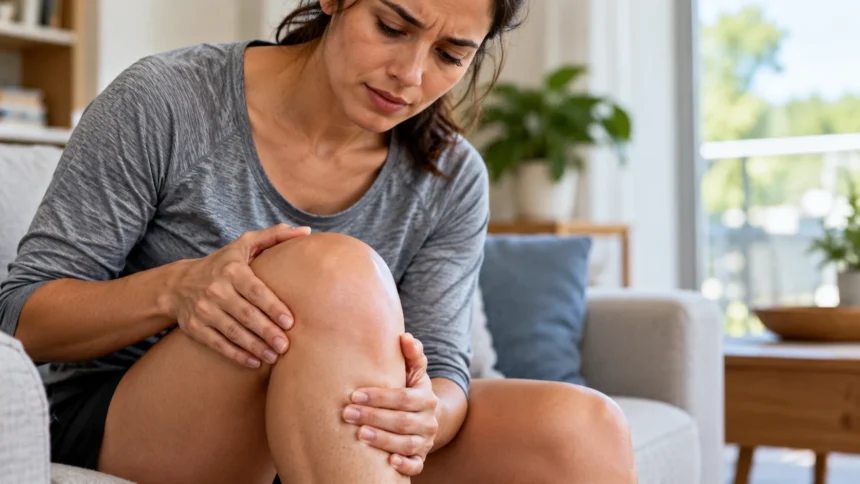
What Is a Small Knee Joint Effusion?
A small knee joint effusion means there is a mild buildup of excess fluid inside or around the knee joint. A healthy knee naturally contains a small amount of synovial fluid that lubricates the joint and allows smooth movement. When irritation, inflammation, or injury occurs, the joint may produce additional fluid. This extra fluid is commonly described as knee effusion or swelling.
Unlike significant knee swelling, a small joint effusion may not always be obvious from appearance alone. You might notice mild puffiness around the kneecap, a feeling of fullness inside the joint, or slightly reduced flexibility. Some people discover a small knee joint effusion only after an examination, ultrasound, MRI, or another imaging test performed for knee discomfort.
The presence of fluid does not automatically mean something serious is wrong. Mild knee effusion can develop after increased physical activity, a minor injury, arthritis, or temporary irritation of the joint lining. However, understanding why the fluid developed is important, especially when swelling continues, repeatedly returns, or occurs alongside significant pain, redness, fever, or difficulty walking.
What Does a Small Knee Effusion Feel Like?
A small knee joint effusion can feel different from person to person depending on its cause and the amount of inflammation involved. Some people notice pressure or tightness rather than obvious pain. The knee may feel slightly fuller than usual, especially when bending deeply, squatting, climbing stairs, or sitting with the knee flexed for a long period.
Mild stiffness is another common sensation associated with excess knee fluid. You may notice that the affected knee does not bend or straighten quite as comfortably as the opposite knee. Movement may still be possible, but the joint can feel heavy, restricted, or mildly uncomfortable. Symptoms are sometimes more noticeable after activity or toward the end of the day.
Small effusions can also occur with tenderness, warmth, or aching depending on the underlying condition. For example, an irritated joint after exercise may produce mild soreness, while arthritis may cause recurring stiffness and discomfort. Symptoms such as severe pain, rapidly increasing swelling, pronounced redness, or an inability to bear weight deserve more immediate medical attention rather than routine home management.
Common Causes of Small Knee Joint Effusion
One of the most common reasons for mild fluid accumulation is temporary irritation from repetitive activity. Running, prolonged walking, sports, kneeling, or suddenly increasing exercise intensity can place additional stress on the knee. The tissues inside the joint may respond by producing extra synovial fluid. This type of minor swelling may settle as the knee recovers from the increased workload.
Degenerative joint changes can also contribute to knee effusion. Osteoarthritis gradually affects the cartilage and other structures inside the knee, potentially causing inflammation and increased fluid production. In these situations, swelling may appear after physical activity and improve with rest before returning again. Older adults are more likely to experience this pattern, although joint degeneration can affect younger people as well.
Other possible causes include inflammatory conditions, infections, gout, meniscus problems, ligament injuries, and cartilage damage. Because several conditions can produce similar symptoms, the amount of swelling alone cannot identify the exact cause. A healthcare professional may consider recent activity, injury history, pain location, stiffness, warmth, and other symptoms when determining what may be contributing to the effusion.
How Knee Injuries Can Lead to Joint Effusion
Even relatively minor injuries can trigger fluid accumulation inside the knee. A sudden twist, awkward landing, collision, or overstretching movement can irritate structures such as the meniscus, ligaments, tendons, or cartilage. The body’s inflammatory response then increases fluid within the joint. Mild injuries may produce only a small effusion along with temporary soreness and stiffness.
Meniscus injuries are one possible source of recurring knee swelling, particularly after twisting movements or activities involving deep knee bending. Depending on the injury, people may experience pain along the joint line, clicking, catching, or difficulty fully extending the knee. Small meniscus changes do not always cause dramatic symptoms, which is why persistent swelling sometimes requires further evaluation.
Ligament injuries can also produce knee effusion, although more significant ligament damage often causes noticeable pain, instability, and swelling. The amount and timing of fluid accumulation may provide useful information during a clinical examination. Any knee injury followed by inability to bear weight, significant instability, rapid swelling, or considerable loss of movement should be professionally assessed rather than treated as simple exercise soreness.
Arthritis and Inflammation as Possible Causes
Osteoarthritis is frequently associated with recurring knee swelling because changes within the joint can irritate its lining. As cartilage becomes thinner or uneven, everyday movement may produce inflammation. The knee can respond by creating additional fluid, resulting in stiffness or fullness. Symptoms often fluctuate, with some days feeling almost normal and others involving greater soreness after prolonged standing or activity.
Inflammatory arthritis can also produce knee joint effusion. Conditions that cause the immune system to affect joint tissues may lead to warmth, swelling, stiffness, and discomfort in one or several joints. Morning stiffness that lasts longer than expected or repeated swelling without an obvious injury may encourage a healthcare professional to investigate inflammatory causes rather than assuming the problem is purely mechanical.
Crystal-related conditions such as gout can also affect the knee, although they often produce more noticeable inflammation. Crystals inside the joint can trigger a strong inflammatory reaction, leading to pain, warmth, redness, and swelling. Because infection can sometimes create similar symptoms, sudden severe knee inflammation should be assessed promptly instead of being assumed to be arthritis or another previously experienced joint problem.
How a Small Knee Joint Effusion Is Diagnosed
Evaluation usually begins with a discussion about when symptoms started and what happened beforehand. A healthcare professional may ask about recent exercise, falls, twisting injuries, previous knee problems, arthritis, medications, and other health conditions. They may also compare both knees and check for swelling, tenderness, warmth, range of motion, stability, and pain during specific movements.
Imaging is not necessary for every mild knee effusion, but it may be recommended when symptoms persist or the cause is unclear. X-rays can help identify fractures or degenerative joint changes, while ultrasound can detect fluid and examine some surrounding soft tissues. MRI provides more detailed information about structures such as cartilage, menisci, ligaments, tendons, and other tissues within the knee.
Occasionally, fluid may be removed from the knee through a procedure known as joint aspiration or arthrocentesis. The collected fluid can be examined when infection, gout, bleeding, or inflammatory disease is suspected. Aspiration is not required for every small effusion, and the decision depends on symptoms, examination findings, medical history, and how strongly a particular underlying condition is suspected.
What You Can Do at Home for Mild Knee Effusion
When swelling is mild and follows increased activity without a serious injury, temporarily reducing aggravating movements may help. This does not always mean completely avoiding movement. Gentle walking and comfortable knee motion can often continue if they do not significantly increase symptoms. High-impact exercise, deep squatting, prolonged kneeling, or activities that repeatedly worsen swelling may need to be reduced temporarily.
Cold therapy can provide short-term comfort when the knee feels irritated or mildly swollen. An ice pack wrapped in a thin cloth can be applied for brief periods rather than directly against the skin. Elevating the leg when resting may also help with general swelling. Some people find light compression comfortable, although it should not be tight enough to cause numbness or circulation problems.
As symptoms improve, gradually returning to normal movement is usually preferable to suddenly resuming intense exercise. Gentle strengthening of the muscles surrounding the knee, hips, and thighs may improve joint support over time. However, persistent or unexplained knee effusion should not simply be managed indefinitely with rest and ice because identifying the underlying cause may be important for preventing repeated flare-ups.
When Should You Get Medical Help?
A small knee joint effusion should be assessed if it continues without an obvious explanation or keeps returning. Swelling that does not improve after several days of reasonable activity modification may indicate an underlying joint issue. Medical evaluation is also sensible when discomfort interferes with walking, work, exercise, sleep, or everyday movements such as using stairs and getting up from a chair.
More urgent assessment is appropriate when the knee becomes very painful, significantly swollen, hot, or red. Fever or feeling generally unwell alongside a swollen joint can sometimes indicate infection, which requires prompt medical evaluation. Sudden swelling after a major injury, particularly when accompanied by instability, deformity, inability to straighten the knee, or inability to bear weight, also deserves timely attention.
You should also seek professional guidance when knee swelling occurs repeatedly without clear activity-related triggers. Recurring effusion may be connected to arthritis, cartilage problems, meniscus irritation, gout, inflammatory disease, or another condition requiring targeted management. Early evaluation does not necessarily mean extensive treatment will be needed, but it can help clarify what is causing the fluid and what steps are appropriate.
Medical Treatment Options for Knee Effusion
Treatment for a small knee joint effusion depends primarily on what is causing it rather than the amount of fluid alone. If temporary overuse or a minor strain is responsible, modifying activity and gradually restoring movement may be sufficient. When osteoarthritis contributes to swelling, management may include exercise therapy, strengthening, weight management when appropriate, medication, and adjustments to activities that repeatedly aggravate symptoms.
Physical therapy may be recommended when weakness, limited mobility, previous injury, or movement patterns are contributing to knee irritation. A therapist can assess strength, flexibility, balance, and how the knee responds during functional movements. Exercises may target the quadriceps, hamstrings, calves, hips, and surrounding muscles to improve support without unnecessarily irritating the joint.
Medication, injections, fluid aspiration, or other medical interventions may sometimes be considered depending on the diagnosis. Infection requires specific medical treatment, while gout and inflammatory arthritis have different management approaches. Because treatments vary considerably between conditions, persistent knee effusion should be treated according to its underlying cause instead of relying solely on approaches intended to temporarily reduce swelling.
Recovery and Preventing Repeated Knee Swelling
Recovery time varies because knee effusion is a sign of joint irritation rather than a single condition. Mild activity-related swelling may improve relatively quickly, while arthritis or structural injuries may produce symptoms over a longer period. Monitoring how the knee responds to daily activity can help you increase movement gradually instead of repeatedly moving between complete rest and sudden intense exercise.
Building strength around the knee can improve how forces are distributed during walking, climbing stairs, exercise, and sports. Quadriceps and hip strength are particularly important for supporting lower-body movement. Low-impact activities such as walking, cycling, or swimming may also help maintain mobility when tolerated. Exercise should generally progress gradually, especially after a period of reduced activity or an earlier knee injury.
Prevention also involves paying attention to repeated swelling rather than simply pushing through it. Increasing training volume too quickly, inadequate recovery, poor movement mechanics, and repeated high-impact loading may contribute to irritation in some people. Appropriate footwear, gradual exercise progression, regular strengthening, and professional guidance when symptoms persist can help protect knee function and reduce the likelihood of repeated flare-ups.
Conclusion
A small knee joint effusion means that slightly more fluid than usual has accumulated within the knee joint. It can develop because of increased activity, minor injury, osteoarthritis, inflammation, or several other joint conditions. Mild fluid buildup may cause only subtle symptoms, including fullness, stiffness, reduced flexibility, or discomfort during activities that require deeper knee bending.
Many mild cases improve with sensible activity modification, gentle movement, and time, particularly when symptoms began after unusual physical activity. However, repeated or persistent swelling deserves attention because knee effusion reflects something happening within the joint. Understanding the cause makes it easier to choose appropriate exercises, treatment strategies, and activity adjustments rather than repeatedly treating the swelling alone.
Seek timely medical evaluation when swelling becomes severe or rapidly increases, especially when accompanied by significant pain, redness, warmth, fever, instability, or difficulty bearing weight. Even without these warning signs, ongoing or recurrent knee effusion is worth discussing with a healthcare professional. An accurate assessment can help identify the cause and guide a safer return to comfortable everyday movement.
FAQs
Is a small knee joint effusion serious?
Not necessarily. A small effusion can occur after mild irritation, exercise, or arthritis, but persistent or recurring fluid may indicate an underlying knee condition that should be evaluated.
Can a small knee effusion go away on its own?
Mild activity-related swelling can sometimes improve with reduced aggravating activity, gentle movement, and recovery time. If swelling continues, worsens, or repeatedly returns, medical assessment is advisable.
Should I exercise with fluid in my knee?
Gentle movement may be appropriate when symptoms are mild, but exercises that increase pain or swelling should usually be modified. The safest activity level depends on what is causing the effusion.
How long does a small knee joint effusion last?
There is no single recovery timeline. Minor activity-related irritation may settle relatively quickly, while arthritis, meniscus problems, or inflammatory conditions can cause longer-lasting or recurring episodes.
When should knee swelling become a concern?
Seek prompt medical care for swelling accompanied by severe pain, fever, redness, significant warmth, inability to bear weight, or major injury. Persistent or unexplained swelling should also be professionally assessed.