


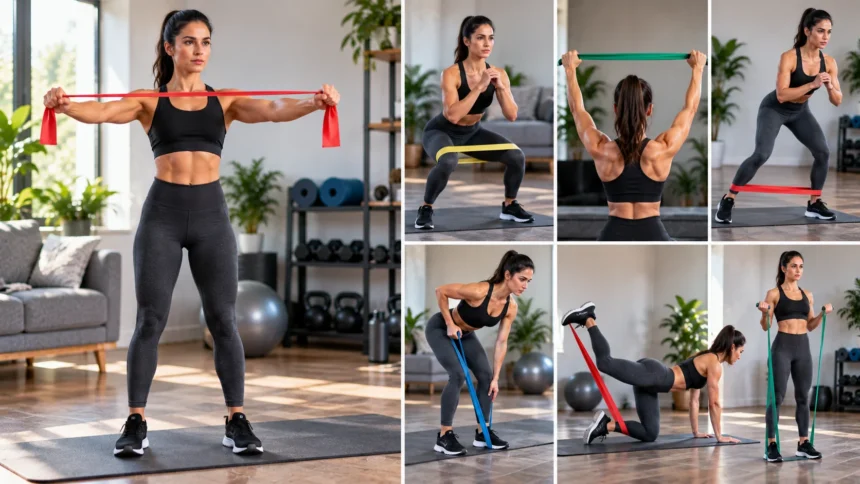
Resistance bands are a practical way to build strength, improve mobility, and train almost anywhere without relying on heavy gym equipment. They can be used for upper-body, lower-body, and core exercises while offering different resistance levels for beginners and experienced exercisers. The key is learning how to control the band rather than simply stretching it as far as possible.
Because resistance increases as a band stretches, your muscles must keep working throughout much of each movement. This makes bands useful for home workouts, warm-ups, rehabilitation-style exercises, and full-body strength sessions. With proper setup, technique, and progression, resistance-band exercises can become a reliable part of a balanced fitness routine.
What Are Resistance Bands Exercises?
Resistance-band exercises use elastic bands to create tension while you push, pull, squat, rotate, or extend your limbs. Bands come in several styles, including mini loops, long flat bands, tube bands with handles, and heavy-duty loop bands. Each type works slightly differently, so choosing the right band depends on the exercise and your current strength.
Unlike dumbbells, which provide a relatively constant external load, bands generally become harder to stretch as the movement progresses. This variable resistance can challenge muscles more strongly toward the end of certain exercises. It also encourages you to control the returning phase because the band continuously pulls back toward its original length.
Resistance bands can be used alone or alongside traditional strength equipment. They work well for squats, rows, presses, curls, glute exercises, shoulder work, and core training. Their portability makes them especially convenient for people who exercise at home, travel frequently, or want an easy way to add resistance to bodyweight movements.
Benefits of Resistance Band Training
One of the biggest advantages of resistance bands is their versatility. A small set can train nearly every major muscle group while taking up very little storage space. You can also change resistance quickly by selecting a stronger band, shortening the band, or moving farther away from an anchor point.
Bands are useful for beginners because they allow gradual progression without requiring large jumps in weight. Someone learning a squat, row, or shoulder exercise can start with light resistance and focus on movement quality. As strength improves, resistance can be increased while keeping the basic exercise pattern familiar.
Resistance-band workouts can also improve muscular endurance, coordination, and stability when performed consistently. Because the band creates tension throughout the movement, smaller stabilizing muscles often contribute alongside the larger muscle groups. The result is a training style that can support general fitness, strength development, and better movement control.
How to Choose the Right Resistance Band
Start by selecting a band that allows you to complete each repetition with good form. If you have to swing, twist, shrug, or hold your breath to move the band, the resistance is probably too high. A lighter band is usually better when learning a new exercise because it gives you more control.
Different muscle groups require different levels of resistance. Your legs and back can usually handle more tension than smaller muscles around the shoulders or arms. Keeping several band strengths available makes it easier to match resistance to the exercise rather than forcing one band to work for every movement.
Band style also matters. Mini loops are useful for glute and hip exercises, while long loop or tube bands work well for rows, presses, curls, and anchored movements. Flat therapy-style bands are particularly easy to adjust because you can change your grip width to increase or decrease the amount of tension.
Resistance Band Squats: Proper Form
Resistance band squats strengthen the quadriceps, glutes, hamstrings, and muscles around the hips. You can place a mini band above your knees or stand on a long band while holding the ends near shoulder height. Keep your feet comfortably apart and maintain a stable stance before beginning the movement.
Push your hips slightly backward while bending your knees and lowering into a comfortable squat. Keep your knees generally tracking in the same direction as your toes, especially when using a mini band around the thighs. Lower only as far as you can remain balanced and keep your torso controlled.
Push through your feet to return to standing while maintaining tension through the band. Avoid letting your knees collapse inward or rushing through the movement just to complete more repetitions. Begin with moderate depth and light resistance, then gradually increase the challenge as your strength and technique improve.
Resistance Band Rows: How to Do Them Correctly
Rows are one of the most useful resistance-band exercises for training the upper back, rear shoulders, and arms. Secure a long band around a stable anchor or wrap it around your feet while seated. Hold each end securely and begin with your arms extended while keeping your shoulders relaxed.
Pull your elbows backward while bringing your hands toward the sides of your torso. Think about moving the shoulder blades gently toward each other without aggressively shrugging your shoulders. Pause briefly near the end of the pull, then return your arms forward slowly while resisting the band’s tension.
Keep your spine stable and avoid leaning backward to create momentum. If your entire torso moves every time you pull, use less resistance or shorten the range. Smooth repetitions help keep the focus on the back muscles and make it easier to develop proper pulling mechanics before progressing to stronger bands.
Resistance Band Chest and Shoulder Exercises
A resistance band chest press can be performed by anchoring a long band behind you at approximately chest height. Hold one end in each hand and step forward until the band has light tension. Press your hands forward while keeping your wrists comfortable and your torso steady throughout the movement.
For shoulder presses, stand on the middle of the band and hold the ends near shoulder level. Press upward without excessively arching your lower back or pushing your ribs forward. Lower your hands slowly and stop the exercise if the overhead position causes sharp shoulder, neck, or upper-back discomfort.
Lateral raises can also be performed with light resistance by standing on the band and raising your arms outward. Keep the movement controlled and avoid swinging the arms to overcome excessive tension. Shoulder exercises usually require less resistance than lower-body movements, so start light and increase gradually only when your form remains consistent.
Resistance Band Glute and Hip Exercises
Glute bridges are an effective way to use a mini resistance band for hip strengthening. Place the band above your knees, lie on your back with your knees bent, and keep your feet flat on the floor. Maintain light outward pressure against the band while lifting your hips using your glutes.
Lateral band walks are another useful option for training the muscles that stabilize the hips. Place a mini band above the knees or around the lower legs, bend slightly at the hips and knees, and take controlled steps sideways. Keep tension in the band without letting your knees collapse inward between steps.
Standing hip abduction can be performed by placing a loop band around your legs and moving one leg gently to the side. Keep your torso upright instead of leaning in the opposite direction for extra range. These exercises work best when the movement stays controlled and comes primarily from the hips rather than momentum.
Resistance Band Arm Exercises
Biceps curls can be performed by standing on the middle of a long band while holding one end in each hand. Keep your elbows close to your sides and bend them to bring your hands toward your shoulders. Lower the hands slowly so the band remains under control during the entire repetition.
For triceps work, you can perform overhead extensions or anchored pushdowns depending on the type of band available. Keep the upper arm relatively stable while straightening the elbow against the resistance. Avoid locking the joint aggressively or using the shoulder and torso to compensate for a band that is too strong.
Arm exercises often respond well to moderate or higher repetitions because resistance bands can provide a smooth training stimulus. However, the final repetitions should still look similar to the first ones. If your elbows begin moving excessively or you need to swing your body, reduce the resistance or end the set.
Resistance Band Core Exercises
Resistance bands can challenge the core by forcing your trunk to resist movement rather than simply bending forward repeatedly. One popular example is the Pallof press, which uses a band anchored beside your body. Hold the band close to your chest, then press your hands forward while resisting the band’s attempt to rotate you.
Maintain a stable torso, relaxed breathing, and a comfortable stance while your arms extend away from your body. Hold the extended position briefly, then bring your hands back toward your chest under control. Moving farther from the anchor increases tension, while stepping closer makes the exercise easier.
Bands can also be used with dead bugs, standing rotations, and anti-extension exercises when appropriate. Start with simple variations that allow you to maintain control before progressing to more demanding movements. Core exercises should create muscular effort without causing sharp back pain, numbness, or symptoms traveling into the legs.
Common Resistance Band Exercise Mistakes
Using too much resistance is one of the most common errors in band training. Heavy tension can encourage poor form, shortened range of motion, and unnecessary body movement. Choose a resistance level that challenges you while still allowing smooth repetitions and comfortable joint positions from beginning to end.
Another mistake is letting the band snap back quickly after each repetition. The returning phase is part of the exercise and should be controlled rather than rushed. Slowing this portion can increase muscular work while reducing the chance of the band pulling your limbs into an awkward position.
People also sometimes ignore band condition and anchor security. Cracked, worn, or damaged bands can break unexpectedly when stretched, while unstable anchors may come loose during exercise. Inspect your equipment regularly and secure the band to something strong enough to handle the tension before beginning an anchored movement.
How to Progress Resistance Band Workouts
Progressive overload is still important when training with resistance bands. As an exercise becomes easier, you can increase repetitions, add another set, use a stronger band, or adjust your position to create more tension. Changing one factor at a time makes it easier to track progress without overwhelming your muscles and joints.
Slowing the tempo is another useful progression strategy. Taking more time during both the stretching and returning phases increases how long the muscles remain under tension. Pauses at the most challenging part of an exercise can also increase difficulty without immediately requiring a much heavier band.
Do not assume that every workout needs to be harder than the previous one. Recovery is an important part of strength development, especially when training the same muscle groups several times each week. Progress works best when increases in resistance or volume are gradual and your exercise technique remains consistent.
When to Modify or Stop an Exercise
Normal muscular fatigue is expected during resistance training, but sharp pain, sudden weakness, or unusual nerve-like symptoms should not be ignored. Stop the movement and reassess your technique if discomfort develops during an exercise. Reducing tension, changing the range, or selecting a different movement may solve a minor form-related issue.
Pay particular attention to pain that travels from the lower back or hip into the leg. Nerve irritation can sometimes create symptoms in areas that seem unrelated to the original source, and learning how sciatica can cause knee pain may provide useful context when symptoms extend beyond the back. Persistent radiating pain should be professionally assessed rather than pushed through during training.
People recovering from injuries or dealing with ongoing joint, nerve, or back problems may need individualized exercise modifications. A physical therapist or other qualified healthcare professional can help determine which movements are appropriate. Resistance bands are adaptable, but that does not mean every band exercise is suitable for every person or condition.
Best Practices for Resistance Band Workouts
Begin each workout with a few minutes of comfortable movement and lighter exercises. This can include easy squats, arm movements, walking, or low-resistance versions of the exercises you plan to perform. A gradual warm-up helps you assess how your body feels before progressing to harder sets.
Organize your routine around major movement patterns rather than performing random exercises. A balanced session might include a squat, row, press, hip exercise, arm movement, and core exercise. This approach makes it easier to train the full body while preventing one area from receiving far more attention than the others.
Focus on consistency instead of trying to make every workout exhausting. Two to four resistance-training sessions per week may work well for many people depending on goals, intensity, and recovery. Give heavily trained muscle groups enough rest between challenging sessions and adjust frequency if soreness or fatigue remains unusually high.
Conclusion
Resistance bands exercises can provide an effective way to build strength, improve muscular endurance, and train your entire body with minimal equipment. Squats, rows, presses, bridges, lateral walks, curls, and core exercises can all be adapted using different band styles. Their portability also makes them convenient for home workouts and travel.
Doing resistance-band exercises correctly matters more than using the strongest band available. Choose manageable resistance, move slowly, control the returning phase, and maintain comfortable joint alignment. Progress gradually through additional repetitions, stronger bands, extra sets, or slower tempos while keeping technique consistent.
A well-designed resistance-band routine can support general fitness for beginners and experienced exercisers alike. Pay attention to unusual pain or nerve-related symptoms, inspect bands regularly, and modify exercises when necessary. With appropriate resistance and consistent practice, bands can become a practical long-term strength-training tool.
FAQs
Are resistance band exercises good for building muscle?
Yes, resistance bands can support muscle growth when they provide enough challenge and training progresses over time. Consistent resistance, adequate volume, recovery, and nutrition all contribute to muscle development.
How many resistance band exercises should I do per workout?
A full-body session may include about five to eight exercises covering major movement patterns. The exact number depends on your goals, workout length, experience level, and the number of sets performed.
How many repetitions should I do with resistance bands?
Many people start with roughly 8 to 15 controlled repetitions per set. Lighter bands may work well for higher repetitions, provided your form remains consistent and the muscles are meaningfully challenged.
Can beginners use resistance bands safely?
Yes. Resistance bands are suitable for beginners because resistance can be adjusted easily. Start with lighter tension, learn proper technique, inspect equipment before use, and increase difficulty gradually as strength improves.
Can resistance bands replace weights?
Bands can provide effective strength training for many goals, but they do not perfectly replicate every free-weight exercise. Some people use bands alone, while others combine them with dumbbells, machines, or bodyweight training.