


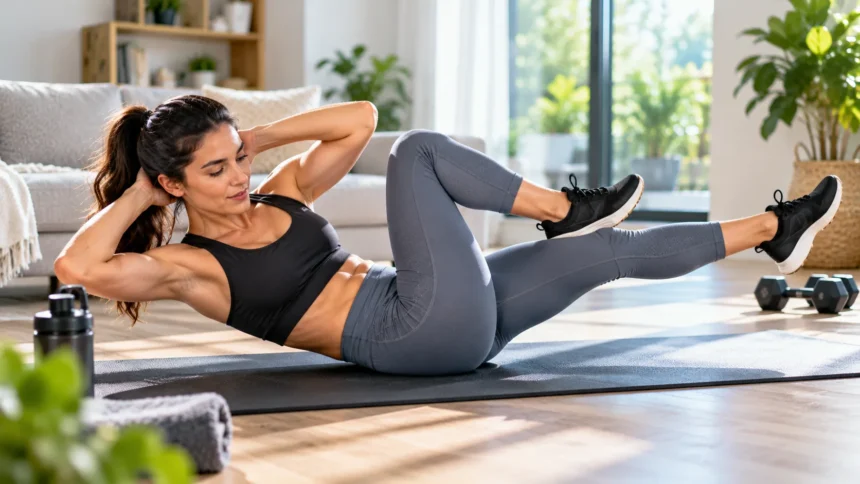
What Is the Bicycle Crunch Exercise?
The bicycle crunch exercise is a bodyweight abdominal movement that combines alternating leg extensions with controlled upper-body rotation. It is commonly included in core workouts because it activates several abdominal muscles while challenging coordination and stability. Unlike traditional crunches, bicycle crunches introduce rotational movement, making them a useful option for developing greater control throughout the trunk.
The exercise gets its name from the cycling motion created by alternating the legs while lying on your back. As one knee moves toward your chest, your upper body rotates in its direction while the opposite leg extends. This coordinated movement engages the abdominal muscles and requires careful positioning to avoid unnecessary tension in the neck or lower back.
Bicycle crunches require minimal equipment and can be performed at home, in a gym, or during a structured fitness session. However, correct technique is more important than performing numerous repetitions quickly. Understanding the muscles involved, exercise benefits, and common mistakes can help you perform bicycle crunches comfortably and incorporate them into a balanced fitness routine.
Muscles Worked During Bicycle Crunches
The rectus abdominis is one of the primary muscles activated during bicycle crunches. This muscle runs vertically along the front of the abdomen and contributes to trunk flexion. When you lift your shoulders slightly away from the floor, the rectus abdominis helps control the movement while working alongside other muscles responsible for stabilizing the torso.
The internal and external obliques also play important roles during alternating upper-body rotation. These muscles are located along the sides of the abdomen and help rotate and stabilize the trunk. Bicycle crunches challenge the obliques as you bring the shoulder region toward the opposite knee while maintaining controlled movement through the abdomen.
Additional muscles contribute to the exercise, including the transverse abdominis and hip flexors. The transverse abdominis helps manage abdominal tension, while the hip flexors assist with lifting and moving the legs. Because several muscle groups work together, bicycle crunches can develop coordinated core movement rather than isolating one abdominal muscle completely.
Benefits of the Bicycle Crunch Exercise
One important benefit of bicycle crunches is their ability to challenge multiple abdominal muscles within a single movement. Combining trunk flexion and rotation creates muscular demands that differ from those of standard crunches. This makes the exercise a practical addition to routines designed to develop abdominal strength, coordination, and controlled movement.
Bicycle crunches can also improve awareness of how the upper and lower body move together. Alternating the legs while rotating the torso requires concentration and timing, especially when repetitions are performed slowly. Greater movement control may support performance in other exercises that require coordinated abdominal engagement and stable trunk positioning.
Another advantage is accessibility, since bicycle crunches do not require expensive equipment or a large exercise area. They can be modified according to experience and physical ability, making them suitable for many fitness routines. However, they should complement other strengthening activities rather than serve as the only exercise used for overall core development.
How to Do Bicycle Crunches Correctly
Begin by lying on your back on a comfortable exercise mat with your knees bent and feet resting on the floor. Place your fingertips lightly beside your head without pulling on your neck. Gently engage your abdominal muscles and lift your shoulders slightly away from the mat while maintaining a relaxed position through your jaw.
Bring one knee toward your chest while extending the opposite leg forward at a comfortable angle. At the same time, rotate your upper body so the opposite shoulder moves toward the bent knee. Focus on rotating through the torso rather than pushing your elbow forward, and keep the movement slow enough to maintain control.
Return toward the center before switching sides and repeating the motion in the opposite direction. Continue alternating while breathing naturally and keeping your lower back comfortable. If extending the legs creates excessive strain, keep them higher or reduce the movement range until you can perform the exercise without discomfort.
Proper Body Positioning During Bicycle Crunches
Correct body positioning begins with creating a stable starting position on the floor. Your head, shoulders, spine, and pelvis should remain comfortably supported before movement begins. As you lift your shoulders, avoid forcing your chin toward your chest because this can create unnecessary tension in the neck muscles.
Your hands should provide light support rather than pulling your head during each repetition. Maintaining space between the chin and chest can help encourage a more relaxed neck position. As the torso rotates, think about moving the shoulder toward the opposite knee instead of trying to make the elbow physically touch it.
The lower body should also move with control throughout the exercise. Avoid swinging the legs aggressively or forcing them close to the floor when abdominal control becomes difficult. Choosing a comfortable leg extension angle allows you to focus on coordinated trunk movement while reducing unnecessary stress around the lower back and hips.
Breathing Techniques for Better Core Control
Breathing correctly during bicycle crunches helps maintain a comfortable rhythm and supports controlled abdominal movement. Many people unintentionally hold their breath when performing challenging repetitions. Instead, aim for steady breathing that allows you to coordinate the trunk rotation and alternating leg movements without creating excessive tension.
A practical approach involves exhaling gently during the rotational portion of the movement. As your shoulder approaches the opposite knee, breathe out while maintaining abdominal engagement. Inhale naturally as you transition toward the center, then exhale during the next controlled rotation toward the opposite side of your body.
There is no need to exaggerate breathing or forcefully tighten the abdomen with every repetition. The objective is to maintain comfortable, continuous breathing while supporting trunk stability. If you find yourself repeatedly holding your breath, reduce the exercise difficulty or slow your pace until the movement feels easier to coordinate.
Common Bicycle Crunch Mistakes to Avoid
One of the most frequent bicycle crunch mistakes is performing repetitions too quickly. Rapid movements often create momentum, reducing the amount of deliberate muscular control required. Slowing down allows you to coordinate upper-body rotation with leg movement while identifying whether fatigue is affecting your technique.
Pulling the head forward with the hands is another common problem. This action can create unnecessary neck tension and distract from abdominal engagement. Keep your fingertips relaxed near your head, avoid pressing the chin toward the chest, and pause when you notice discomfort developing around the neck or shoulders.
Another mistake involves extending the legs too low before developing sufficient control. When the movement becomes too challenging, some individuals experience discomfort in the lower back or begin twisting the pelvis excessively. Raising the extended leg, shortening the movement, or keeping the feet closer to the floor can make the exercise more manageable.
Bicycle Crunches for Beginners
Beginners can benefit from practicing simplified bicycle crunch variations before attempting the full exercise. Start by lying on your back with both knees bent and feet supported. Lift one foot slightly while gently rotating your shoulders toward the opposite knee, then return to the starting position before switching sides.
Another beginner-friendly modification involves keeping one foot on the floor while moving the opposite knee toward the chest. This approach reduces the demands of supporting both legs in the air simultaneously. It also allows greater attention to abdominal engagement, breathing, and shoulder rotation without requiring advanced coordination.
Begin with a small number of comfortable repetitions rather than focusing on speed or intensity. For example, six to eight controlled repetitions per side may provide a manageable starting point, depending on individual ability. Gradually increase the challenge as the exercise becomes more comfortable, and stop if you experience sharp pain or unusual discomfort.
Advanced Bicycle Crunch Variations
Once standard bicycle crunches feel controlled and comfortable, exercise difficulty can be adjusted through slower movement rather than simply increasing repetitions. Extending the legs more gradually increases the time your abdominal muscles must maintain tension. This approach encourages deliberate control and makes it easier to identify changes in technique caused by fatigue.
Another variation involves briefly pausing during each rotational movement while maintaining steady breathing. Hold the position for a comfortable moment before transitioning to the opposite side. The pause increases the challenge to muscular coordination, although the movement should remain smooth and should never require forcing the neck or lower back.
Advanced exercisers may also combine bicycle crunches with other core exercises in a structured workout. Dead bugs, planks, and controlled rotational movements provide different stability challenges. Increasing exercise difficulty should depend on technique, recovery, and individual goals rather than pressure to complete complicated or excessively demanding variations.
Bicycle Crunches vs. Traditional Crunches
Traditional crunches primarily involve lifting the upper torso through a small range of spinal flexion. Bicycle crunches add alternating leg movement and torso rotation, creating different coordination demands. Both exercises activate abdominal muscles, but the additional rotational component of bicycle crunches places greater emphasis on controlled movement involving the obliques.
The standard crunch may be easier for beginners who are learning basic abdominal engagement. Its simpler movement pattern allows individuals to concentrate on lifting the shoulders without coordinating multiple body parts. Bicycle crunches require more timing and control, which can make them challenging for people who are unfamiliar with floor-based core exercises.
Neither exercise is automatically superior for every fitness goal or physical ability. Traditional crunches may suit individuals who prefer a simpler movement, while bicycle crunches provide additional rotational challenges. Combining different core exercises can help develop strength and coordination across multiple movement patterns without depending entirely on one abdominal exercise.
Bicycle Crunches and Core Stability
Core stability involves the coordinated activity of muscles surrounding the abdomen, pelvis, and lower back. These muscles help manage movement and maintain control during everyday tasks and physical activities. Bicycle crunches challenge this coordination by requiring the torso to rotate while the legs alternate between bent and extended positions.
During the exercise, abdominal muscles work to control the movement of the upper body and pelvis. Maintaining a comfortable spinal position becomes particularly important as the legs move farther away from the torso. Practicing slow repetitions can help improve awareness of trunk positioning while reducing the likelihood of relying on uncontrolled momentum.
However, bicycle crunches are only one component of a comprehensive core training program. Exercises such as bird dogs, side planks, and dead bugs challenge stability through different movement patterns. Including a variety of appropriate exercises can support balanced muscular development and help individuals build confidence during physical activities.
Can Bicycle Crunches Reduce Belly Fat?
Bicycle crunches strengthen abdominal muscles, but they do not selectively remove fat from the stomach. The idea that exercising one body area directly reduces fat in that location is commonly called spot reduction. Research does not support relying on targeted abdominal exercises as a method for choosing where the body loses fat.
The exercise can still contribute to overall fitness by improving abdominal strength and movement coordination. Strong core muscles help support different physical activities, including walking, lifting, and recreational exercise. However, changes in body composition depend on numerous factors, and abdominal exercises alone do not determine how someone’s body looks.
A balanced fitness routine should emphasize physical function, enjoyable movement, adequate recovery, and overall health. Bicycle crunches can be included alongside resistance training, cardiovascular activities, and mobility exercises. Their value is best measured through improvements in strength, control, and exercise confidence rather than expectations about achieving a particular appearance.
How Many Bicycle Crunches Should You Do?
The appropriate number of bicycle crunches depends on your experience, physical ability, and the difficulty of the variation. Beginners may start with approximately six to ten controlled repetitions per side. Performing fewer repetitions with proper form is generally more useful than rushing through a larger number while allowing technique to deteriorate.
As the exercise becomes easier, gradually increase the repetitions or choose a slightly more challenging variation. Some individuals may find one or two short sets sufficient when including bicycle crunches in a broader workout. Recovery needs and individual tolerance should guide progression rather than following an unnecessarily demanding routine.
Pay attention to signs of fatigue, particularly changes in neck positioning, leg control, or lower-back comfort. When your technique becomes difficult to maintain, ending the set is a sensible choice. The goal is to develop consistent, comfortable movement while allowing enough recovery between challenging abdominal training sessions.
How Often Should You Perform Bicycle Crunches?
Bicycle crunches can be included in a regular fitness routine according to individual goals and recovery needs. Many people find that practicing abdominal strengthening exercises several times per week provides an opportunity to build skill and muscular endurance. The ideal frequency depends on overall training intensity and other activities involving the core muscles.
For beginners, two or three nonconsecutive sessions per week may offer a manageable starting point. These sessions can include bicycle crunches alongside complementary movements such as planks or dead bugs. Gradually adjusting frequency based on comfort helps prevent unnecessary overload while encouraging regular practice and improved movement coordination.
Daily bicycle crunches are not necessary for developing abdominal strength or maintaining core function. Muscles benefit from appropriate recovery, particularly after unfamiliar or challenging exercise sessions. If soreness persists or your technique becomes less controlled, reducing the frequency or difficulty may be more beneficial than continuing the same demanding routine.
Safety Tips and Exercise Modifications
Bicycle crunches are suitable for many healthy individuals, but they may not be comfortable for everyone. People experiencing neck pain, significant lower-back discomfort, or recent abdominal injuries should avoid forcing the movement. A qualified healthcare professional can help determine whether a modified exercise or alternative core movement is more appropriate.
Using an exercise mat can provide additional comfort for the spine and shoulders during floor-based movements. Keeping your knees slightly bent during leg extensions may reduce the challenge when full extensions feel difficult. If lifting the shoulders causes discomfort, practicing gentler abdominal exercises such as pelvic tilts or dead bugs may be preferable.
Stop exercising if you experience sharp pain, dizziness, or symptoms that feel unusual for ordinary muscular effort. Individuals recovering from surgery, managing pregnancy-related physical changes, or living with certain medical conditions may require personalized modifications. Exercise should support physical well-being rather than require pushing through pain or ignoring important warning signs.
How to Include Bicycle Crunches in Your Workout
Bicycle crunches work well as part of a structured core workout that includes different movement patterns. You might begin with gentle mobility exercises, followed by controlled abdominal strengthening movements. Including bicycle crunches after an appropriate warm-up allows you to focus on coordination without immediately introducing demanding rotational movements.
A balanced session could combine bicycle crunches with dead bugs, bird dogs, and supported plank variations. These exercises challenge abdominal control, spinal stability, and coordination in complementary ways. Selecting manageable repetitions and allowing brief recovery periods can help maintain technique throughout the workout without creating unnecessary muscular fatigue.
Bicycle crunches may also be included after walking, strength training, or other recreational activities. Their flexibility makes them convenient for short home workouts or gym sessions. The most effective routine is one that matches your ability, supports your movement goals, and can be practiced consistently without causing ongoing discomfort.
Conclusion
The bicycle crunch exercise is a practical bodyweight movement that challenges the abdominal muscles through controlled trunk rotation and alternating leg movements. It engages the rectus abdominis, obliques, and supporting muscle groups while encouraging coordination. When performed with proper technique, bicycle crunches can contribute to improved core strength and movement awareness.
Correct form is more important than speed, repetition counts, or attempting difficult variations too early. Maintaining relaxed neck positioning, comfortable spinal alignment, and steady breathing can make the exercise more manageable. Beginners should start with simple modifications and increase difficulty gradually as their strength and coordination improve.
Bicycle crunches are most effective when included within a balanced fitness program that develops different aspects of muscular strength and stability. They are not a substitute for comprehensive physical activity or a method of targeting fat loss in one body area. With appropriate progression and attention to comfort, they can become a useful addition to regular core training.
Frequently Asked Questions (FAQs)
What muscles do bicycle crunches work?
Bicycle crunches primarily engage the rectus abdominis and internal and external obliques. The transverse abdominis and hip flexors also contribute to controlling trunk position and alternating leg movements throughout the exercise.
Are bicycle crunches better than regular crunches?
Bicycle crunches introduce rotational movement and additional coordination demands, while regular crunches focus mainly on trunk flexion. Neither is universally better, and the appropriate choice depends on individual fitness goals, comfort, and exercise experience.
Can beginners do bicycle crunches?
Yes, beginners can practice modified bicycle crunches with smaller movements and supported feet. Starting slowly helps develop abdominal control and coordination before progressing to full alternating leg extensions and upper-body rotations.
How many bicycle crunches should I do daily?
Daily practice is not necessary. Beginners can start with approximately six to ten controlled repetitions per side during suitable workout sessions, adjusting the amount according to technique, comfort, and recovery needs.
Do bicycle crunches help strengthen the core?
Yes, bicycle crunches challenge several abdominal muscles and encourage coordinated trunk movement. They can contribute to core strength when performed correctly and combined with other exercises that develop stability, muscular endurance, and movement control.