


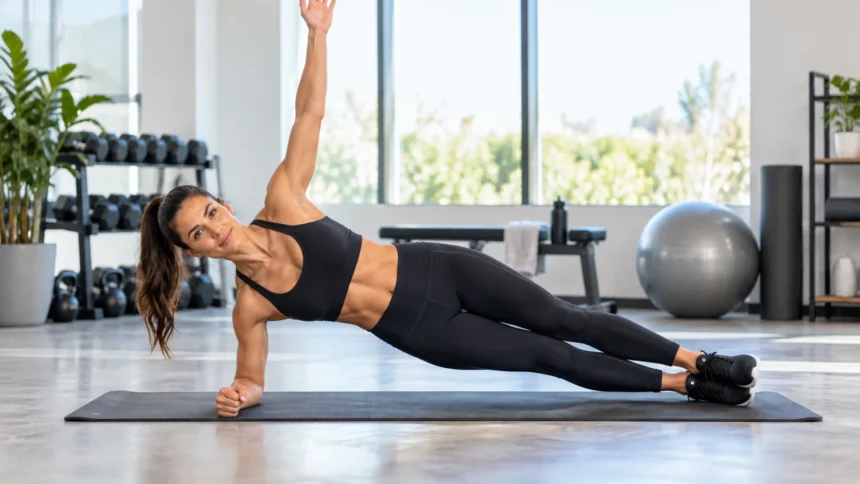
Side planks are a simple but challenging core exercise that trains your body to resist sideways bending while maintaining a stable position. Unlike traditional planks, which mainly place the body face down, the side plank requires you to balance on one arm and the side of your feet. This makes it especially useful for strengthening the obliques, hips, shoulders, and deeper stabilizing muscles.
Because side planks require no equipment, they can fit easily into home workouts, gym sessions, warm-ups, or rehabilitation-style programs. However, proper technique matters because poor alignment can place unnecessary stress on the shoulder, neck, or lower back. Learning correct form, useful variations, and appropriate progression can help you get more from the exercise while reducing avoidable discomfort.
What Is a Side Plank?
A side plank is an isometric exercise in which you support your body sideways using one forearm or hand and the outside edge of your feet. Your body remains relatively still while your core muscles work to keep your hips lifted and your spine aligned. The exercise mainly challenges your ability to maintain stability against gravity.
Unlike dynamic exercises that involve repeated bending or lifting, side planks create muscle tension without much visible movement. This type of contraction can be useful for improving muscular endurance and body control. The longer you maintain good alignment, the more your trunk, shoulder, and hip stabilizers must continue working together.
Side planks can be modified for beginners or made significantly harder for advanced exercisers. You can perform them from the knees, forearm, straight arm, stacked feet, staggered feet, or with added leg movements. This flexibility makes the exercise suitable for many fitness levels when the variation matches your current strength and control.
What Muscles Do Side Planks Work?
The obliques are among the main muscles activated during side planks. These muscles run along the sides of your abdomen and help with rotation, lateral bending, and trunk stability. During a side plank, they work primarily to stop your torso from collapsing toward the floor rather than actively twisting your body.
The deeper core muscles also contribute to maintaining spinal stability. Your transverse abdominis, multifidus, and other trunk-supporting muscles help control the position of your pelvis and rib cage. This coordinated effort is one reason side planks can feel demanding even though the body remains mostly stationary.
Muscles around the hips and shoulders also play important roles. The gluteus medius helps keep the pelvis lifted and stable, while shoulder muscles support your upper body against the floor. Your quadriceps, inner thighs, and back muscles may also contribute, especially when you perform more challenging versions of the exercise.
Benefits of Side Planks for Core Strength
One of the main benefits of side planks is improved lateral core strength. Many abdominal exercises emphasize forward bending or resisting extension, while side planks specifically challenge the body from the side. Training this direction can create a more balanced core routine instead of repeatedly working only the front abdominal muscles.
Side planks also improve core endurance, meaning your trunk muscles become better at maintaining stability for longer periods. This can be useful during exercises that require a strong torso, including lifting, running, carrying objects, and performing compound movements. Good core endurance helps the trunk stay controlled while the arms and legs generate movement.
Another advantage is that side planks challenge multiple areas simultaneously without requiring complicated equipment. One exercise can train your obliques, shoulders, hips, and trunk stabilizers at the same time. This makes them particularly useful when you want a time-efficient core exercise that fits easily into a broader strength or conditioning workout.
Side Planks and Lower Back Support
A strong core helps your trunk manage physical loads during everyday movement and exercise. Side planks can contribute by strengthening muscles that resist excessive sideways movement of the spine and pelvis. Better trunk control may help you maintain more stable positions during walking, lifting, running, and other daily activities.
However, side planks should not be considered a guaranteed treatment for every type of back discomfort. Lower back pain can develop for many reasons, and strengthening alone may not solve the underlying issue. If you experience recurrent lower back spasms, it is important to consider the cause instead of assuming weak core muscles are always responsible.
When performed comfortably, side planks can still be part of a balanced strengthening program for the trunk and hips. The key is choosing an appropriate variation and avoiding positions that reproduce sharp pain. Persistent or worsening back symptoms deserve professional assessment, particularly when they interfere with walking, sleep, exercise, or normal daily activity.
How to Do a Side Plank Correctly
Begin by lying on your side with your legs extended and your feet stacked or slightly staggered. Place your elbow directly underneath your shoulder with your forearm resting comfortably on the floor. Keep your head, ribs, hips, knees, and feet in a relatively straight line before lifting your body.
Press your forearm into the floor and lift your hips until your body forms a straight line from your head to your feet. Gently brace your abdomen and squeeze your glutes without holding your breath. Keep your chest open and avoid allowing your top shoulder to rotate forward toward the floor.
Hold the position only as long as you can maintain good alignment. When your hips begin dropping, your shoulder starts collapsing, or your body rotates significantly, end the set and rest. Beginners may start with shorter holds and gradually increase duration as strength and control improve rather than immediately chasing long plank times.
Common Side Plank Mistakes to Avoid
Allowing the hips to sag is one of the most common side plank mistakes. When the pelvis drops toward the floor, the exercise becomes less controlled and may place unnecessary stress on the trunk or shoulder. Think about gently lifting the underside of your waist while keeping your body aligned from your head through your legs.
Another mistake is placing the elbow too far away from the shoulder. This creates a less stable base and may increase strain around the shoulder joint. Keeping the elbow approximately underneath the shoulder usually provides better support and allows you to distribute force through the forearm more comfortably.
Holding your breath can also make the exercise harder than necessary. Try breathing slowly while maintaining light abdominal tension instead of bracing as hard as possible. If you have to strain excessively, shake uncontrollably, or lose your alignment after only a few seconds, switching to an easier variation may produce better-quality practice.
Side Plank Variations for Beginners
A bent-knee side plank is one of the easiest ways to learn the movement. Lie on your side with your knees bent and support your upper body on your forearm. Lift your hips while keeping your knees on the floor, creating a straight line from your head through your hips to your knees.
Another beginner-friendly option is using staggered feet rather than stacking one foot directly on top of the other. Place the top foot slightly in front of the bottom foot to create a wider base of support. This reduces the balance demand while still allowing your obliques, hips, and shoulders to work through the side plank position.
Beginners can also use shorter repetitions instead of long holds. For example, performing several controlled holds of 10 to 20 seconds may be more effective than struggling through one minute with poor form. As control improves, you can gradually increase hold time, reduce support, or progress toward the standard full side plank.
Advanced Side Plank Variations
Once a standard side plank becomes comfortable, raising the top leg can increase the challenge significantly. This variation requires additional hip strength and balance while your core continues preventing rotation. Keep the movement controlled and avoid lifting the leg so high that your pelvis twists or your lower hip begins dropping.
A straight-arm side plank is another useful progression. Instead of supporting yourself on your forearm, place your hand on the floor underneath your shoulder and keep your elbow straight. This version increases the stability demands around the wrist and shoulder, making it appropriate only when those joints tolerate the position comfortably.
You can also add controlled movements such as reaching the top arm underneath your torso or moving between a side plank and another plank variation. Dynamic versions increase coordination and difficulty, but they should only be added after you can hold a basic side plank confidently. More movement is not automatically better if technique deteriorates.
How Long Should You Hold a Side Plank?
There is no single perfect side plank duration for everyone. Beginners may benefit from holds of around 10 to 20 seconds, while more experienced exercisers may comfortably maintain good form for 30 to 60 seconds. Quality matters more than keeping the timer running after your alignment has already broken down.
Instead of focusing only on maximum duration, consider completing multiple sets on each side. Two or three controlled sets can provide useful training without requiring extremely long holds. You can increase difficulty gradually by extending the time, choosing a harder variation, or adding controlled movement rather than simply holding forever.
Both sides should generally receive similar attention, although one side may initially feel weaker or less coordinated. Small differences are common and do not necessarily indicate a problem. If one side consistently causes pain, major weakness, or difficulty supporting your body, consider reducing the intensity and seeking guidance if the issue continues.
How Often Should You Do Side Planks?
Side planks can usually be performed several times per week as part of a broader core-strengthening routine. The ideal frequency depends on your training level, total workout volume, recovery, and whether you are using easier or more demanding variations. You do not necessarily need to train side planks every day to improve.
A practical approach is to include them two to four times per week alongside exercises that train other core functions. Dead bugs, bird dogs, carries, regular planks, and resistance exercises can complement side planks by challenging the trunk in different directions. A varied program generally provides broader benefits than depending on one exercise alone.
Progress should be gradual, especially if side planks are new to you. Increase hold time or difficulty only when you can maintain stable hips, controlled breathing, and comfortable shoulder positioning. Muscle fatigue is expected, but sharp pain, numbness, or symptoms that worsen after each session are signs that the exercise should be modified or stopped.
Best Practices for Getting More From Side Planks
Start each repetition by creating good alignment before lifting your hips. Set your shoulder, ribs, pelvis, and legs in position rather than trying to correct everything after the plank has already begun. A strong starting position makes it easier to maintain control and direct tension toward the intended muscles.
Focus on controlled breathing throughout the hold. Slow breaths can help you avoid unnecessary tension in your neck, jaw, and shoulders while the trunk continues working. Think about maintaining gentle abdominal tension instead of aggressively sucking in your stomach or holding your breath for the entire repetition.
Finally, progress according to performance rather than ego. A shorter side plank with excellent alignment is more useful than a longer hold performed with sagging hips and excessive twisting. Choose a variation that challenges you while still allowing consistent technique, then progress gradually as your core strength, shoulder stability, and hip control improve.
Conclusion
Side planks are an effective bodyweight exercise for strengthening the obliques, hips, shoulders, and deeper core muscles. They challenge your ability to resist sideways movement while maintaining stable alignment. Because they require little space and no equipment, they can fit easily into home workouts, gym programs, and general strength routines.
Proper form matters more than holding the position for an impressive amount of time. Keep your shoulder supported, hips lifted, spine aligned, and breathing controlled throughout each repetition. Beginners can use bent knees or staggered feet, while stronger exercisers can progress to leg lifts, straight-arm versions, and dynamic variations.
Side planks can support a stronger and more balanced core, but they should be one part of a complete fitness program rather than the only exercise you perform. Combine them with strength, mobility, and movement exercises that suit your goals. If the movement consistently causes sharp shoulder, hip, or back pain, modify it or seek professional guidance.
FAQs
Are side planks better than regular planks?
Neither exercise is universally better. Regular planks emphasize resisting extension, while side planks place more demand on the obliques and lateral core. Including both can provide more balanced trunk training.
How long should a beginner hold a side plank?
Beginners can start with approximately 10 to 20 seconds per side while maintaining good form. Several shorter, controlled sets are usually better than one long repetition performed with sagging hips.
Do side planks reduce belly fat?
Side planks strengthen core muscles but cannot selectively burn fat from the stomach. Fat loss generally depends on overall energy balance, activity, nutrition, sleep, and other lifestyle factors rather than one abdominal exercise.
Can I do side planks every day?
Some people can tolerate daily side planks, but doing them every day is not necessary for progress. A few sessions each week can be enough when combined with appropriate recovery and other exercises.
Why do I feel side planks in my shoulder?
Your supporting shoulder works hard to stabilize your upper body during a side plank. Mild muscular effort is normal, but sharp or worsening shoulder pain may indicate poor positioning or the need for an easier variation.