


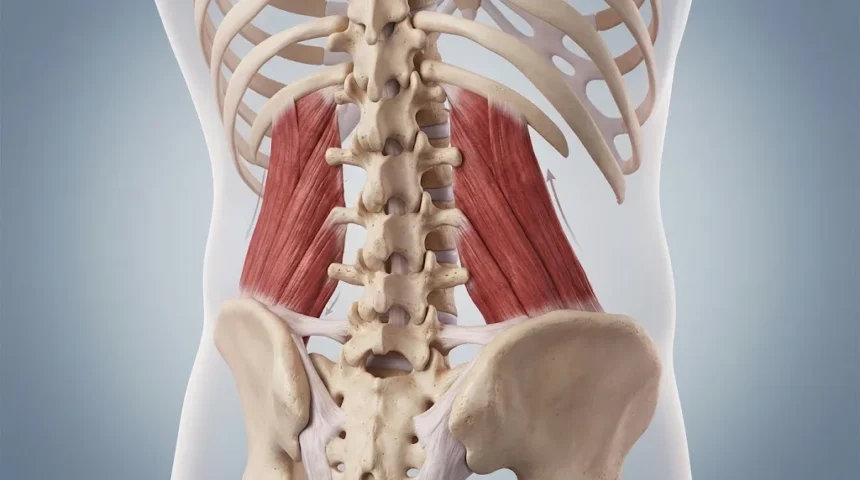
The quadratus lumborum muscle is one of the most important muscles in the lower back, yet many people rarely hear about it until discomfort develops. Located deep within the posterior abdominal wall, this muscle helps control the lumbar spine, pelvis, and lower ribs. It contributes to everyday movements ranging from walking and standing to bending sideways and maintaining an upright posture.
Because the quadratus lumborum connects the pelvis, lumbar vertebrae, and twelfth rib, it plays several roles rather than performing a single movement. It provides stability when the body moves, helps keep the pelvis level, and supports movements of the lower spine. Its location also allows it to interact closely with other muscles involved in core stability and breathing.
Understanding quadratus lumborum anatomy and function can make lower back movement easier to understand. It also helps explain why excessive sitting, repetitive lifting, uneven movement, or poor muscular control may sometimes place additional stress on this deep back muscle. Learning how the muscle works provides useful context for exercise, posture, and movement awareness.
What Is the Quadratus Lumborum Muscle?
The quadratus lumborum, commonly shortened to QL, is a paired muscle located on both sides of the lower back. The name comes from its roughly rectangular shape and its position within the lumbar region. Although it sits deep beneath several larger muscles, it performs important roles in spinal movement, pelvic control, trunk stability, and positioning of the twelfth rib.
The QL is generally classified as part of the posterior abdominal wall rather than one of the superficial back muscles. It lies deeper than muscles such as the latissimus dorsi and is positioned near the lumbar spine. Because of this location, the muscle can influence both the trunk and pelvis during movements involving walking, standing, bending, lifting, and balancing.
Each side of the body has its own quadratus lumborum muscle, and the two sides can work independently or together. Contracting one side produces different movements than contracting both sides simultaneously. This ability allows the QL to assist with lateral bending while also contributing to lumbar extension and stabilization when both sides become active.
Where Is the Quadratus Lumborum Located?
The quadratus lumborum sits deep in the lower back on either side of the lumbar spine. It extends upward from the pelvis toward the lowest rib and lumbar vertebrae. Because it is positioned behind much of the abdominal cavity, it is sometimes described as a deep posterior abdominal muscle rather than simply a traditional back muscle.
Several structures surround the QL and help define its anatomical position. The erector spinae muscles are positioned posteriorly, while the psoas major lies closer to the front and medial side of the lumbar region. The transverse abdominal muscles and thoracolumbar fascia also have important anatomical relationships with the quadratus lumborum.
The kidneys are positioned anterior to the QL, which demonstrates just how deep the muscle lies within the body. Its protected location makes the muscle difficult to see or feel compared with superficial muscles. However, despite being hidden beneath several tissue layers, its influence on lumbar and pelvic movement can be significant.
Quadratus Lumborum Origin and Insertion
The lower attachments of the quadratus lumborum arise primarily from the iliac crest and the iliolumbar ligament. The iliac crest forms the upper border of the pelvis and provides a strong foundation for the muscle. These attachments allow the QL to influence pelvic movement while also supporting the relationship between the pelvis and lumbar spine.
The muscle travels upward from the pelvis and attaches to the twelfth rib as well as the transverse processes of several lumbar vertebrae. Most anatomical descriptions identify attachments along the transverse processes of the first through fourth lumbar vertebrae. These spinal attachments allow the muscle to contribute directly to movement and stabilization of the lumbar region.
Its connections between the pelvis, lumbar vertebrae, and lowest rib explain why the QL has multiple functions. Rather than simply moving the lower back, it can influence three connected regions at once. This arrangement becomes especially useful during walking, side bending, weight shifting, breathing, and activities requiring the spine to remain controlled against external forces.
Fiber Arrangement and Anatomical Relationships
The quadratus lumborum contains groups of muscle fibers running in slightly different directions between its attachment points. Some fibers extend between the iliac crest and twelfth rib, while others connect the pelvis with the lumbar transverse processes. Additional fibers connect the lumbar vertebrae with the twelfth rib, creating a strong network across the lower trunk.
This multidirectional fiber arrangement helps explain why the quadratus lumborum participates in several movements rather than functioning as a simple side-bending muscle. Different fibers may contribute more strongly depending on body position and movement demands. The muscle can therefore generate movement while simultaneously helping stabilize nearby spinal segments and the pelvis.
The QL is also closely associated with the thoracolumbar fascia, a large connective tissue system surrounding muscles of the lower back. This fascia interacts with several core and spinal muscles during movement. Together, these structures help transfer force between the upper body, lumbar spine, pelvis, and lower limbs during everyday and athletic activities.
Quadratus Lumborum Innervation and Blood Supply
The quadratus lumborum receives nerve signals primarily from the anterior branches of the lower thoracic and upper lumbar spinal nerves. Anatomical descriptions commonly include contributions from the twelfth thoracic nerve and the first few lumbar spinal nerves. These nerves provide the motor input required for the muscle to contract and perform its various movement and stabilization functions.
Nerve supply is important because the QL must constantly adjust its activity according to body position. Walking, standing on one leg, carrying an object, or bending sideways all create different demands. The nervous system coordinates the QL with surrounding abdominal, spinal, hip, and pelvic muscles to produce smooth, controlled movement instead of isolated muscular contraction.
Blood reaches the muscle through branches of vessels supplying the lumbar and surrounding abdominal regions. Adequate circulation provides oxygen and nutrients required for muscular activity and tissue recovery. Like other skeletal muscles, the quadratus lumborum depends on consistent blood flow to support repeated contractions during posture, movement, exercise, and normal daily activities.
Main Functions of the Quadratus Lumborum
One major quadratus lumborum function is lateral flexion of the trunk. When the muscle on one side contracts, it can help bend the lumbar spine toward that same side. This movement occurs during activities such as reaching downward beside the body, leaning sideways, or adjusting the trunk while carrying an uneven load.
When both QL muscles contract together, they can assist with extension and stabilization of the lumbar spine. Rather than producing dramatic backward bending on their own, they usually work alongside larger spinal extensor muscles. This combined activity helps maintain an upright trunk and provides additional support during movements requiring control of the lower back.
The quadratus lumborum also helps control the pelvis and twelfth rib. Because it connects these structures directly, muscular contraction can influence pelvic elevation and rib positioning. These combined functions make the QL particularly important during locomotion, posture, trunk stabilization, breathing mechanics, and movements requiring coordination between the lower and upper body.
How the Quadratus Lumborum Produces Lateral Flexion and Hip Hiking
Lateral flexion occurs when the trunk bends toward one side. Because the quadratus lumborum attaches to the lumbar transverse processes and pelvis, contraction on one side can shorten the distance between these structures. This creates side bending within the lumbar region while surrounding muscles help control the amount and direction of movement.
The QL can also elevate one side of the pelvis, a movement commonly described as hip hiking. This happens when the trunk remains relatively stable while the pelvis is pulled upward toward the rib cage. Hip hiking may occur naturally during walking, stepping over an obstacle, climbing stairs, or adjusting the position of the leg.
These actions demonstrate how muscle function depends heavily on which structure remains fixed. If the pelvis is stable, the QL can influence the spine and trunk. When the trunk is stabilized instead, the same muscle can influence pelvic position, making the quadratus lumborum a versatile contributor to coordinated movement between the spine and lower body.
Role of the QL in Spinal and Pelvic Stability
Stability is one of the most important roles of the quadratus lumborum. The lumbar spine must remain controlled while forces travel through the body during walking, lifting, reaching, and carrying. The QL works with abdominal muscles, spinal extensors, multifidus, diaphragm, and pelvic structures to help manage these forces without unnecessary movement.
The muscle becomes particularly relevant when weight is placed more heavily on one side of the body. Standing on one leg, climbing stairs, or carrying a bag in one hand creates asymmetrical forces through the pelvis. The quadratus lumborum can respond by helping prevent excessive pelvic dropping or uncontrolled side bending of the lumbar spine.
Good spinal stability does not require the QL to remain constantly tight. Instead, effective movement depends on the muscle contracting and relaxing at appropriate moments alongside other muscles. Balanced coordination allows the spine and pelvis to remain stable without placing excessive demand on one structure or relying on unnecessary muscular tension.
Quadratus Lumborum Function During Walking
Walking requires continuous coordination between the trunk, pelvis, hips, and legs. As one foot leaves the ground and swings forward, the pelvis naturally shifts and rotates. The quadratus lumborum contributes to controlling these movements, particularly when the body temporarily transfers most of its weight onto one leg during the walking cycle.
A small amount of pelvic movement is normal and useful during walking. The QL helps control this motion rather than simply preventing it altogether. Working alongside the gluteal muscles and other trunk stabilizers, it helps keep movement efficient while limiting excessive dropping or hiking of the pelvis as each leg moves forward.
The role of the QL becomes even more noticeable during demanding walking activities. Hiking on uneven terrain, climbing stairs, carrying groceries, or stepping over obstacles requires additional pelvic and lumbar control. In these situations, the quadratus lumborum may increase its activity to help coordinate the relationship between the trunk and lower limbs.
Quadratus Lumborum and Breathing
Although the quadratus lumborum is not considered a primary breathing muscle, its attachment to the twelfth rib gives it a supporting role in respiratory mechanics. During breathing, the lower ribs move as the chest and abdominal cavities change shape. The QL can help stabilize the lowest rib during certain phases of respiration.
Stabilizing the twelfth rib provides a firm attachment point for other muscles involved in breathing, particularly the diaphragm. The diaphragm has attachments near the lower rib cage and lumbar region, creating an anatomical relationship with structures around the QL. Coordinated function between these tissues supports efficient pressure changes within the trunk during respiration.
Breathing and spinal stability are closely connected because the trunk must remain controlled while respiratory muscles continue working. During exercise or heavy physical activity, these demands occur simultaneously. The quadratus lumborum contributes to this system by helping maintain structural control around the lumbar spine and lower ribs while normal breathing continues.
Quadratus Lumborum in Exercise and Everyday Movement
The QL participates in far more activities than obvious side-bending exercises. Carrying groceries, lifting a suitcase, reaching toward the floor, getting out of a chair, or standing for long periods can all require varying levels of quadratus lumborum activity. Its contribution is often subtle because multiple muscles share these tasks simultaneously.
Exercises involving unilateral loads can create especially noticeable demands on the QL. Carrying a dumbbell in one hand, performing certain side-plank variations, or stabilizing the body during single-leg movements requires resistance against unwanted trunk movement. In these situations, the QL may work isometrically, meaning it generates tension without creating obvious movement.
Balanced training should focus on coordinated trunk and hip function rather than attempting to isolate the quadratus lumborum constantly. Core strength, hip control, spinal mobility, and appropriate loading all influence how forces are distributed. A well-functioning movement system allows the QL to contribute when necessary without requiring it to compensate excessively for weaknesses elsewhere.
Quadratus Lumborum Tightness, Strain, and Discomfort
Like other skeletal muscles, the quadratus lumborum can become uncomfortable after excessive loading, repetitive movement, or unfamiliar physical activity. Long periods in one position may also contribute to sensations of stiffness around the lower back. However, feeling tightness in this region does not automatically mean the QL itself is damaged or shortened.
Discomfort associated with the quadratus lumborum is often described around one side of the lower back between the pelvis and lowest rib. Symptoms may become noticeable during side bending, prolonged standing, walking, lifting, or changing positions. Similar symptoms can also come from other muscles, joints, nerves, or nearby structures, so location alone cannot identify the cause.
Persistent or severe lower back pain should not be self-diagnosed solely as a quadratus lumborum problem. Symptoms accompanied by weakness, numbness, significant injury, fever, bladder or bowel changes, or unexplained worsening deserve professional assessment. Understanding QL anatomy can improve movement awareness, but determining the exact source of pain may require a broader clinical evaluation.
Why Understanding Quadratus Lumborum Anatomy Matters
Learning quadratus lumborum anatomy helps explain why lower back function involves more than the lumbar spine alone. The QL creates a direct muscular connection between the pelvis, vertebrae, and rib cage. Changes in one of these regions can therefore influence how the muscle participates in movement elsewhere within the trunk.
This knowledge is useful when evaluating posture, exercise technique, and movement patterns. A person experiencing difficulty controlling the pelvis during walking may have different movement demands than someone who feels discomfort during lateral bending. Understanding the actual function of the muscle makes it easier to avoid oversimplified explanations that blame every lower back problem on QL tightness.
The quadratus lumborum should ultimately be viewed as one part of a larger movement system. It works continuously with the abdominal wall, spinal muscles, diaphragm, hips, and pelvis. Healthy function depends on coordination between these structures rather than maximizing the strength, flexibility, or activation of one individual muscle.
Conclusion
The quadratus lumborum is a deep lower back muscle connecting the pelvis, lumbar vertebrae, and twelfth rib. Its anatomical position allows it to influence several regions simultaneously. Major quadratus lumborum functions include lateral flexion, pelvic elevation, lumbar stabilization, assistance with extension, and stabilization of the lowest rib.
During everyday movement, the QL contributes to activities such as walking, standing, lifting, carrying, climbing stairs, and balancing on one leg. It frequently works as a stabilizer rather than producing visible movement. This stabilizing role helps coordinate forces traveling between the upper body, lumbar spine, pelvis, and lower limbs.
Understanding the QL provides a clearer picture of how the lower back functions as part of an interconnected system. Rather than viewing it as simply a muscle that becomes tight, it is more accurate to recognize its varied roles in movement and stability. Balanced mobility, strength, and muscular coordination allow the quadratus lumborum to perform these roles efficiently.
FAQs
Where is the quadratus lumborum muscle located?
The quadratus lumborum is located deep on both sides of the lower back. It runs between the iliac crest of the pelvis, lumbar vertebrae, and twelfth rib.
What is the main function of the quadratus lumborum?
The QL helps bend the trunk sideways, elevate the pelvis, stabilize the lumbar spine, and support the twelfth rib. It also contributes to trunk control during walking and lifting.
Can the quadratus lumborum cause lower back pain?
The QL can become uncomfortable after excessive loading or repetitive activity, but lower back pain has many possible causes. Persistent or severe symptoms should be properly evaluated rather than automatically blamed on one muscle.
Does the quadratus lumborum help with breathing?
The quadratus lumborum can help stabilize the twelfth rib during breathing. This provides support for surrounding respiratory structures, although the QL itself is not considered a primary breathing muscle.
How do you keep the quadratus lumborum healthy?
Regular movement, balanced core and hip strengthening, appropriate mobility work, and gradual exercise progression can support QL function. Avoiding excessive reliance on one side of the body may also help distribute muscular workload more evenly.