


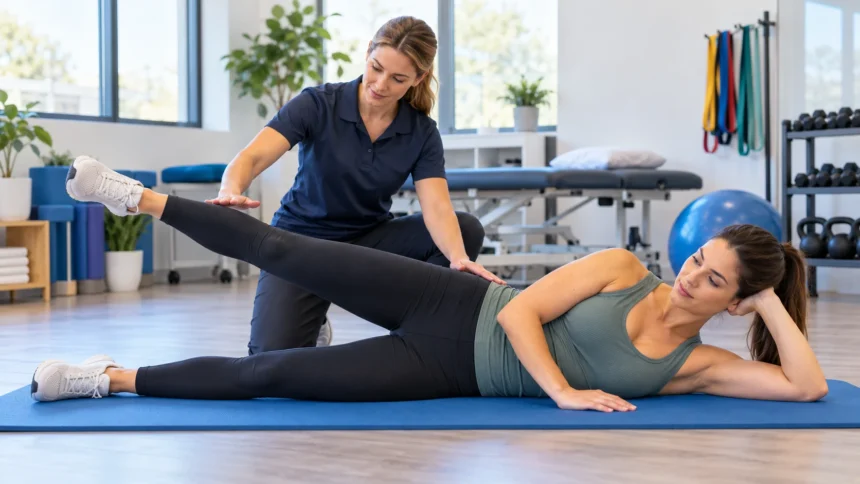
Hip abduction exercises are an effective way to strengthen the muscles that support your hips, pelvis, and lower body. These movements involve moving your leg away from the center of your body. They are commonly included in fitness routines, physical therapy programs, and rehabilitation exercises because they help improve hip stability and movement control.
Strong hip muscles contribute to everyday activities such as walking, climbing stairs, standing on one leg, and maintaining balance. When these muscles work effectively, they help control the position of your pelvis during movement. Hip abduction exercises can be performed using body weight, resistance bands, or exercise machines, depending on individual ability and training goals.
Understanding proper hip abduction exercise form is important for making each movement comfortable and effective. This guide explains how hip abduction works, the main muscles involved, its potential benefits, and several common exercises. It also covers technique, frequent mistakes, and safety considerations to help you develop a balanced strengthening routine.
What Are Hip Abduction Exercises?
Hip abduction exercises are movements that strengthen the muscles responsible for moving the thigh away from the body’s midline. This movement occurs at the hip joint and is important for controlling leg position. Exercises such as side-lying leg raises, standing hip abductions, and banded side steps all involve hip abduction.
Hip abduction is different from hip adduction, which brings the leg toward the body’s midline. Both movements are necessary for normal lower-body coordination and stability. Strengthening the muscles involved in these actions can support everyday movements, particularly activities requiring balance and single-leg control.
Hip abduction exercises vary in difficulty and equipment requirements. Some use body weight and require little space, while others involve resistance bands, cable machines, or gym equipment. The most appropriate exercise depends on individual strength, comfort, movement quality, and any recommendations provided by a healthcare or fitness professional.
Which Muscles Do Hip Abduction Exercises Work?
Hip abduction exercises primarily target the gluteus medius and gluteus minimus muscles. These muscles are located along the outer portion of the hip and play important roles in moving and stabilizing the thigh. They also contribute to controlling pelvic position during activities that involve standing or moving on one leg.
The upper fibers of the gluteus maximus and the tensor fasciae latae can also contribute to hip abduction. These muscles work together in different ways depending on hip position and movement direction. Their coordinated activity helps support the hip joint during walking, running, and other lower-body activities.
Hip strength involves more than one muscle group, so abduction exercises are usually most useful as part of a balanced routine. Hip extensors, adductors, and other surrounding muscles also contribute to movement control. Developing strength across these muscle groups can support overall lower-body function without placing excessive emphasis on one exercise.
Benefits of Hip Abduction Exercises
One important benefit of hip abduction exercises is improved strength in the muscles surrounding the hip joint. Stronger hip abductors can contribute to better pelvic control during walking, climbing stairs, and standing on one leg. These muscles are especially important when the body needs to maintain balance while weight shifts between the legs.
Hip abduction exercises may also support coordination during physical activities that involve changing direction or moving sideways. Strengthening the relevant muscles can improve a person’s ability to control leg movement under appropriate conditions. However, improvements depend on exercise technique, individual needs, and consistency rather than one exercise alone.
Another benefit is the flexibility of hip abduction training. Many exercises can be performed at home without expensive equipment, while resistance options are available for different ability levels. When included in a well-rounded strengthening program, these movements can support mobility, stability, and confidence during everyday activities.
How to Perform Hip Abduction Exercises With Proper Form
Proper hip abduction form begins with maintaining a comfortable and controlled body position. Whether standing, lying down, or using an exercise machine, avoid unnecessary twisting through the lower back or pelvis. The goal is to move the leg through a manageable range while keeping the movement smooth and controlled.
The amount of movement does not need to be large to engage the hip muscles effectively. Raising the leg too high can cause the pelvis or trunk to move in ways that reduce the exercise’s intended focus. A smaller movement performed with good control is often more useful than forcing a larger range.
Breathing normally and avoiding unnecessary tension can also make the exercise more comfortable. If the movement causes sharp pain, significant discomfort, or unusual symptoms, stop rather than pushing through. Individuals recovering from injuries or managing hip conditions should follow exercise guidance tailored to their specific needs.
Side-Lying Hip Abduction Exercise
Side-lying hip abduction is a common strengthening exercise that primarily targets the gluteus medius and gluteus minimus. It is often used in physical therapy and general fitness programs because it requires minimal equipment. The supported position also allows individuals to focus on controlled movement without needing to maintain standing balance.
In this exercise, the person lies comfortably on one side with the lower leg positioned for support. The upper leg moves gently away from the lower leg while the pelvis remains stable. The movement should stay within a comfortable range without excessive rotation or lifting through the lower back.
Side-lying hip abduction can be adapted according to strength and comfort. Some people benefit from performing the movement without additional resistance, while others may use equipment when appropriate. Maintaining controlled technique is more important than achieving a large movement or completing an unusually high number of repetitions.
Standing Hip Abduction Exercise
Standing hip abduction strengthens the outer hip muscles while also involving balance and postural control. It is commonly included in rehabilitation and general strengthening programs. The exercise can be useful for individuals who want to practice hip movement in a position more closely related to everyday standing activities.
During standing hip abduction, one leg supports the body while the other moves gently outward. A stable support surface can help maintain balance when needed. Keeping the trunk upright and avoiding excessive leaning allows the moving leg to work without unnecessary compensation from the upper body.
Standing variations may be performed with body weight or suitable resistance according to individual ability. The exercise should feel controlled rather than rushed. People with balance difficulties or existing medical conditions may benefit from professional guidance before attempting more challenging versions.
Seated Hip Abduction Exercise
Seated hip abduction involves moving the thighs outward while remaining in a supported sitting position. This movement can be performed using certain exercise machines or appropriate resistance equipment. It is commonly used in fitness settings because it allows the hip muscles to work without requiring standing balance.
Maintaining a stable seated posture is important for effective movement. Excessive leaning, sudden jerking, or pushing beyond a comfortable range can make the exercise less controlled. The resistance should be suitable for the person’s current ability rather than selected only to make the movement feel difficult.
Seated hip abduction can provide a useful variation within a broader lower-body program. However, machine-based training does not fully replace exercises involving standing or walking control. Combining different movement patterns may help develop strength that supports a wider range of everyday activities.
Resistance Band Hip Abduction Exercises
Resistance bands provide a convenient way to add adjustable resistance to hip abduction movements. They are commonly used in home workouts, rehabilitation programs, and gym warm-ups. Different band strengths allow exercises to be adapted according to individual comfort and muscle strength.
Banded hip abduction may involve standing movements, side steps, or other controlled variations. The band adds resistance as the legs move apart, encouraging the hip muscles to work against that resistance. Proper positioning and a manageable movement range are important for maintaining comfortable technique.
Resistance bands should be inspected regularly because worn or damaged material can fail unexpectedly. Stronger resistance is not automatically better, especially when it causes poor movement control. A suitable band should allow smooth motion without discomfort or excessive compensation from other body areas.
Clamshell Exercise for Hip Strength
The clamshell exercise is frequently used to strengthen muscles around the outer hip. It involves a controlled movement while the body remains supported in a side-lying position. The exercise is often included in rehabilitation programs because it can be adapted to different abilities and comfort levels.
Clamshells involve hip rotation as well as movement between the thighs, so they are not identical to straight-leg hip abduction exercises. They can still recruit muscles involved in hip stability, including portions of the gluteal muscle group. Maintaining pelvic control helps keep the movement focused.
This exercise can be performed without additional resistance or modified according to professional guidance. People sometimes add bands for increased resistance, but this is not necessary for everyone. Comfortable positioning and controlled movement are more important than making the exercise increasingly difficult.
Banded Lateral Walks for Hip Stability
Banded lateral walks involve moving sideways against resistance while maintaining a controlled lower-body position. They are commonly used in fitness programs to train the hip muscles during coordinated movement. Unlike isolated leg raises, this exercise challenges both hips as the body shifts from one side to the other.
The movement requires balance, coordination, and appropriate control of the knees and pelvis. Resistance should remain manageable so that posture and movement quality do not deteriorate. A stable environment and suitable footwear may also help maintain comfort during side-to-side movement.
Lateral walking exercises can complement other hip strengthening activities, particularly for individuals who already have good basic balance. However, they are not necessary for every rehabilitation program. People recovering from injuries should follow individualized guidance before adding more demanding sideways movements.
Fire Hydrant Exercise for the Hips
The fire hydrant exercise is a bodyweight movement commonly included in glute strengthening routines. It involves lifting one thigh outward while the body remains supported on the hands and knees. The exercise combines hip abduction with other hip movements depending on positioning and technique.
Maintaining a stable trunk and pelvis helps prevent unnecessary twisting during the exercise. The movement should remain within a comfortable range rather than forcing the leg upward. Some individuals may need modifications when pressure through the wrists, knees, or shoulders causes discomfort.
Fire hydrants can provide variety within a general hip strengthening program. However, they may not be appropriate for everyone, particularly those with certain joint conditions or recent injuries. Exercise selection should prioritize comfort, control, and individual goals rather than copying challenging movements without suitable preparation.
Hip Abduction Machine Benefits and Limitations
The hip abduction machine is a common piece of gym equipment designed to provide resistance as the thighs move outward. It can help train the muscles involved in hip abduction while the user remains seated. Adjustable resistance makes it possible to accommodate different experience levels and training goals.
One advantage of machine-based exercise is the support provided by the seat and backrest. This may help individuals concentrate on the hip movement without managing as many balance demands. However, the machine’s fixed movement path may not suit every person’s anatomy or physical limitations.
Machine exercises also have limitations because daily activities require coordination across several joints and muscle groups. Seated hip abduction may contribute to strength development but does not automatically improve every aspect of balance or walking. Including other appropriate lower-body movements can help create a more complete exercise program.
Hip Abduction vs. Hip Adduction Exercises
Hip abduction and hip adduction describe opposite movements of the thigh relative to the body’s midline. Abduction moves the leg outward, while adduction moves it inward. Both movements occur at the hip joint and involve different muscle groups that contribute to coordinated lower-body function.
Hip abduction primarily involves muscles such as the gluteus medius and gluteus minimus. Hip adduction relies on muscles along the inner thigh, including the adductor longus, adductor brevis, and adductor magnus. These muscle groups work together during everyday activities that require balance and controlled leg movement.
A balanced strengthening program may include both hip abduction and adduction exercises when appropriate. Training only one movement pattern can overlook other important muscles involved in hip stability. Exercise selection should reflect individual goals, physical abilities, and any professional recommendations related to existing conditions.
Hip Abduction Exercises for Beginners
Beginners often benefit from starting with simple hip abduction movements that require minimal equipment. Side-lying and supported standing variations are common options because they can be adapted to different comfort levels. Learning controlled movement before adding significant resistance helps build confidence and awareness of body position.
A beginner routine should emphasize quality rather than the number of exercises performed. Comfortable movement, normal breathing, and appropriate recovery are important foundations. People may progress at different rates depending on their existing strength, activity level, and any physical limitations.
There is no need to experience significant soreness for hip strengthening exercises to be useful. Mild muscular effort can occur during unfamiliar movement, but sharp pain or persistent discomfort is a reason to stop. A qualified professional can help select suitable modifications when standard exercises feel difficult.
Hip Abduction Exercises for Older Adults
Hip abduction exercises may support strength and balance in older adults when included in an appropriate physical activity program. The outer hip muscles help stabilize the pelvis during standing and walking. Maintaining their function can contribute to confidence during everyday movements that involve weight shifting.
Supported standing exercises and selected seated movements may be useful for individuals who prefer additional stability. However, exercise suitability depends on current mobility, medical conditions, and balance ability. A physical therapist or qualified exercise professional can help identify safe and appropriate options.
Strength training should be combined with other activities that support mobility, balance, and general physical health. Hip abduction exercises alone cannot prevent every fall or resolve all walking difficulties. A comprehensive approach considers the individual’s needs, living environment, and overall functional abilities.
Hip Abduction Exercises for Runners
Running involves repeated single-leg support, making hip muscle control relevant to lower-body movement. The gluteus medius and surrounding muscles contribute to pelvic stability during each stride. Hip abduction exercises are sometimes included in running programs to strengthen muscles involved in this process.
Strengthening the hip abductors may improve muscle capacity, but it does not guarantee injury prevention or better running performance. Running mechanics depend on many factors, including training history, overall strength, fatigue, and individual anatomy. A well-rounded program should address these factors rather than relying on one exercise category.
Runners experiencing ongoing hip, knee, or lower-back discomfort should avoid assuming that weak hip abductors are the only cause. A healthcare professional can assess symptoms and identify appropriate treatment. When suitable, hip strengthening can form one part of an individualized return-to-activity or conditioning program.
Hip Abduction Exercises for Knee Stability
The hip muscles contribute to the control of thigh position during movements such as walking, squatting, and stepping. Because the hip and knee work together, strengthening the hip abductors may support lower-body movement control. This connection is one reason hip exercises sometimes appear in knee rehabilitation programs.
Some people with certain knee conditions may benefit from hip-focused strengthening as part of a broader exercise plan. However, knee pain can arise from many different causes, and hip weakness is not always present. The most useful exercises depend on the specific diagnosis, symptoms, and individual movement abilities.
Hip abduction exercises should not replace a complete assessment when knee pain persists. A physical therapist may recommend additional strengthening, mobility, or activity modifications. Combining appropriate exercises with gradual progress can support recovery more effectively than concentrating exclusively on one muscle group.
Hip Abduction Exercises for Lower Back Support
Hip abductor muscles help control pelvic position during standing and walking, which can influence how the lower body moves. Because the pelvis and lower back are mechanically connected, hip strength may contribute to overall movement control. However, the relationship between hip weakness and back pain is complex.
Certain rehabilitation programs include hip strengthening exercises alongside trunk exercises and general movement activities. These programs aim to improve physical capacity and confidence rather than correct one universal cause of back pain. Some individuals may benefit from hip-focused training, while others require different approaches.
Persistent lower-back pain should be evaluated according to its symptoms and possible causes. Hip abduction exercises are not a guaranteed treatment for back discomfort. Professional guidance is particularly important when pain is accompanied by leg weakness, numbness, or other concerning neurological symptoms.
Common Hip Abduction Exercise Mistakes
One common mistake during hip abduction exercises is using excessive resistance before developing proper movement control. When the resistance is too demanding, individuals may compensate by leaning or twisting their bodies. This can make it harder to target the intended movement and may increase discomfort.
Another mistake involves forcing the leg beyond a comfortable range. Larger movements are not always more effective, especially when the pelvis begins to rotate or the lower back takes over. Maintaining a manageable range allows the hip muscles to work while preserving better overall alignment.
Moving too quickly can also reduce exercise quality. Rapid repetitions may rely on momentum instead of controlled muscle activity. A comfortable pace, appropriate breathing, and attention to technique help make the movement more consistent without adding unnecessary physical strain.
How Often Should You Do Hip Abduction Exercises?
The appropriate frequency of hip abduction exercises depends on individual goals, experience, and overall activity levels. Strengthening programs generally include opportunities for recovery between demanding sessions. However, rehabilitation exercises may follow a different schedule depending on symptoms and professional recommendations.
Some individuals perform hip abduction movements as part of a broader lower-body routine rather than training them separately. Others may use gentle movements during rehabilitation when guided by a clinician. Exercise planning should consider all physical activities being performed, not only the number of hip-specific sessions.
More frequent exercise is not always more beneficial. Excessive training without adequate recovery can contribute to soreness and reduced movement quality. A sustainable routine that feels manageable and supports gradual improvement is preferable to pushing through discomfort or following an unnecessarily demanding schedule.
When Should You Avoid Hip Abduction Exercises?
Hip abduction exercises should be stopped when they produce sharp pain, significant discomfort, or worsening symptoms. Certain hip conditions, recent surgeries, and injuries may require modified movement or temporary restrictions. A healthcare professional can determine which activities are appropriate based on diagnosis and recovery stage.
Some individuals experience discomfort around the outer hip because of conditions involving nearby tendons or other tissues. Certain positions and resistance levels may aggravate these symptoms. Exercises should be selected according to individual tolerance rather than assuming that every hip strengthening movement is suitable for all conditions.
Seek medical attention when hip pain follows a significant injury or is accompanied by an inability to bear weight, marked swelling, or other concerning symptoms. Persistent pain that affects walking or sleep also deserves assessment. Early guidance can help identify the underlying problem and prevent unsuitable exercise choices.
Tips for Getting Better Results From Hip Abduction Exercises
Consistent technique is more important than performing the most challenging variation available. Focus on maintaining a stable pelvis, using comfortable movements, and avoiding unnecessary compensation. Choosing exercises that match your current ability can help create a more enjoyable and sustainable strengthening routine.
Progress should be gradual and based on comfort, movement quality, and individual goals. Additional resistance or more demanding variations may become appropriate as strength improves. However, increasing difficulty is not necessary during every session, especially when existing exercises already provide a suitable challenge.
Hip abduction training works best when combined with other appropriate lower-body activities. Walking, general strengthening, and mobility exercises can support broader physical function. Adequate rest and a balanced approach help ensure that hip exercises contribute positively to overall health rather than becoming a source of unnecessary strain.
Conclusion
Hip abduction exercises strengthen muscles that move and stabilize the thigh, particularly the gluteus medius and gluteus minimus. These muscles support pelvic control during walking, standing, and other everyday activities. Exercises such as side-lying leg raises, standing hip abductions, and seated machine movements provide different ways to train them.
The benefits of hip abduction exercises depend on appropriate technique, individual needs, and a balanced strengthening program. Controlled movement, manageable resistance, and suitable recovery help support progress. People experiencing persistent hip pain or recovering from an injury may need professional guidance before beginning or changing their routines.
Whether performed at home or in a gym, hip abduction exercises can be a useful part of maintaining lower-body strength and stability. Choose movements that feel comfortable and match your abilities. By focusing on quality rather than intensity, you can build a practical routine that supports everyday movement and long-term physical function.
Frequently Asked Questions
1. What Are Hip Abduction Exercises Good For?
Hip abduction exercises help strengthen the outer hip muscles and support pelvic stability. They may improve movement control during walking, standing, and other activities when included in a balanced exercise program.
2. Which Muscles Do Hip Abduction Exercises Target?
Hip abduction primarily works the gluteus medius and gluteus minimus. The tensor fasciae latae and portions of the gluteus maximus may also contribute depending on the exercise and hip position.
3. Can Hip Abduction Exercises Help With Hip Pain?
They may be helpful for certain conditions when recommended as part of an individualized rehabilitation program. However, hip pain has many possible causes, and some exercises can aggravate particular problems.
4. Are Hip Abduction Exercises Suitable for Beginners?
Yes, many hip abduction exercises can be adapted for beginners. Bodyweight and supported variations provide opportunities to practice controlled movement before considering additional resistance or more challenging exercises.
5. Is the Hip Abduction Machine Better Than Resistance Bands?
Neither option is universally better. Machines provide seated support and adjustable resistance, while bands allow more movement variations. The best choice depends on individual goals, comfort, equipment access, and exercise technique.
