


Low Back Exercises: Form, Benefits and Tips
Low back exercises can help you build strength, practice controlled movement, and make everyday activities feel more manageable. A useful routine often combines gentle mobility with exercises for the trunk and hips. The aim is to improve your movement capacity gradually, rather than forcing your back into a particular shape or expecting one exercise to solve every problem.
People start lower back exercises for different reasons, including stiffness, reduced fitness, or a return to activity after discomfort. Those situations do not all need the same routine, and similar symptoms can have different causes. Choose movements according to your ability and response, and seek individual guidance when an injury, medical condition, or ongoing pain affects your choices.
You do not need complicated equipment to begin practicing basic exercises. A comfortable surface, enough room to move, and a few minutes of focused attention may be sufficient. This guide explains common movements, their purposes, and practical form cues, along with ways to progress and signs that require medical assessment instead of continued exercise.
Understand What Low Back Exercises Can Do
Lower back training involves more than strengthening the muscles directly beside the spine. Your abdominal muscles, hips, and other supporting muscles contribute to movement during walking, reaching, and lifting. Exercises that involve these areas can help develop coordination and capacity, giving you several ways to approach a task instead of relying on one repeated movement pattern.
Mobility exercises and strengthening exercises have different purposes. A gentle movement may help you explore a comfortable range, while a strengthening exercise challenges muscles to produce or control force. A balanced routine can include both, but the most useful combination depends on your goals and whether a particular direction of movement improves or aggravates your symptoms.
Exercise does not need to change the appearance of your spine to be worthwhile. Better control, improved endurance, or greater confidence in ordinary activities can be meaningful outcomes. Avoid judging progress only by how far you can stretch, because reaching an extreme position is not necessary for many everyday tasks and may not suit your current needs.
Know When to Get Help Before Exercising
Seek emergency medical help for back pain with new bladder or bowel problems, loss of feeling around the genitals or anus, or pain, tingling, weakness, or numbness in both legs. Back pain with chest pain or following a serious accident also needs emergency assessment. Do not try to stretch away these symptoms or wait for an exercise routine to help.
Get prompt medical advice if pain is severe and starts suddenly, worsens quickly, or occurs with fever or feeling generally unwell. Persistent pain that disrupts daily life also deserves assessment, particularly with unexplained weight loss or pain that is worse at night. These signs require investigation without proving that a specific condition is present.
If you have recent surgery, a fracture, osteoporosis, pregnancy-related concerns, or an established condition with movement restrictions, ask which exercises are appropriate. A general routine cannot account for every clinical situation. Stop exercising and seek advice if you develop new weakness, spreading numbness, or significant worsening rather than assuming that discomfort is a necessary part of progress.
Prepare Your Space and Start Gently
Choose a surface that lets you move comfortably without slipping. A mat can provide cushioning, but it should not be so unstable that maintaining your position becomes the main challenge. Keep enough space around you, and use a sturdy support nearby if getting down to the floor or standing back up is difficult.
Begin with a little comfortable movement, such as a short walk around the room, if that suits your symptoms. Then practice the starting position of each exercise before adding repetitions. This gives you time to check comfort, understand the movement, and decide whether a smaller range or an easier variation would be a better starting point.
Breathe normally and move at a pace that allows you to stay in control. You should not need to hold your breath or tense your entire body to complete a gentle exercise. The suggested repetitions below are modest starting examples, so adjust them to your response or follow the dosage provided by your clinician or physiotherapist.
Pelvic Tilts for Gentle Movement Awareness
Pelvic tilts help you practice a small movement of the pelvis while lying down. Lie on your back with your knees bent and feet supported on the floor, keeping your head comfortable. Allow your shoulders to relax, then notice the natural space beneath your lower back without trying to force it flat immediately.
Gently roll your pelvis so the space beneath your lower back becomes slightly smaller. Release toward your comfortable starting position, keeping the movement smooth and your breathing easy. Begin with about five slow repetitions, using a small range rather than pressing hard into the floor or lifting your hips as though performing a bridge.
The purpose is controlled movement, not a strong stretch or an intense abdominal workout. Avoid pushing through pain or repeatedly exaggerating the opposite arch between repetitions. If the position itself is uncomfortable, stop and seek an alternative, because practicing a movement successfully means it suits your body rather than merely resembling a demonstration.
Knee Rolls for Comfortable Lower-Trunk Mobility
Knee rolls introduce gentle movement while your upper body remains supported. Lie on your back with your knees bent and feet resting on the floor, placing your arms where they feel comfortable. Keep your knees near each other without squeezing forcefully, and begin from a position where your breathing remains relaxed.
Slowly allow both knees to move a short distance toward one side, then return to the center. Repeat toward the other side without trying to reach the floor or create a large twist. Start with roughly three to five movements in each direction, keeping the range small enough that your shoulders remain comfortably supported.
Avoid using momentum or letting the legs drop suddenly at the end of the movement. A smaller controlled motion can be more useful than a deeper position that causes pain or makes you tense. Skip the exercise if twisting aggravates your symptoms, and ask for guidance if you are unsure whether rotation fits your current condition.
Single Knee-to-Chest for a Gentle Stretch
A single knee-to-chest movement explores comfortable bending through the hip and lower back while you are supported. Lie on your back with both knees bent, then bring one knee toward your body. Hold behind the thigh or around the upper shin according to comfort, avoiding unnecessary pressure directly over the front of the knee.
Draw the leg inward only until you feel a mild, comfortable stretch. Keep your head and shoulders relaxed, breathe normally, and hold for a few seconds before returning the foot to the floor. Try two or three gentle repetitions on each side rather than pulling harder to make the movement look more impressive.
This position will not suit every type of back discomfort. Stop if it causes sharp pain, increases symptoms traveling into the leg, or creates an unpleasant sensation that does not settle when you release. A useful stretch should fit your response, so do not assume that bending toward the chest is automatically the right choice for everyone.
Glute Bridges for Hip and Trunk Strength
Glute bridges challenge the buttock muscles while requiring control through the trunk. Lie on your back with your knees bent and feet about hip-width apart, supported firmly on the floor. Keep your arms relaxed beside you and place your feet where you can push comfortably without straining your knees or sliding.
Gently tighten your abdominal muscles and press through your feet to lift your hips. Rise only as far as you can while keeping the movement comfortable and avoiding an exaggerated lower-back arch. Pause briefly, then lower slowly, starting with around five controlled repetitions rather than trying to hold the highest possible position.
Keep your weight supported through your feet and upper back rather than pushing into your neck. If your hamstrings cramp, lower your hips, rest, and reconsider foot placement or the size of the movement. Stop if bridging causes back pain, and use a smaller lift only if it remains comfortable and appropriate for your situation.
Modified Bird Dogs for Movement Control
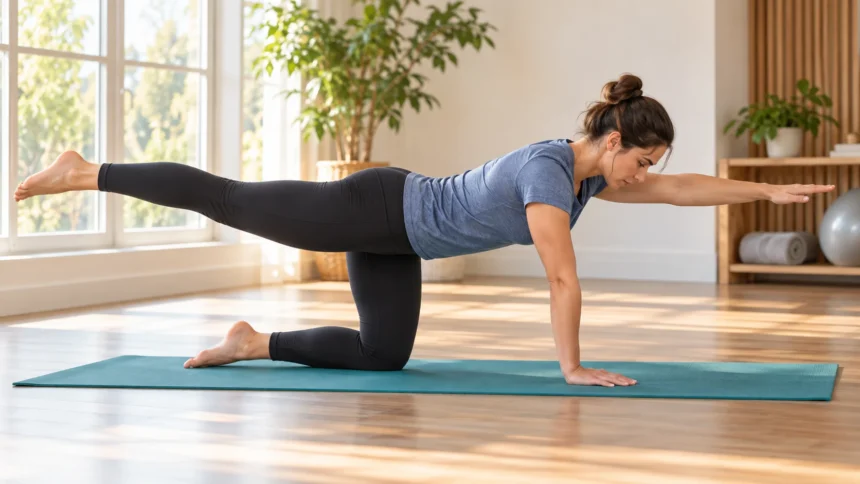
A modified bird dog helps you practice moving a limb while keeping the rest of your body controlled. Begin on your hands and knees with your hands beneath your shoulders and knees beneath your hips. Look toward the floor, keep your neck comfortable, and find a back position that feels easy to maintain without rigid bracing.
Start by sliding one foot backward along the floor rather than lifting both an arm and a leg immediately. Return slowly, then repeat on the other side, aiming for about three controlled repetitions each. You can also practice lifting one arm separately if that feels comfortable and does not cause your trunk to sway.
Progress to reaching an opposite arm and leg only when the simpler versions feel steady. Extend outward rather than lifting high, and avoid twisting your hips or letting your lower back sag. The challenge comes from controlled movement, so reduce the range or return to a simpler variation when maintaining the position becomes difficult.
Cat-Cow Movements for Gentle Spinal Mobility
Cat-cow movements allow you to explore bending and extending the spine from an all-fours position. Set your hands beneath your shoulders and knees beneath your hips, using suitable cushioning if needed. Before moving, check that supporting your weight through the wrists and knees feels comfortable enough to focus on the exercise.
Slowly round your back within an easy range, allowing your head to follow the movement without forcing it downward. Then move toward a gentle arch, keeping the motion small rather than dropping your abdomen sharply. Begin with about five smooth cycles and continue breathing instead of holding tension as you move between positions.
Avoid treating either end position as a target you must reach. The movement should remain controlled, and you can reduce the range in one direction if the full motion feels uncomfortable. If either bending or arching consistently worsens symptoms, stop the exercise and ask whether another mobility option would better suit your needs.
Walking and Movement Breaks Support Your Routine
Walking can provide a practical way to stay active alongside focused exercises. Choose a pace, route, and duration that fit your current comfort and ability, including a short indoor walk if necessary. You do not need to start with a demanding distance, especially when a manageable amount helps you establish a consistent routine.
Break up long periods in one position by changing posture or taking a brief movement break. There is no need to hold one supposedly perfect sitting position throughout the day. Instead, arrange your workspace for comfort and give yourself opportunities to move in ways that fit your responsibilities and how your body responds.
Use everyday function as part of your progress check. Notice whether getting out of a chair, walking a familiar route, or completing a normal task becomes easier over time. These observations can help you judge whether the overall routine is useful, while persistent difficulties provide specific information to discuss with a physiotherapist or other clinician.
Build a Routine and Progress Gradually
Begin with two or three exercises that feel manageable instead of completing every movement in this guide. A short session might combine a gentle mobility exercise with a bridge or modified bird dog. Choose a small starting amount, then observe your symptoms during the session and afterward before deciding whether to repeat or expand it.
Increase one element at a time, such as repetitions, range, or difficulty. For example, you might add a few comfortable bridge repetitions before considering a more challenging variation. Making several changes together can make it harder to understand what caused a flare-up or whether the additional challenge was appropriate for your current capacity.
Gentle mobility may fit more frequent practice, while harder strengthening sessions can require recovery between them. There is no universal schedule that suits every person with lower-back symptoms, so follow individualized advice where available. Keep the routine sustainable, and avoid turning a missed session into a reason to perform an unusually large amount next time.
Common Form Mistakes and How to Avoid Them
Rushing through repetitions can make it difficult to control the movement or notice how your symptoms respond. Use a steady pace and pause when you need to reset your position. Finishing fewer repetitions with comfortable technique is a better starting point than completing a target number while repeatedly losing control or pushing into pain.
Another common mistake is assuming that more tension, greater range, or a harder variation always produces a better result. Excessive bracing can interfere with breathing, while an unnecessary stretch may irritate symptoms. Match the challenge to the purpose of the exercise, remembering that movement practice and strength development do not require the same level of effort.
Do not continue an exercise solely because it is widely recommended or helped someone else. Your response matters, and repeated worsening is a reason to adjust the plan or seek advice. If pain remains troublesome after a few weeks, limits ordinary activities, or makes choosing movements difficult, arrange an assessment rather than endlessly changing online routines.
Conclusion
Low back exercises can provide a practical way to develop movement awareness, strengthen supporting muscles, and gradually improve everyday capacity. Pelvic tilts, gentle knee rolls, bridges, and modified bird dogs each offer a different type of challenge. Their usefulness depends on whether they suit your symptoms, abilities, and goals rather than on completing a particular exercise list.
Start with manageable movements and prioritize controlled technique, comfortable breathing, and a realistic amount of practice. Build the routine gradually, changing one element at a time so you can understand your response. Look for meaningful improvements in daily activities, and remember that greater range or a more difficult variation is not the only sign of progress.
Seek guidance when symptoms persist, worsen, or leave you unsure about appropriate exercise. Emergency warning signs require medical assessment rather than a new stretch or strengthening routine. With suitable choices and regular review, exercise can become a useful part of caring for your lower back while keeping attention on what helps you function more comfortably.
FAQs
What Are Good Low Back Exercises for Beginners?
Gentle pelvic tilts, small knee rolls, glute bridges, and modified bird dogs can be starting options.
Choose according to comfort and symptoms, because no single exercise is suitable for every person or condition.
How Often Should I Do Low Back Exercises?
Frequency depends on the exercise, its difficulty, and your response.
Gentle mobility may suit frequent practice, while more demanding strengthening needs recovery; follow an individualized schedule if your clinician has provided one.
Should Low Back Exercises Hurt?
Do not push through sharp pain, worsening symptoms, or new tingling or weakness.
Reduce or stop the movement and seek guidance when needed, rather than assuming pain shows that an exercise is working.
Can Low Back Exercises Cure Back Pain?
Exercises may improve strength, movement, and function, but they do not guarantee a cure.
Back pain has different causes, so persistent symptoms or specific medical conditions may require assessment and a tailored management plan.
When Should I Seek Help Instead of Exercising?
Seek emergency help for back pain with new bladder or bowel problems, saddle numbness, or symptoms in both legs.
Chest pain, a serious accident, or rapidly worsening neurological symptoms also require urgent assessment.