


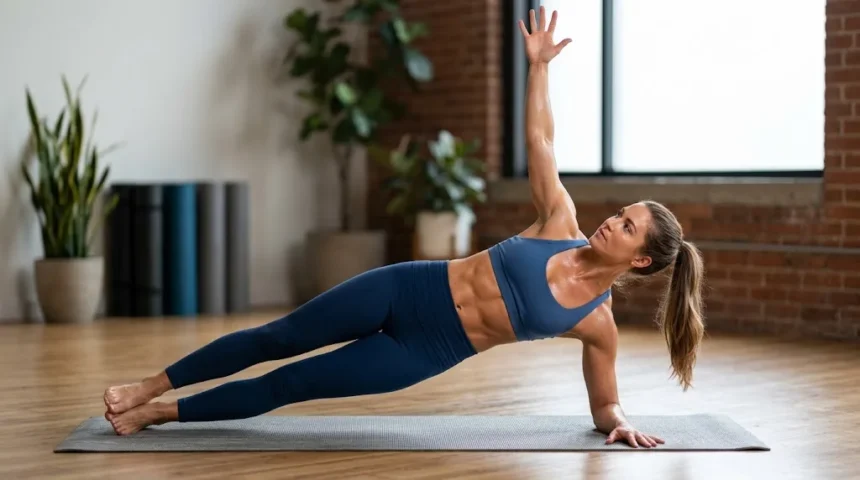
The side plank is a simple-looking exercise that challenges far more than just the abdominal muscles. Holding your body in a straight line while supporting yourself on one forearm or hand requires the core, hips, shoulders, and legs to work together. That makes the side plank a useful bodyweight exercise for strength, stability, and movement control.
Unlike exercises that involve repeated bending or twisting, the side plank trains your body to resist unwanted movement. Your muscles must work isometrically, meaning they create tension without producing much visible motion. This type of training can improve trunk stability while teaching the body to maintain better alignment under load.
Understanding the side plank muscles worked can help you use the exercise more effectively. The obliques are heavily involved, but several supporting muscles also contribute to maintaining position. Learning which muscles are targeted, what benefits the exercise offers, and how to perform it correctly can help you build a stronger and more balanced core.
What Muscles Does the Side Plank Work?
The side plank primarily targets the muscles along the sides of your torso, particularly the internal and external obliques. These muscles help control rotation, side bending, and trunk stability. During a side plank, they work continuously to prevent your hips and ribs from dropping toward the floor.
The transverse abdominis also contributes by helping stabilize the trunk from deeper within the abdominal wall. Although it is not as visible as the rectus abdominis, this deep core muscle plays an important role in controlling pressure and supporting the spine. Together, these muscles create a strong foundation for maintaining the side plank position.
Several secondary muscles also work during the exercise, including the gluteus medius, gluteus maximus, quadratus lumborum, shoulder stabilizers, and muscles of the legs. Because your entire body must stay aligned, the side plank becomes a full-body stability exercise rather than an isolated abdominal movement.
Obliques Are the Primary Muscles Targeted
The internal and external obliques are among the main muscles responsible for keeping your torso elevated during a side plank. These muscles run along the sides of your abdomen and help control rotation and lateral flexion. When you hold the plank, they resist gravity and prevent your trunk from collapsing toward the floor.
Strong obliques contribute to better control during movements such as turning, carrying, walking, running, and lifting. They also work with other core muscles to help transfer force between the upper and lower body. This makes them important not only for exercise performance but also for many everyday movements.
The side plank is especially valuable because it challenges the obliques without requiring repeated twisting. Instead of shortening and lengthening through large ranges of motion, they maintain steady tension. This can be useful for people who want to train core stability and anti-lateral flexion in a controlled way.
How the Deep Core Muscles Work During a Side Plank
The transverse abdominis acts like a deep support layer around the midsection. During a side plank, it helps maintain abdominal tension and contributes to trunk stability. It works alongside the obliques to prevent unwanted movement and helps keep the ribs, pelvis, and spine in a more controlled position.
The multifidus and other small stabilizing muscles near the spine also contribute. These muscles are not usually felt as strongly as the larger abdominal muscles, but they help control spinal position. Their involvement is one reason the side plank is often considered a stability exercise rather than simply an abdominal strength movement.
Breathing properly can help these deeper muscles work without creating unnecessary tension. Try to breathe steadily while maintaining gentle abdominal bracing instead of holding your breath. This allows you to keep the core engaged while making the exercise more sustainable and comfortable throughout the set.
Glutes and Hip Muscles Also Work Hard
The gluteus medius plays an important role during a side plank because it helps stabilize the pelvis. This muscle sits on the outer hip and assists with controlling side-to-side movement. When your hips begin to sag, the gluteus medius and surrounding muscles must work harder to keep the pelvis lifted.
The gluteus maximus also contributes, particularly when you actively squeeze the buttocks and maintain a straight body line. Keeping the hips slightly forward rather than allowing them to rotate backward increases the demand on the posterior hip muscles. This improves the exercise’s ability to connect core stability with hip strength.
Strong hip muscles are useful for walking, running, balancing, climbing stairs, and many athletic movements. Because the side plank trains the trunk and hips at the same time, it can help improve coordination between these regions. This makes it especially useful as part of a broader strength or mobility routine.
Shoulders and Upper Body Provide Important Support
Your supporting shoulder carries a significant portion of your body weight during a side plank. The deltoids, rotator cuff muscles, serratus anterior, and other shoulder stabilizers help maintain a strong position. These muscles work together to keep the shoulder from collapsing as your body remains elevated.
Proper shoulder positioning matters because poor alignment can make the exercise uncomfortable. When using the forearm variation, keep the elbow directly beneath the shoulder and gently push the floor away. This creates active support through the shoulder rather than allowing your body weight to sink passively into the joint.
The upper arm, chest, and upper-back muscles also contribute to maintaining control. Although they are not the main target, they provide important stability throughout the hold. This is one reason people often feel the side plank in the shoulder as well as the core and hips.
Benefits of Adding Side Planks to Your Routine
One of the biggest side plank benefits is improved lateral core stability. The exercise teaches your body to resist bending sideways, which can be useful during lifting, carrying, and athletic movement. This type of strength helps the torso remain controlled while the arms or legs move around it.
Side planks may also help improve balance and body awareness because you are supporting yourself on a relatively narrow base. Your nervous system must constantly adjust muscle tension to keep your body aligned. With practice, this can improve coordination and make challenging positions feel more controlled.
Another advantage is convenience. Side planks require no equipment and can be performed at home, in a gym, or while traveling. They are also easy to modify, allowing beginners and experienced exercisers to choose a version that matches their current strength and comfort level.
How to Perform a Side Plank Correctly
Begin by lying on one side with your legs extended and your feet stacked or staggered. Place your forearm on the floor with your elbow directly beneath your shoulder. Brace your core, squeeze your glutes, and lift your hips until your body forms a straight line from your head to your feet.
Keep your ribs stacked over your pelvis and avoid allowing the upper shoulder to rotate toward the floor. Your head should remain in a comfortable neutral position rather than dropping downward. Think about pushing the floor away through your supporting forearm while keeping the hips lifted and controlled.
Hold the position for as long as you can maintain good form rather than chasing an arbitrary time target. Beginners may start with shorter holds and gradually increase duration. Quality matters more than holding longer while the hips sag, the shoulder collapses, or the body begins twisting.
Common Side Plank Mistakes to Avoid
One common mistake is allowing the hips to drop toward the floor. This usually happens when the core or hip muscles become fatigued. Once the hips sag significantly, the exercise loses some of its intended training effect and may place unnecessary stress on other areas.
Another mistake is placing the elbow too far away from the shoulder. Poor elbow positioning can make the supporting shoulder feel unstable or overloaded. Keeping the elbow directly underneath the shoulder usually creates a stronger base and allows the upper body to support the exercise more effectively.
Some people also hold their breath or tense the neck excessively. Try to breathe steadily and keep the jaw and neck relaxed while maintaining core tension. If a position creates unusual sensitivity or discomfort, gradual exposure and appropriate desensitization techniques may sometimes be relevant, but persistent pain should be professionally assessed.
Side Plank Variations for Different Fitness Levels
Beginners can perform a modified side plank with the knees bent and the lower knee resting on the floor. This shortens the lever and reduces the amount of body weight the core and shoulder must support. It is a useful option for learning proper alignment before progressing to the full exercise.
The full forearm side plank increases the challenge by extending both legs. You can make it harder by lifting the top leg, reaching the upper arm overhead, or holding a weight carefully. These variations increase demands on the hips, core, balance, and shoulder stabilizers.
A high side plank performed on the hand creates a different upper-body challenge. The supporting wrist and shoulder must tolerate more load while the trunk remains stable. Progress gradually and choose variations that allow you to maintain alignment without pain, shaking that becomes excessive, or loss of control.
How Long Should You Hold a Side Plank?
There is no single ideal side plank duration for everyone. Beginners may start with holds of around 10 to 20 seconds per side, focusing on good alignment. As strength improves, you can gradually increase the hold time or add more challenging variations instead of simply trying to hold forever.
For general core training, several controlled sets are often more useful than one extremely long attempt. For example, you might perform two or three sets per side and stop when form begins to deteriorate. This approach keeps the exercise focused on muscular control rather than endurance at any cost.
Progress should be gradual, especially if you are new to isometric core exercises. Increasing time, adding repetitions, changing leverage, or introducing movement are all ways to progress. Choose one variable at a time so your muscles and joints have a chance to adapt safely.
When to Modify or Avoid the Side Plank
The side plank may need modification if you have shoulder, wrist, hip, or lower back discomfort. A bent-knee variation can reduce the overall load, while a forearm plank may be more comfortable than supporting your body on the hand. Exercise should feel challenging, but it should not produce sharp or worsening pain.
People recovering from injury or surgery may need individualized guidance before adding side planks. The exercise creates considerable tension through the torso and supporting shoulder, which may not be appropriate during every stage of recovery. A physical therapist or qualified healthcare professional can recommend suitable progressions.
Stop the exercise if you experience sudden sharp pain, numbness, tingling, dizziness, or unusual weakness. These symptoms are different from normal muscular fatigue. Choosing another core exercise temporarily may be more appropriate until the cause of the discomfort is understood.
How to Add Side Planks to a Workout
Side planks can fit well into core training, strength sessions, or short home workouts. They are often performed after compound exercises or alongside other trunk movements such as dead bugs, bird dogs, and front planks. This creates a more balanced routine that challenges the core in several directions.
You can train side planks two or three times per week depending on your overall program and recovery. Start with a manageable number of sets and gradually increase the difficulty. There is little benefit in training the exercise every day if soreness or fatigue prevents you from maintaining proper technique.
For balanced development, train both sides even if one side feels easier. Small strength differences are common, but consistently skipping the weaker side can reinforce the imbalance. Begin with the weaker side when appropriate and use similar duration and quality on both sides.
Conclusion
The side plank primarily works the obliques while also challenging the transverse abdominis, glutes, hip stabilizers, shoulders, and spinal support muscles. Because these muscles must work together to keep the body aligned, the exercise provides more than simple abdominal strengthening. It develops stability across the entire side of the body.
Benefits can include better core control, stronger hips, improved balance, and greater resistance to unwanted side bending. Good technique matters more than how long you can hold the position. Keeping the shoulder supported, hips elevated, and body aligned allows the targeted muscles to work more effectively.
Beginners can start with modified side planks and progress gradually as strength improves. More advanced variations can increase the challenge without requiring equipment. If the exercise causes sharp pain, neurological symptoms, or persistent discomfort, stop and seek appropriate guidance rather than forcing the position.
Frequently Asked Questions
What muscles does a side plank work the most?
The side plank mainly targets the internal and external obliques. It also works the transverse abdominis, gluteus medius, gluteus maximus, shoulder stabilizers, and muscles that support the spine.
Do side planks work the abs?
Yes. Side planks work several abdominal muscles, particularly the obliques and deep core. They train these muscles isometrically by requiring them to resist side bending and maintain trunk stability.
Are side planks good for the hips?
Yes. The gluteus medius and other hip stabilizers work to keep the pelvis elevated and aligned. This makes the exercise useful for developing both core and lateral hip strength.
How long should beginners hold a side plank?
Beginners can start with approximately 10 to 20 seconds per side while maintaining good form. Duration can gradually increase as core, hip, and shoulder strength improve.
Can I do side planks every day?
Some people can tolerate frequent side planks, but daily training is not necessary for progress. Allow adequate recovery and reduce frequency if you experience lingering soreness, joint discomfort, or declining technique.