


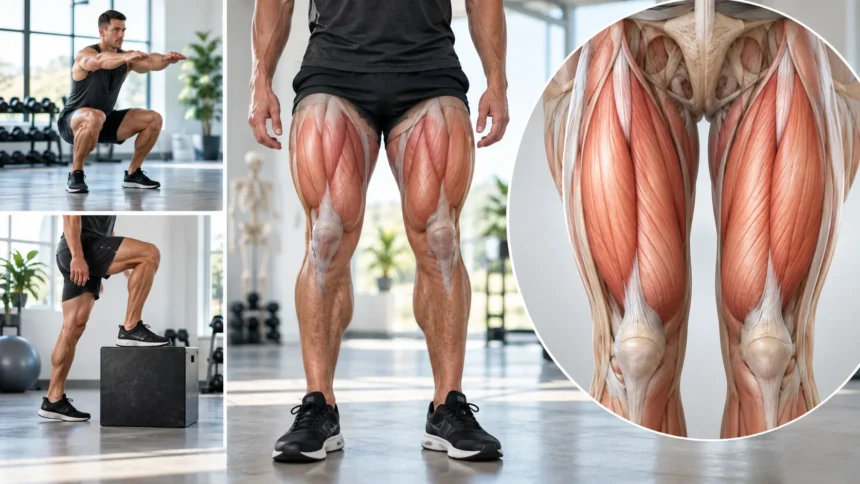
The quadriceps are among the largest and most powerful muscle groups in the human body. Located at the front of the thigh, they play an essential role in straightening the knee, supporting the hip, absorbing force, and controlling everyday movements. Walking, running, climbing stairs, standing from a chair, and jumping all depend heavily on healthy quadriceps function.
Although people often refer to the quadriceps as one muscle, the group actually contains four separate muscles that work together. Each has a slightly different anatomical position and role, but they eventually combine through the quadriceps tendon near the knee. Understanding these muscles can make strength training, rehabilitation, and movement mechanics easier to understand.
Strong quadriceps support athletic performance as well as normal daily activity. Weakness, tightness, overuse, or injury can make movements involving the knee feel more difficult or uncomfortable. This guide explains quadriceps anatomy, function, common movements, strengthening principles, flexibility, and signs that may deserve professional evaluation.
What Are the Quadriceps?
The quadriceps femoris is a group of four muscles located mainly along the front and sides of the thigh. The name comes from the fact that the group has four major muscular components. Together, these muscles produce powerful knee extension and contribute to the stability and control needed during standing and movement.
All four muscles eventually connect with the quadriceps tendon above the kneecap. Force travels through this tendon, the patella, and the patellar tendon toward the upper shin. This arrangement allows muscular contraction in the thigh to produce movement at the knee while helping manage forces during activities such as walking and squatting.
The quadriceps are active during both simple and demanding movements. They help you rise from a chair, control your body while descending stairs, and generate force during jumping or sprinting. Because they perform so many tasks, their strength and coordination are important for both everyday function and athletic performance.
The Four Quadriceps Muscles Explained
The rectus femoris runs down the center of the front thigh and differs from the other quadriceps muscles because it crosses both the hip and knee joints. This position allows it to contribute to knee extension and hip flexion. Activities involving kicking or lifting the thigh can therefore place considerable demand on this muscle.
The vastus lateralis sits along the outer portion of the thigh and is generally the largest component of the quadriceps group. The vastus medialis lies more toward the inner thigh and extends toward the inside of the knee. Both muscles play major roles in straightening the knee and controlling movement around the patella.
The vastus intermedius lies underneath the rectus femoris, making it less visible from the surface. Like the vastus lateralis and medialis, it crosses only the knee and contributes primarily to knee extension. All four muscles work together rather than functioning independently during most normal movements.
Quadriceps Function in Knee Extension
Knee extension means straightening the leg at the knee joint. This is the primary action of the quadriceps and occurs whenever you stand from a chair, kick a ball, climb stairs, or push upward from a squat. The muscles contract and create tension through the quadriceps tendon to produce the movement.
The quadriceps also control the knee while it bends under load. When you walk downstairs or lower into a squat, the muscles lengthen while remaining active to slow the movement. This type of controlled lengthening is called an eccentric contraction and is important for absorbing force safely.
Strong knee extension is important for both mobility and athletic performance. If quadriceps strength is reduced, activities such as rising from low seats or climbing steps may become more difficult. Strength deficits can also change how other muscles around the hip, knee, and ankle contribute during movement.
Role of the Quadriceps in Hip Movement
Most of the quadriceps group acts only at the knee, but the rectus femoris also crosses the hip joint. Because of this anatomy, it contributes to hip flexion, which is the movement of bringing the thigh forward or upward. Running, kicking, and climbing stairs all involve repeated hip flexion.
The rectus femoris therefore has to coordinate two joints at the same time. Its position can influence how it feels during certain stretches because extending the hip while bending the knee places the muscle in a lengthened position. This is why some traditional quadriceps stretches create tension through both the thigh and front of the hip.
Hip position can also affect quadriceps exercises. For example, different squat, lunge, and leg-extension variations place slightly different demands on the rectus femoris and the other quadriceps muscles. Understanding these relationships can help explain why one movement may feel different from another even when both involve knee extension.
Quadriceps in Walking and Everyday Movement
The quadriceps help control the knee shortly after the foot contacts the ground during walking. They prevent the knee from bending excessively and help support body weight as you move forward. Their involvement changes throughout each step, working together with the glutes, calves, hamstrings, and other lower-body muscles.
Standing up from a chair requires significant quadriceps effort, particularly when the seat is low. The muscles straighten the knees as the hips and trunk move upward. Carrying additional weight or standing without using your hands increases the demand placed on the thighs.
Stairs require even greater quadriceps involvement because the body must be raised or lowered through a larger vertical distance. Going up requires forceful knee extension, while descending demands controlled eccentric strength. This is one reason weak or painful quadriceps often become noticeable during stair climbing before they affect easier activities.
Quadriceps in Sports and Exercise
Running increases quadriceps demand because the muscles must repeatedly absorb impact and generate force at higher speeds. Sprinting, cutting, jumping, and sudden stops place additional stress on the front thigh. Athletes therefore need both strength and endurance rather than simply having large quadriceps muscles.
Squats, lunges, step ups, leg presses, and split squats all involve substantial quadriceps activity. Exercise technique, depth, resistance, and joint position influence how much work the quadriceps perform relative to the glutes and other muscles. No single exercise is required for everyone, so training can be adapted to individual ability.
Sports such as football, basketball, cycling, and skiing also rely heavily on quadriceps strength. Repeated knee extension and force absorption can fatigue the muscles over time. Gradual conditioning and recovery are important because sudden increases in training volume can exceed what the muscles and tendons are prepared to tolerate.
How to Strengthen the Quadriceps
Body-weight exercises are a practical starting point for quadriceps strengthening. Squats, sit-to-stands, step ups, and supported split squats can develop strength without requiring complex equipment. Beginners should focus on comfortable range, controlled movement, and consistent technique before increasing resistance.
As strength improves, external resistance can be added using dumbbells, barbells, machines, or resistance bands. Leg presses and knee-extension machines can provide more focused quadriceps loading, while squats and lunges train the quads together with several other muscle groups. A balanced program often includes both compound and targeted movements.
Progressive overload is important because muscles adapt when training becomes gradually more challenging. You might increase resistance, repetitions, range of motion, or exercise difficulty over time. Progress should remain manageable, since sudden jumps in volume or weight can cause excessive soreness or aggravate the knee or surrounding tissues.
Quadriceps Stretching and Mobility
A standing quadriceps stretch is commonly performed by bending one knee and bringing the heel toward the buttock while holding the ankle. Keep the knees relatively close together and avoid aggressively pulling the foot. You should feel gentle tension along the front of the thigh rather than pain around the knee.
A half-kneeling variation can also stretch the rectus femoris and front of the hip. Gently tuck the pelvis while keeping the trunk upright, then bend the rear knee only if comfortable. Because the rectus femoris crosses two joints, combining hip extension and knee flexion can create a stronger stretch.
Stretching is useful when the muscles feel stiff, but it should not be treated as the answer to every type of discomfort. Muscle tension can occur in many regions for different reasons, just as knots in neck may involve their own contributing factors. Strength, recovery, mobility, and workload all influence how muscles feel.
Common Quadriceps Problems
Quadriceps strains can occur when the muscle fibers are overloaded during sprinting, kicking, jumping, or sudden movements. Symptoms may include sharp pain, tenderness, swelling, or discomfort when straightening the knee. Mild strains may improve with gradual recovery, while more significant injuries can require professional rehabilitation.
The quadriceps tendon can also become painful, particularly with repeated jumping, running, or heavy knee-extension activity. Tendon discomfort is often felt just above the kneecap and may be more noticeable during squats, stairs, or jumping. Persistent symptoms usually require appropriate load management rather than repeatedly exercising through increasing pain.
Delayed-onset muscle soreness can occur after unfamiliar training and should be distinguished from injury. Normal soreness usually develops gradually after exercise and improves over several days. Sudden severe pain, bruising, major swelling, or inability to contract the muscle normally may suggest something more significant than ordinary post-workout soreness.
When Quadriceps Pain Needs Medical Attention
Seek medical evaluation after a significant injury if you cannot straighten the knee, bear weight normally, or walk without major difficulty. A sudden tearing sensation, large amount of swelling, obvious deformity, or rapidly developing bruising may indicate a serious muscle or tendon injury.
Persistent knee or thigh pain also deserves attention when it does not improve with reasonable activity modification. Pain can come from muscles, tendons, joints, nerves, or other structures, so symptoms should not automatically be blamed on tight quadriceps. A physical examination can help identify which structure is actually involved.
Urgent evaluation may be appropriate when thigh pain appears with major swelling, unusual redness, warmth, significant weakness, or other concerning symptoms. Exercise should help build capacity over time rather than repeatedly producing severe pain. When symptoms are unexplained or progressively worsening, professional assessment is safer than continuing to train through them.
Conclusion
The quadriceps are a four-muscle group located at the front of the thigh. The rectus femoris, vastus lateralis, vastus medialis, and vastus intermedius work together to straighten the knee, control movement, and support activities such as walking, standing, running, jumping, and climbing stairs.
Strong quadriceps contribute to knee control and overall lower-body function. Exercises such as squats, lunges, step ups, sit-to-stands, and leg extensions can strengthen them when progressed gradually. Mobility and stretching can complement training, particularly when the front of the thigh feels stiff after activity.
Understanding quadriceps anatomy can make exercise and rehabilitation easier to approach. Strength, flexibility, coordination, and appropriate workload all matter, and no single exercise is ideal for everyone. Significant weakness, injury, swelling, or persistent pain should be evaluated rather than treated only with stretching or harder workouts.
FAQs
What are the four quadriceps muscles?
The quadriceps consist of the rectus femoris, vastus lateralis, vastus medialis, and vastus intermedius. They work together primarily to extend the knee and control lower-body movement.
What is the main function of the quadriceps?
The main function is knee extension, meaning straightening the leg at the knee. The quadriceps also help control knee bending during activities such as walking downstairs and lowering into a squat.
Which quadriceps muscle also moves the hip?
The rectus femoris crosses both the hip and knee joints. It contributes to hip flexion as well as knee extension, unlike the other three quadriceps muscles.
What exercises strengthen the quadriceps?
Squats, lunges, step ups, sit-to-stands, leg presses, and knee extensions can all strengthen the quadriceps. The best exercise depends on your ability, equipment, goals, and joint comfort.
When should quadriceps pain be checked by a doctor?
Seek evaluation for severe pain, major swelling, bruising, inability to straighten the knee, or significant weakness after injury. Persistent or progressively worsening thigh pain should also be professionally assessed.