


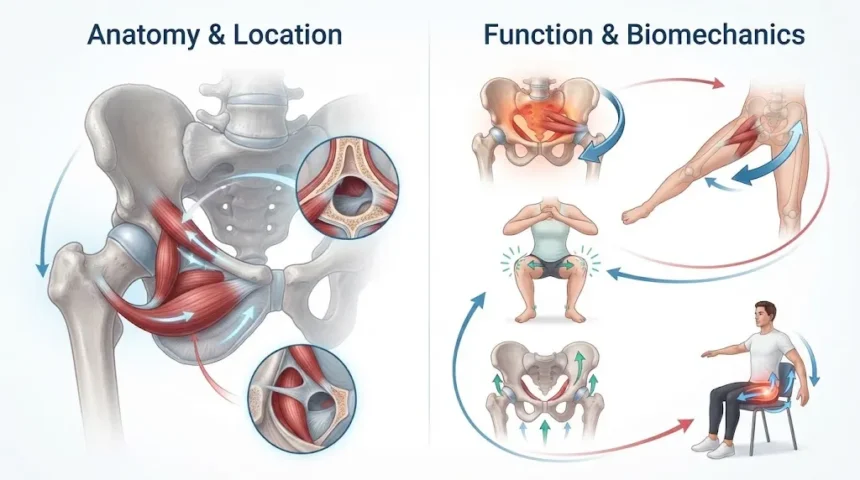
The obturator internus is a small but important muscle located deep within the pelvis. It plays a role in hip movement, pelvic stability, and coordination between the pelvis and lower limb. Because it sits beneath larger muscles, many people are unfamiliar with it until pain, tightness, or pelvic floor problems bring attention to the area.
Although the obturator internus is often discussed as a hip rotator, its function is more complex than simply turning the leg outward. It helps stabilize the head of the femur inside the hip socket and interacts closely with surrounding muscles, fascia, nerves, and pelvic floor structures. This makes it relevant to both movement and pelvic health.
Understanding where the obturator internus is located and how it works can make symptoms around the deep buttock, hip, or pelvis easier to understand. This guide explains its anatomy, attachments, functions, common sources of irritation, and how it fits into broader lower-body movement patterns.
What Is the Obturator Internus?
The obturator internus is one of several deep muscles surrounding the hip joint. It lies inside the pelvis before its tendon passes through a small opening toward the back of the hip. From there, it attaches to the upper portion of the femur, allowing it to influence both hip rotation and stabilization.
The muscle belongs to a group sometimes called the deep external rotators of the hip. Other muscles in this group include the piriformis, gemelli, quadratus femoris, and obturator externus. Together, these muscles help control how the femur moves inside the hip socket during walking, standing, turning, and other daily activities.
Despite its relatively small size, the obturator internus is positioned strategically. It connects pelvic anatomy with hip mechanics and also lies close to important pelvic floor structures. This explains why dysfunction in the muscle can sometimes produce symptoms that are felt in more than one region.
Where Is the Obturator Internus Located?
The obturator internus begins along the inner surface of the pelvis around the obturator foramen, a large opening formed by pelvic bones. Its muscle fibers converge into a tendon that changes direction as it passes through the lesser sciatic foramen. This creates a pulley-like path before the tendon reaches the femur.
After leaving the pelvis, the tendon travels toward the greater trochanter of the femur. It attaches near an area known as the medial surface of the greater trochanter, close to several other deep hip rotators. This location allows the muscle to influence the position and rotation of the upper leg.
Because the muscle is so deep, it cannot be seen or easily touched like the gluteus maximus or quadriceps. Its position behind pelvic structures and beneath larger muscles makes assessment more specialized. Pain in this region can therefore be difficult to distinguish from problems involving nearby hip, pelvic floor, or nerve structures.
What Does the Obturator Internus Do?
One of the main functions of the obturator internus is external rotation of the hip when the leg is relatively straight. External rotation means turning the thigh outward so the knee and foot rotate away from the body’s midline. This movement occurs during many athletic, everyday, and balance-related activities.
When the hip is flexed, the muscle can contribute differently to movement and may assist with abduction depending on joint position. This means its role changes as the femur moves through different angles. The obturator internus therefore works as part of a coordinated system rather than producing one isolated movement in every position.
The muscle also helps stabilize the hip joint by controlling the femoral head inside the socket. During walking, running, or standing on one leg, this stabilizing role may be more important than producing a large visible movement. Small deep muscles often contribute to movement quality even when they are not obvious from the outside.
Obturator Internus and Hip Stability
Hip stability depends on several muscles working together to control the femur while the pelvis moves above it. The obturator internus contributes to this by providing subtle rotational control around the joint. It can help prevent excessive movement and maintain better alignment when body weight shifts from one leg to the other.
During walking, the hip repeatedly moves through flexion, extension, rotation, and small side-to-side adjustments. The deep rotators respond to these changes by helping guide the joint through controlled ranges. Weakness, fatigue, or poor coordination may affect how efficiently the hip manages load during repetitive movement.
This does not mean every hip problem is caused by the obturator internus. Larger muscles such as the glutes, adductors, and core also play major roles in stability. The obturator internus is best understood as one important part of a broader system that distributes force through the pelvis and lower limb.
Obturator Internus and the Pelvic Floor
The obturator internus has an important anatomical relationship with the pelvic floor. A layer of connective tissue called the obturator fascia covers part of the muscle and provides attachment for portions of the pelvic floor. Because of this connection, changes in one region can sometimes influence tension and function in the other.
Pelvic floor muscles help support pelvic organs and contribute to continence, pressure management, and movement. The obturator internus sits along the lateral wall of the pelvis, creating a mechanical relationship with these structures. This is one reason pelvic health professionals may consider the obturator internus when assessing deep pelvic or hip symptoms.
Tension in this muscle does not automatically mean there is pelvic floor dysfunction, and pelvic symptoms do not always come from the obturator internus. However, the close relationship between the two areas means symptoms can overlap. A careful assessment may be needed when pain involves both the hip and pelvic region.
What Can Cause Obturator Internus Tightness?
Repeated hip activity can contribute to a feeling of tightness around the deep rotators. Running, cycling, prolonged sitting, heavy lifting, or repetitive rotational sports may increase demand on the muscle. If activity levels increase faster than the surrounding tissues can adapt, the area may begin to feel sore or restricted.
Long periods in the same position can also create discomfort. Sitting for many hours keeps the hips flexed and may change how muscles around the pelvis and buttocks are loaded. Some people notice deep aching after desk work, driving, or travel even when there has been no clear injury.
Muscle tightness elsewhere in the lower body may also affect overall movement patterns. People dealing with tight calves may change how they walk or load the legs, which can influence the hips over time. The body works as a connected system, so local symptoms are not always caused by one isolated muscle.
What Does Obturator Internus Pain Feel Like?
Pain involving the obturator internus may be felt deep in the buttock, around the back of the hip, or inside the pelvis. The discomfort can feel difficult to pinpoint because the muscle is not close to the surface. Some people describe aching, pressure, tightness, or pain that appears during specific hip movements.
Symptoms may become more noticeable with prolonged sitting, hip rotation, deep squatting, running, or movements that load the pelvis. In some cases, people may feel discomfort when changing direction or moving from sitting to standing. The exact pattern depends on whether the issue involves the muscle, surrounding tissues, or another nearby structure.
Deep pelvic or buttock pain should not automatically be assumed to come from the obturator internus. Piriformis problems, hip joint conditions, pelvic floor issues, nerve irritation, and other causes can produce similar symptoms. Persistent pain should be evaluated rather than repeatedly stretched without understanding the source.
Obturator Internus and Nerve Irritation
Several important nerves pass close to structures around the pelvis and deep buttock. Because of this crowded anatomy, pain near the obturator internus may sometimes occur alongside nerve-related symptoms. Burning, tingling, numbness, or electric sensations are less typical of ordinary muscle tightness and may suggest another structure is involved.
The pudendal nerve, sciatic nerve, and other neural structures travel through nearby regions, although their relationship to symptoms can be complex. Nerve irritation can sometimes create pain that spreads beyond the original area. Symptoms may extend toward the buttock, thigh, pelvic region, or other areas depending on the nerve affected.
If pain includes progressive weakness, significant numbness, or changes in bladder or bowel control, seek medical attention promptly. These symptoms should not be treated as routine muscle tension. A qualified healthcare professional can help distinguish muscular discomfort from nerve-related or other medical causes.
How the Obturator Internus Is Assessed
Assessment usually begins with questions about where the pain is felt, what activities trigger it, and whether symptoms involve the hip, pelvis, or lower back. A clinician may look at walking, hip range of motion, strength, and movement patterns. This helps determine whether the deep rotators may be contributing to the problem.
Because the obturator internus is located deep within the pelvis, direct assessment is different from examining a superficial muscle. Pelvic health physical therapists may use specialized techniques when appropriate and with informed consent. External hip testing can also provide useful information about how the surrounding muscles are functioning.
Imaging is not always necessary for muscle-related symptoms, but it may be considered if another condition is suspected. The most important step is identifying the broader cause rather than focusing only on one structure. Treatment is generally more effective when it addresses the movement pattern, load, and contributing tissues together.
Can Stretching Help the Obturator Internus?
Gentle hip mobility may help when symptoms are related to stiffness or temporary muscle tension. Positions involving controlled hip flexion and rotation can create a stretch around the deep gluteal area. The exact sensation varies because several muscles in the region are affected by similar positions.
Stretching should feel mild to moderate rather than sharp or aggressive. Deep pinching in the hip, pelvic pain, numbness, or tingling are signs to stop or modify the position. Forcing the hip farther into rotation is unlikely to solve a problem that comes from irritation, nerve involvement, or poor load tolerance.
Mobility work is usually most useful when combined with strength and movement rather than used alone. If the muscle feels repeatedly tight after activity, the real issue may involve fatigue or insufficient strength. In that situation, only stretching may provide temporary relief without improving the underlying reason the symptoms keep returning.
Exercises That Support Obturator Internus Function
Hip strengthening exercises can help improve control around the joint. Glute bridges, side-lying hip exercises, controlled step-downs, and resistance-band movements may strengthen several muscles that work with the obturator internus. The goal is not necessarily to isolate the muscle but to improve coordinated hip stability.
Single-leg exercises can also challenge the deep rotators because the hip must remain stable while body weight shifts onto one side. Step-ups, split squats, and controlled single-leg balance exercises may be useful when performed at an appropriate level. Good technique and gradual progression are more important than using heavy resistance immediately.
People with active pain should choose exercises that remain comfortable and avoid forcing painful ranges. A physical therapist can adjust exercise selection when symptoms are persistent or complicated. Building strength gradually usually provides a better long-term strategy than repeatedly stretching the same area whenever tightness returns.
How to Keep the Obturator Internus Healthy
Regular movement helps prevent long periods of stiffness around the hips and pelvis. If you sit for much of the day, stand up periodically, walk, and move through comfortable hip ranges. Small changes in position can reduce the repeated loading that occurs when the body stays in one posture for several hours.
Strength training can also improve the ability of the hips to handle daily and athletic demands. Include exercises for the glutes, adductors, deep rotators, and core rather than focusing on one muscle. Balanced strength makes it easier for the pelvis and hips to share load instead of overworking the same tissues repeatedly.
Recovery matters as well. Sudden increases in running distance, lifting volume, or sports training can overwhelm tissues that have not had time to adapt. Progress activity gradually, sleep adequately, and respond early to recurring pain rather than pushing through symptoms that continue getting worse.
Conclusion
The obturator internus is a deep pelvic muscle that plays an important role in hip rotation and stability. It begins inside the pelvis, passes through the lesser sciatic foramen, and attaches near the upper femur. Its location also creates a close anatomical relationship with the pelvic floor and surrounding nerves.
Although the muscle is small, it contributes to controlled hip movement during walking, standing, running, and other lower-body activities. Tightness or irritation may produce deep buttock, hip, or pelvic discomfort, but similar symptoms can come from several nearby structures. This is why persistent pain should not automatically be blamed on one muscle.
Maintaining regular movement, balanced hip strength, and gradual training progression can support healthy obturator internus function. Gentle mobility may help when stiffness is present, but pain accompanied by numbness, weakness, or significant pelvic symptoms deserves professional assessment. Understanding the muscle’s role makes it easier to see how deeply connected the hip and pelvis really are.
FAQs About the Obturator Internus
What is the main function of the obturator internus?
The obturator internus helps externally rotate the hip and stabilize the femoral head inside the hip socket. Its exact contribution changes depending on the position of the hip.
Where is obturator internus pain usually felt?
Pain may be felt deep in the buttock, back of the hip, or pelvic region. Because several nearby muscles and nerves can produce similar symptoms, location alone cannot confirm the cause.
Can the obturator internus affect the pelvic floor?
Yes. The obturator internus has a close anatomical relationship with the pelvic floor through surrounding fascia. This connection means dysfunction in one area can sometimes influence tension or symptoms in the other.
Can stretching release the obturator internus?
Gentle hip mobility may reduce a feeling of tightness, but stretching does not always address the underlying issue. Persistent symptoms may require strengthening, load management, or professional assessment.
When should obturator internus pain be checked?
Seek evaluation for persistent or worsening pain, significant weakness, numbness, tingling, or symptoms affecting bladder or bowel function. These signs may indicate a problem beyond ordinary muscle tightness.