


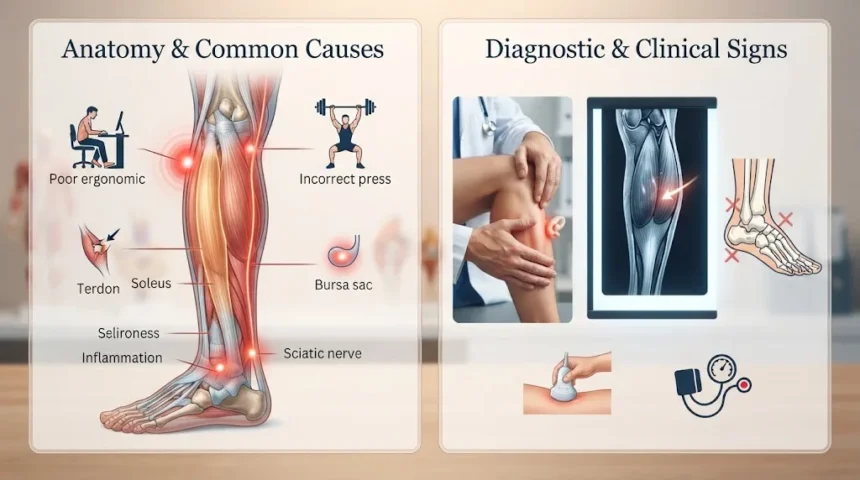
Tight calves can feel stiff, shortened, achy, or difficult to relax, especially after walking, running, standing, or sitting for long periods. The sensation usually involves the gastrocnemius and soleus muscles, which work together to point the foot downward and help control the ankle. Many cases are related to everyday muscle fatigue or temporary stiffness rather than a serious medical problem.
Your calves work constantly during normal movement. They help push you forward when walking, absorb force as your foot lands, stabilize the ankle, and contribute to climbing stairs or rising onto your toes. When these muscles handle more activity than they are accustomed to, they can temporarily feel tight even when there is no significant injury.
However, persistent calf tightness can sometimes reflect limited ankle mobility, training overload, nerve irritation, circulation problems, or another underlying issue. Paying attention to whether the tightness affects one or both legs, when it occurs, and whether pain, swelling, weakness, or numbness appears can help clarify what may be contributing.
Overuse and Exercise Are Common Causes of Tight Calves
Running, hiking, jumping, cycling, and repeated calf raises can leave the lower legs feeling tight after exercise. This is especially common when you suddenly increase training distance, speed, hills, or workout frequency. The calf muscles may simply be responding to a workload that exceeds what they are currently conditioned to handle comfortably.
New exercise programs can create similar symptoms even when the workout does not directly target the calves. Squats, lunges, sports drills, and long walks all require ankle stabilization and push-off from the lower leg. If your muscles are fatigued, stiffness may become more noticeable later in the day or the following morning.
The solution is not always aggressive stretching. Reducing training volume temporarily, allowing adequate recovery, and gradually rebuilding workload can be more useful when overuse is the main cause. If tightness becomes sharp pain, causes limping, or follows a sudden pulling sensation, consider the possibility of a calf strain rather than ordinary post-exercise stiffness.
Long Periods of Sitting Can Make Calves Feel Stiff
Sitting for several hours keeps the ankles and knees in relatively fixed positions. When you stand again, the calf muscles may feel stiff because they have not moved through much range for a long time. Office workers, drivers, students, and people working from home often notice this sensation after getting up from a chair.
Limited movement can also reduce how often the ankle travels through full dorsiflexion, the motion where the shin moves toward the foot. Over time, people may feel less comfortable squatting, walking uphill, or keeping their heels down during certain exercises. Regular movement breaks can help restore variety without requiring an intense stretching routine.
Try standing every 30 to 60 minutes, walking briefly, or moving your ankles through comfortable circles and flexion. These small movement breaks are often easier to maintain than waiting until the end of the day for one long mobility session. Consistency is usually more valuable than forcing the calves into an uncomfortable stretch once they already feel stiff.
Limited Ankle Mobility May Contribute to Calf Tightness
Restricted ankle dorsiflexion can make the calves feel constantly tight because the lower leg is repeatedly working near the edge of its comfortable range. You may notice this during deep squats, descending stairs, or walking uphill. Some people compensate by lifting their heels, turning their feet outward, or leaning excessively through other joints.
Calf stiffness is one possible contributor, but ankle mobility can also be limited by joint structure, previous injuries, swelling, or restrictions around the Achilles tendon. This is why stretching alone does not always improve the problem. A combination of controlled mobility, strength work, and gradual exposure to deeper ankle positions may be more effective.
A simple way to notice limited mobility is to compare both sides during a knee-to-wall movement. If one ankle moves significantly less or produces pain, that difference may be worth addressing. Persistent limitation after a previous sprain or injury may benefit from assessment by a physical therapist or other qualified clinician.
Weak or Fatigued Lower-Leg Muscles Can Feel Tight
Muscles sometimes feel tight because they are working hard rather than because they are actually shortened. If your calves lack strength or endurance for your daily activity, they may fatigue quickly and develop a tense, overworked sensation. This can happen during running, prolonged standing, or repeated walking on hills or stairs.
Strengthening can therefore be just as important as stretching. Calf raises with straight and bent knees can train both major calf muscles, while controlled single-leg exercises improve stability. Start with a manageable number of repetitions and progress gradually so your calves adapt instead of becoming even more fatigued from doing too much too soon.
A balanced leg program should also include the hamstrings, glutes, and quadriceps. Exercises such as hamstring curls can complement calf training by strengthening the back of the leg through a different movement pattern. Stronger surrounding muscles can help distribute effort more effectively during walking, running, and lower-body exercise.
Dehydration and Muscle Cramping Can Affect the Calves
Calf tightness sometimes appears alongside muscle cramps, especially during or after prolonged exercise. Dehydration may contribute when significant fluid loss occurs through sweating, particularly during hot-weather activity. However, muscle cramps are complex and cannot always be explained simply by drinking too little water or lacking one specific electrolyte.
Fatigue, unfamiliar exercise intensity, prolonged muscle use, and individual susceptibility can all influence cramping. Athletes may notice their calves tighten late in a long run or game when the muscles are exhausted. Replacing fluids appropriately and gradually improving conditioning can be useful, but repeatedly cramping despite good hydration may deserve closer evaluation.
Do not automatically take large amounts of electrolyte supplements because your calves feel tight. Excessive supplementation can create its own problems, especially if you have kidney, heart, or blood-pressure conditions. Focus on normal hydration and a balanced diet unless a healthcare professional has identified a specific nutritional or electrolyte issue.
Footwear and Walking Mechanics Can Increase Calf Demand
Shoes can change how your feet, ankles, and calves handle each step. Moving suddenly from highly cushioned or higher-heeled shoes to very flat footwear may increase calf and Achilles loading because the ankle works through a different range. Minimalist shoes can create a similar transition problem when introduced too quickly.
Worn-out footwear can also affect comfort if cushioning, support, or traction has deteriorated. However, there is no single shoe style that prevents calf tightness for everyone. Foot shape, activity, training surface, walking mechanics, and personal comfort all matter, so choose footwear that suits your normal movement rather than following one universal rule.
If you change running shoes or begin using barefoot-style footwear, make the transition gradually. Short exposures allow the calves and Achilles tendon time to adapt to the altered load. Sudden changes combined with high training volume can leave the lower legs feeling unusually tight and may increase the risk of overuse symptoms.
Nerve Irritation Can Sometimes Feel Like Calf Tightness
Nerve-related symptoms can occasionally be described as tightness even when the calf muscle itself is not the main problem. Irritation from the lower back or along the sciatic nerve may create pulling, burning, tingling, or an unusual tense sensation extending into the lower leg. Symptoms may change with spinal position rather than stretching alone.
Nerve involvement becomes more likely when calf tightness appears with numbness, pins and needles, weakness, or pain traveling from the back or buttock. Stretching aggressively into these sensations may make symptoms worse because the nerve can become more irritated. Gentle movement and professional assessment are more appropriate when neurological symptoms persist.
A clinician may examine your back, hip, strength, sensation, and reflexes to determine whether a nerve is involved. Most mild nerve irritation does not require emergency treatment, but progressive weakness, severe numbness, or changes in bladder or bowel control require prompt medical attention because they can indicate more serious nerve compression.
Could Tight Calves Be Related to Circulation?
Circulation problems can sometimes cause calf discomfort, heaviness, cramping, or tightness, particularly during walking. Peripheral artery disease may cause symptoms that predictably appear after a certain amount of activity and improve with rest. Risk increases with factors such as smoking, diabetes, high blood pressure, and cardiovascular disease.
Another important condition is a deep vein thrombosis, or DVT, which is a blood clot in a deep vein. DVT usually affects one leg and may cause swelling, warmth, pain, tenderness, or skin color changes. This is different from the familiar feeling of both calves being stiff after exercise or a long day.
Seek urgent medical evaluation if one calf suddenly becomes swollen, painful, warm, or noticeably larger than the other, particularly after surgery, prolonged travel, immobilization, or if you have clotting risk factors. Chest pain, sudden shortness of breath, or coughing blood requires emergency care because these symptoms can indicate a pulmonary embolism.
How to Stretch Tight Calves Safely
A simple wall stretch can target the gastrocnemius. Place one foot behind you, keep that knee straight, and press the heel gently toward the floor while leaning forward. You should feel a comfortable stretch in the upper calf without sharp pain, numbness, or a strong pulling sensation that makes you want to immediately leave the position.
To target the deeper soleus muscle, use the same setup but bend the back knee slightly while keeping the heel down. Hold each stretch for around 20 to 30 seconds and breathe normally. Repeat a few times if it feels comfortable, but avoid bouncing aggressively because greater intensity does not necessarily produce better flexibility.
Dynamic calf movements can also be useful before exercise. Ankle rocks, slow calf raises, and controlled heel-to-toe walking prepare the tissues without prolonged static holds. Save longer static stretching for after activity or separate mobility sessions if flexibility is your main goal, and stop if stretching consistently increases pain.
Strengthening Your Calves Can Reduce Recurrent Tightness
Straight-knee calf raises primarily challenge the gastrocnemius, while bent-knee calf raises place more emphasis on the soleus. Both muscles are important for walking, running, and ankle stability. Begin with two-leg variations if necessary, then progress toward single-leg raises once you can complete the movement with control and a comfortable range.
Use slow repetitions rather than bouncing quickly up and down. Rise onto the balls of your feet, pause briefly, and lower your heels under control. Progress by adding repetitions, holding weights, increasing range of motion, or moving to one leg when the current version no longer feels challenging.
Strength gains take time, so do not expect one workout to eliminate recurring tightness. Consistent training over several weeks can improve the calves’ ability to tolerate repeated loading. Combine strengthening with sensible training progression, recovery, and appropriate mobility rather than treating stretching as the only solution whenever your lower legs feel tense.
When Should You See a Doctor for Tight Calves?
Seek medical advice if calf tightness persists for several weeks, repeatedly limits normal activity, or becomes progressively worse. Professional evaluation is also useful if symptoms are strongly one-sided, occur without an obvious activity-related cause, or repeatedly return despite sensible changes to exercise, footwear, mobility, and recovery.
Pain associated with weakness, numbness, significant swelling, skin changes, or difficulty walking deserves more attention. These symptoms may indicate nerve involvement, injury, circulation problems, or another condition requiring specific treatment. A physical examination can help determine whether the problem mainly involves muscle, tendon, nerve, joint, or blood flow.
Urgent assessment is important for sudden one-sided calf swelling, warmth, redness, or unexplained significant pain because a blood clot needs to be ruled out. Seek emergency care if these symptoms occur with chest pain or shortness of breath. Do not attempt to massage a calf aggressively when a possible clot is a concern.
Conclusion
Calves can feel tight for many reasons, including exercise overload, long periods of sitting, limited ankle mobility, muscle fatigue, footwear changes, and cramping. In many cases, the problem is temporary and improves when activity, mobility, strengthening, and recovery are balanced more effectively. Tightness does not automatically mean your calf muscles simply need more stretching.
Pay attention to the pattern of your symptoms. Tightness after a difficult workout is different from one-sided swelling, numbness, weakness, or discomfort that appears predictably while walking. Understanding when symptoms happen and what makes them better or worse can help you choose the most appropriate next step rather than treating every calf sensation the same way.
Gentle mobility and progressive strengthening can help many people with recurring calf stiffness, but persistent or unusual symptoms deserve professional assessment. Seek prompt care for sudden swelling or significant neurological symptoms. The safest approach is to treat ordinary muscle tightness conservatively while remaining alert to signs that may point to a different underlying problem.
FAQs
Why are my calves always tight?
Persistent calf tightness can result from overuse, long periods of sitting, limited ankle mobility, muscle fatigue, or training changes. Recurrent symptoms may also warrant assessment for nerve, tendon, or circulation problems.
Should I stretch tight calves every day?
Gentle daily stretching can be appropriate if it feels comfortable, but stretching alone may not solve recurring tightness. Strengthening, movement breaks, training adjustments, and recovery are often equally important.
Can weak calves feel tight?
Yes. Weak or poorly conditioned calf muscles can fatigue quickly and feel tense during normal activity. Progressive calf strengthening may improve their ability to tolerate walking, running, and prolonged standing.
Why is only one calf tight?
One-sided tightness may come from an old injury, strength difference, nerve irritation, or overuse. Sudden one-sided swelling, warmth, redness, or significant pain needs prompt medical evaluation.
Can tight calves cause ankle problems?
Calf stiffness can limit ankle movement and make certain activities feel more difficult. However, ankle problems can also cause calf tightness, so persistent restriction should be assessed rather than automatically blamed on one muscle.