


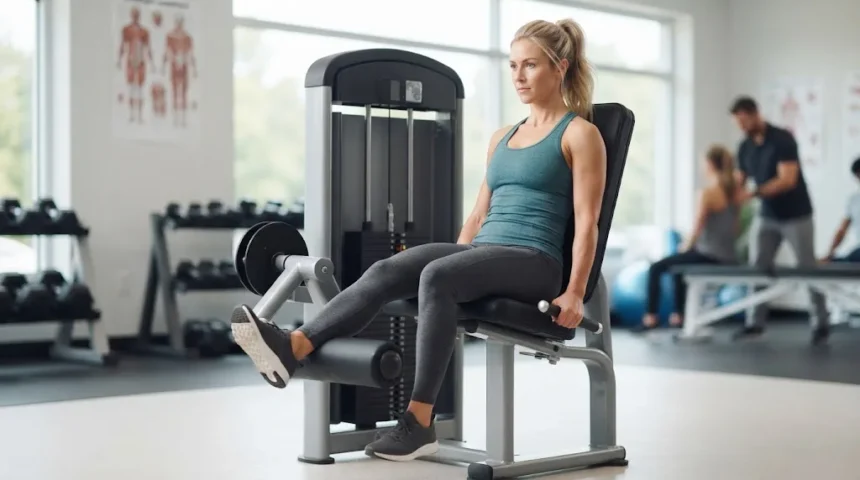
Hamstring curls are one of the most direct exercises for strengthening the muscles at the back of your thighs. They can be performed with gym machines, resistance bands, stability balls, or even body weight, making them suitable for many training environments. When performed correctly, hamstring curls can support stronger knees, better athletic performance, and more balanced lower-body development.
The hamstrings play an important role in bending the knee, extending the hip, controlling leg movement, and stabilizing the lower body. Weak or poorly conditioned hamstrings may make certain movements feel harder, especially running, jumping, climbing stairs, or lifting. Adding knee-flexion exercises such as hamstring curls can help target these muscles more directly than many compound exercises alone.
Good technique matters because simply moving the weight from one point to another does not guarantee effective hamstring training. Controlling the movement, selecting an appropriate resistance, and maintaining proper hip and knee alignment can improve muscle engagement. Understanding the different curl variations and common mistakes can help you get more value from each repetition.
What Are Hamstring Curls?
Hamstring curls are resistance exercises that primarily involve bending the knee against resistance. As the heel moves toward the buttocks, the muscles on the back of the thigh shorten and produce knee flexion. The exercise can be performed while lying, sitting, standing, or using equipment that changes how resistance is applied throughout the movement.
The hamstring group contains three main muscles: the biceps femoris, semitendinosus, and semimembranosus. These muscles work together to bend the knee while also contributing to hip extension and lower-body control. Hamstring curls emphasize their knee-flexion function, making the movement different from hip-dominant exercises such as Romanian deadlifts and good mornings.
Most gyms provide either lying or seated leg curl machines, although resistance bands and sliders can work well at home. Each variation places the muscles under slightly different conditions. Rather than searching for one universally superior option, choose a version that feels comfortable, allows controlled movement, and fits your training goals and available equipment.
Benefits of Hamstring Curls
One major benefit of hamstring curls is direct hamstring strengthening. Compound movements frequently involve several muscle groups at once, while curls allow you to focus specifically on knee flexion. This can make them useful for bodybuilders, recreational lifters, athletes, and anyone trying to develop stronger muscles along the back of the thighs.
Hamstring curls can also contribute to balanced lower-body training. Many programs contain squats, lunges, and leg presses that strongly involve the quadriceps, while direct hamstring work receives less attention. Including curls alongside hip-extension exercises can help train the posterior thigh through multiple functions rather than relying on a single type of movement.
Stronger hamstrings may also support activities requiring knee control, acceleration, deceleration, and repeated leg movement. Running, sprinting, jumping, and changing direction all place substantial demands on the posterior thigh. Strength training cannot prevent every injury, but developing greater muscular capacity may help the body tolerate progressively higher physical demands more effectively.
Muscles Worked During Hamstring Curls
The primary muscles working during a hamstring curl are the biceps femoris, semitendinosus, and semimembranosus. They contract to flex the knee and pull the lower leg backward. Although all three contribute to the movement, the amount of involvement can vary somewhat depending on foot position, joint angle, exercise variation, individual anatomy, and how the resistance is applied.
The gastrocnemius, one of the major calf muscles, can also assist because it crosses the knee joint. However, the hamstrings remain the primary target when the exercise is performed correctly. Other muscles around the hips, trunk, and pelvis work mainly to stabilize your position so the knee can bend without excessive movement elsewhere.
Hamstring curls do not fully train every function of the hamstrings because the muscles also help extend the hip. For complete posterior-chain development, combine curls with exercises such as Romanian deadlifts, hip hinges, bridges, or appropriately programmed deadlift variations. Training both knee flexion and hip extension can provide a more complete strength stimulus.
How to Perform a Lying Hamstring Curl
Lie face down on the machine with your knees positioned close to the machine’s pivot point. Place the lower pad just above the back of your ankles and keep your hips comfortably against the bench. Choose a manageable weight that allows you to perform the full movement without jerking, twisting, or lifting your hips aggressively.
Begin with your legs nearly straight without forcefully locking the knees. Bend your knees and bring your heels toward your buttocks while keeping the movement smooth and controlled. Pause briefly near the top when your hamstrings are fully shortened, then slowly lower the weight instead of allowing the machine to pull your legs downward.
Avoid excessively arching your lower back as the weight gets heavier. If your hips repeatedly rise from the pad, the resistance may be too challenging or your setup may need adjustment. Using a slightly lighter weight often makes it easier to keep tension on the hamstrings rather than creating momentum through the hips and spine.
How to Perform a Seated Hamstring Curl
Sit firmly against the back pad of the machine with your knees aligned near its rotational axis. Position the upper pad over your thighs and the lower pad above your ankles. Adjust the seat so your legs can begin in a comfortably extended position without forcing your knees or hips into an uncomfortable range.
Pull your heels downward and backward by bending your knees until you reach a strong but comfortable contraction. Keep your hips and back against the machine rather than leaning or shifting to move more resistance. Pause briefly at the shortened position, then return slowly until the legs are extended again without letting the weight stack slam.
The seated variation places the hips in flexion, which lengthens certain portions of the hamstrings before knee flexion begins. Many people find this setup comfortable and easy to control. However, both seated and lying curls can be effective, so the better option is generally the one that fits your body, equipment, and training plan.
Standing Hamstring Curls for Home or Gym Workouts
Standing hamstring curls can be performed using a cable, resistance band, ankle weight, or dedicated machine. Stand upright while holding a stable support if necessary, then bend one knee and bring the heel toward the buttocks. Keep your thighs relatively aligned so the working knee does not swing dramatically forward during each repetition.
This unilateral variation trains one leg at a time, which can help you notice differences in coordination or strength between sides. It is also convenient for home workouts because a resistance band can provide enough tension for controlled repetitions. Increasing band resistance, adding ankle weight, or slowing the tempo can make the exercise progressively more challenging.
Avoid leaning forward or rotating your pelvis simply to lift your heel higher. The goal is controlled knee flexion, not achieving the greatest possible range by moving the entire body. Keep your trunk steady, breathe naturally, and stop the movement when you can no longer bend the knee without losing your position.
Stability Ball and Slider Hamstring Curls
A stability ball hamstring curl combines knee flexion with hip and trunk control. Lie on your back with your heels on a stability ball, lift your hips, and pull the ball toward you by bending your knees. Your hamstrings work while the glutes and core help maintain a stable bridge position throughout the movement.
Slider curls use a similar pattern but require sliding your heels across the floor. Begin on your back with your feet on sliders or towels placed on a smooth surface, raise your hips, and gradually pull the heels inward. Slowly extend the legs again while resisting the urge to let your hips drop excessively toward the floor.
These variations can be challenging even without external weights because the hamstrings must control your body weight. Start with a limited range if necessary and gradually increase difficulty as control improves. Single-leg versions are substantially harder and should generally be introduced only after you can perform the standard movement with consistently good technique.
Common Hamstring Curl Mistakes to Avoid
Using too much weight is one of the most common mistakes. Heavy resistance often encourages lifters to swing the legs, arch the back, or lift the hips to complete repetitions. Reducing the load and controlling both the lifting and lowering phases usually creates a better training stimulus because the hamstrings remain responsible for more of the movement.
Another mistake is rushing through the lowering phase. Allowing the resistance to drop quickly reduces control and eliminates part of the muscular work available during each repetition. Lower the weight gradually until the knees return to the starting position, while maintaining enough control that the plates do not crash together between repetitions.
Poor machine setup can also make the exercise uncomfortable or less effective. The knee should generally align reasonably well with the machine’s pivot while the roller sits securely above the ankle rather than directly on the heel. Take a moment to adjust the seat, pads, and range before beginning instead of adapting your body to a poorly positioned machine.
How Many Hamstring Curls Should You Do?
The appropriate number of repetitions depends on your training goal, experience, and the amount of resistance used. For general muscle and strength development, many people can benefit from moderate repetition ranges performed with controlled technique. The final repetitions should feel challenging while still allowing you to maintain proper positioning and a smooth range of motion.
Beginners might start with two or three working sets and focus primarily on learning the movement. More experienced lifters may use additional sets, heavier resistance, different repetition ranges, or multiple variations depending on their overall lower-body program. Hamstring curls do not need to be taken to complete muscular failure during every workout to produce a useful training stimulus.
Progress can come from gradually increasing weight, repetitions, control, or range of motion. Avoid changing every variable at once because excessive increases can make recovery difficult. Keeping a simple training record can help you identify when the current resistance has become manageable enough to justify a small and sensible progression.
Hamstring Curls vs. Romanian Deadlifts
Hamstring curls and Romanian deadlifts both strengthen the hamstrings, but they emphasize different muscle actions. A curl primarily trains knee flexion, whereas a Romanian deadlift strongly challenges the hamstrings through hip extension and a hip-hinge movement. Because the hamstrings cross both joints, using both patterns can provide broader muscular development.
Romanian deadlifts also involve the glutes, spinal erectors, grip, and other muscles needed to control the weight. Hamstring curls provide a more isolated movement and generally require less total-body coordination. This makes curls useful when you want additional hamstring training without adding as much overall fatigue as a heavy compound hip-hinge exercise.
You do not necessarily need to choose one over the other. A balanced workout might include Romanian deadlifts earlier in the session and hamstring curls afterward as a more focused accessory exercise. The exact order and volume should depend on your primary goals, recovery ability, training experience, and the other exercises included in your program.
How Hamstring Curls Support Knee Stability
The hamstrings cross the back of the knee and contribute to controlling knee movement during everyday activity and exercise. By producing knee flexion and helping manage forces around the joint, they work alongside the quadriceps and other muscles. Developing strength in both the front and back of the thigh supports more balanced muscular control around the knee.
Strong hamstrings can be especially useful during movements that involve slowing the body down. When running, landing, or changing direction, the posterior thigh helps control rapid leg motion and contributes to coordinated deceleration. Proper conditioning therefore matters for athletes whose sports require frequent acceleration, sprinting, cutting, or explosive changes in speed.
Strength is only one part of healthy movement. Mobility, technique, training volume, recovery, and overall conditioning also influence how your joints respond to physical demands. A well-rounded mobility routine can address several areas of the body and may include upper-body movements such as a bicep stretch alongside lower-body flexibility work.
Best Practices for Hamstring Curl Training
Start each session with a general warm-up and gradually prepare your legs for heavier work. Light cycling, walking, dynamic leg movement, or easy warm-up sets can increase temperature and help you practice the exercise pattern. You do not need an exhausting warm-up; the goal is simply to become prepared for the resistance and movements that follow.
Keep your repetitions controlled and use a range of motion that feels comfortable for your knees and hamstrings. Avoid forcing the heel toward the buttocks when the movement becomes painful or mechanically restricted. Progressively improving control through a suitable range is generally more productive than chasing extreme motion simply to make each repetition appear deeper.
Allow enough recovery between challenging hamstring sessions. These muscles may already receive substantial work from deadlifts, lunges, running, sprinting, and other lower-body exercises, even when curls are not performed. Consider your total weekly workload instead of judging recovery based only on the number of sets completed on the leg curl machine.
When to Avoid or Modify Hamstring Curls
Temporary muscle fatigue or mild post-workout soreness does not necessarily mean hamstring curls must be avoided completely. However, sharp pain during knee bending is different from normal muscular effort. Reduce the resistance or stop the exercise if you experience sudden pain, significant weakness, unusual swelling, or symptoms that worsen with each repetition.
Anyone recovering from a hamstring strain, knee injury, surgery, or significant tendon problem may need a modified exercise program. The appropriate range, resistance, and progression depend on the specific injury and stage of recovery. A physiotherapist or other qualified healthcare professional can provide individualized guidance when standard gym programming is not appropriate.
Pain around the back of the thigh does not always originate from the hamstring muscles themselves. Nerve irritation, referred pain, tendon problems, and other conditions can create similar symptoms. Persistent discomfort, significant bruising, difficulty walking, or repeated pain during normal activities should be evaluated rather than repeatedly tested with heavier resistance exercises.
Conclusion
Hamstring curls are a practical exercise for strengthening the muscles along the back of the thigh through knee flexion. Lying, seated, standing, stability-ball, and slider variations can all be useful when performed with proper control. Choosing the right version depends on your equipment, training experience, mobility, and individual comfort.
Good form involves maintaining stable hips, controlling both phases of the movement, and selecting resistance that does not require excessive momentum. Hamstring curls can work especially well alongside hip-hinge exercises because the two movements challenge different functions of the same muscle group. Gradual progression helps build strength without unnecessarily increasing training stress.
For the best results, treat hamstring curls as one part of a balanced lower-body program rather than a complete solution on their own. Include appropriate strength work, mobility, recovery, and progressive training. If the exercise causes persistent or sharp pain, reduce the load and consider professional assessment before continuing intensive hamstring training.
FAQs
Are hamstring curls good for building muscle?
Yes. Hamstring curls directly load the muscles at the back of the thigh through knee flexion, making them useful for hypertrophy when combined with progressive resistance, adequate training volume, and recovery.
Are seated or lying hamstring curls better?
Both can strengthen the hamstrings effectively. Seated curls train the muscles from a more lengthened hip position, while lying curls provide a different setup that some people find more comfortable.
How many sets of hamstring curls should I do?
Two to four controlled working sets can be suitable for many training programs. The ideal amount depends on your experience, weekly hamstring volume, exercise intensity, and recovery capacity.
Can I do hamstring curls at home?
Yes. Resistance bands, sliders, stability balls, or ankle weights can all be used for home hamstring curls. Choose a variation that allows smooth knee flexion without pain or excessive body movement.
Should hamstring curls hurt behind the knee?
You may feel muscular effort around the lower hamstring, but sharp or persistent pain behind the knee is not something to push through. Reduce the resistance and seek assessment if discomfort continues.