


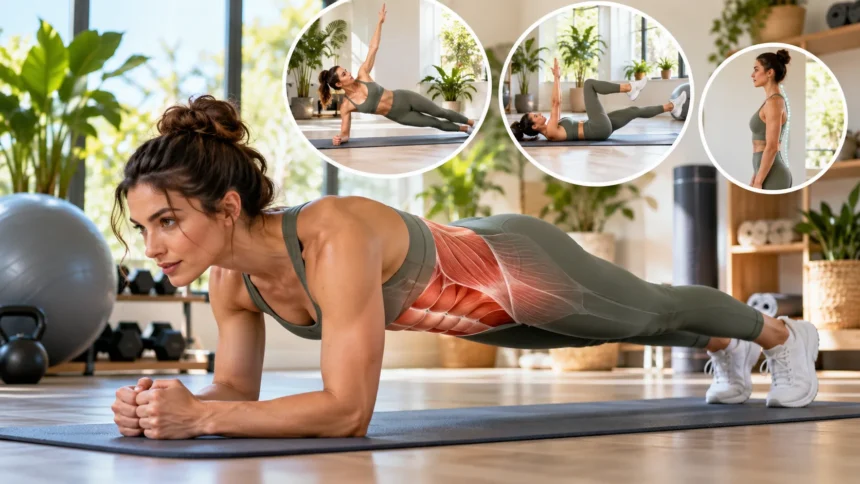
What Does It Mean to Strengthen Your Core?
Strengthening your core means improving the ability of the muscles around your abdomen, lower back, hips, and pelvis to support and control movement. Your core does more than create visible abdominal definition. It helps stabilize your trunk while you walk, lift, bend, rotate, exercise, and perform many everyday activities.
The core includes muscles such as the rectus abdominis, obliques, transverse abdominis, diaphragm, pelvic floor, and several muscles surrounding the spine and hips. These muscles work together rather than acting independently. A strong core therefore depends on coordination, endurance, and control as much as maximum strength.
Effective core training should prepare your body to resist unwanted movement while also allowing controlled bending and rotation when needed. This is why a complete routine includes more than crunches. Exercises that challenge stability, breathing, balance, and different movement directions can create a stronger and more functional core.
Why Core Strength Matters for Everyday Movement
Your core acts as a connection between the upper and lower body during movement. When you carry groceries, climb stairs, stand from a chair, or lift an object from the floor, trunk muscles help transfer force efficiently. Better core strength can make these tasks feel more stable and reduce unnecessary movement through the torso.
Core muscles also contribute to balance and posture. They help control the position of the pelvis and spine while your arms and legs move independently. This becomes particularly important during single-leg movements, running, reaching, or carrying objects because the body must stay organized while forces change around it.
A strong core does not mean keeping your abdominal muscles tightly braced all day. Your trunk needs to move, breathe, and relax normally between demanding tasks. Core training should help you create tension when required and release it afterward instead of encouraging constant stiffness throughout everyday life.
Learn Proper Core Bracing First
Core bracing means creating controlled tension around your midsection without holding your breath or pulling your stomach inward aggressively. Imagine preparing your trunk for a gentle push while continuing to breathe normally. This produces a stable base for exercises such as squats, deadlifts, planks, and loaded carries.
Practice bracing while lying on your back with your knees bent. Place your hands lightly around your abdomen, breathe normally, and gently tighten the muscles around your trunk. You should feel tension develop around the front and sides without your shoulders lifting or your lower back being forced hard into the floor.
Once you understand the sensation, practice creating the same tension while sitting, standing, and performing simple movements. The goal is not maximum contraction during every exercise. Use enough tension to control your position while still allowing smooth breathing and natural movement through the rest of your body.
Start With the Dead Bug Exercise
The dead bug is a beginner-friendly core exercise that teaches you to keep your trunk stable while moving your arms and legs. Lie on your back with your hips and knees bent, then raise your arms toward the ceiling. Create gentle abdominal tension before slowly extending one leg and the opposite arm.
Move only as far as you can without allowing your lower back to arch excessively. Return to the starting position and repeat on the opposite side. The movement should remain slow because rushing makes it easier to use momentum instead of maintaining controlled tension through the abdominal muscles.
Beginners can shorten the movement by extending only one leg or one arm at a time. As control improves, gradually increase the range and number of repetitions. The dead bug is effective because it builds core stability while teaching coordination between the trunk and moving limbs.
Build Stability With Bird Dog Exercises
Bird dogs strengthen the core while challenging balance and coordination. Begin on your hands and knees with your hands under your shoulders and knees under your hips. Gently brace your trunk, then extend one leg behind you and the opposite arm forward while keeping your pelvis relatively level.
Avoid lifting the arm or leg so high that your lower back begins to arch or your torso rotates. Think about reaching outward rather than upward. Hold the position briefly, return with control, and repeat on the opposite side while keeping your breathing relaxed throughout the movement.
As the exercise becomes easier, increase the hold time or perform slower repetitions. You can also pause with the arm and leg extended before returning. Bird dogs are particularly useful because they train the core to resist rotation while the hips and shoulders move independently.
Use Planks to Improve Core Endurance
Planks train the abdominal muscles, shoulders, hips, and trunk to maintain a stable position against gravity. Begin with your forearms on the floor and your knees down if needed. Keep your body controlled from the shoulders through the hips while maintaining enough abdominal tension to prevent excessive sagging or arching.
A plank does not need to last several minutes to be effective. Shorter holds performed with good technique can provide a stronger training stimulus than extremely long holds where your position gradually deteriorates. End the set when you can no longer maintain comfortable breathing and trunk control.
Progress by increasing the hold slightly, using a full plank from the toes, or introducing side planks. Side planks challenge the obliques and lateral trunk muscles in a different direction. Including multiple plank variations can improve core endurance without relying on repeated spinal flexion exercises.
Strengthen the Hips With Glute Bridges
Glute bridges primarily train the glutes, but they also require the core to help stabilize the pelvis and lower back. Lie on your back with your knees bent and feet planted on the floor. Brace gently, press through your feet, and lift your hips until your body forms a comfortable line from shoulders to knees.
Avoid pushing the hips so high that your lower back arches significantly. The movement should come mainly from hip extension rather than excessive spinal movement. Pause briefly near the top, then lower yourself slowly while maintaining control through the abdomen and hips.
Once bodyweight bridges become easy, you can increase difficulty with resistance bands, added weight, or single-leg variations. Strong hips and a stable trunk often work together during functional movements. Combining glute exercises with direct core work creates a more balanced approach than training the abdominal muscles alone.
Add Anti-Rotation Exercises for Better Control
Anti-rotation exercises teach your core to resist twisting when an outside force tries to rotate your body. This type of strength is useful during carrying, lifting, sports, and many everyday activities. Resistance-band or cable presses are common examples because they create sideways tension that your trunk must control.
For a simple band press, attach a resistance band to a stable point around chest height and stand sideways to the anchor. Hold the band near your chest, brace gently, and press your hands forward without allowing your torso to rotate toward the anchor. Return slowly and repeat with control.
Choose enough resistance to challenge you without making your body twist or lean dramatically. Anti-rotation training complements planks and dead bugs by challenging stability from another direction. A complete core program should prepare the trunk to resist extension, side bending, and rotation rather than focusing on only one movement pattern.
Include Mobility Alongside Core Strength
Core strength works best when your hips, spine, and shoulders can move comfortably through the ranges required by your activities. Excessive stiffness can make certain exercises harder to perform with good control. Gentle mobility work can therefore complement strengthening by allowing different parts of the body to move more freely.
Exercises that encourage controlled upper-back rotation can be particularly useful for people who sit for long periods. A movement such as Thread the Needle can be included as part of a mobility routine when it feels comfortable. It allows the upper back and shoulders to move while the hips remain relatively stable.
Mobility should not replace strength training, and more flexibility is not always better. The goal is to have enough range to perform your desired movements while maintaining control. Combining mobility exercises with resistance training can help develop both usable movement and stability across the trunk, hips, and shoulders.
Progress Your Core Training Gradually
Your core becomes stronger when exercises gradually become more challenging. Progress can come from increasing hold time, adding repetitions, using resistance, extending the arms or legs farther, or moving to more demanding variations. You do not need to change every variable simultaneously to continue making progress.
Start with exercises you can perform accurately and repeat consistently. Once a movement becomes easy, increase one aspect of difficulty while keeping your technique controlled. For example, you might progress from a knee plank to a full plank before adding longer holds or more advanced variations.
Core training does not need to leave you extremely sore after every session. Consistent moderate challenges usually create better long-term progress than occasional maximum-effort workouts. Allow enough recovery between demanding sessions and remember that many compound exercises already train the core indirectly.
Common Core Training Mistakes to Avoid
One common mistake is focusing entirely on crunches and sit-ups. These exercises can train the abdominal muscles, but they represent only one type of movement. A balanced program should also include exercises that resist extension, rotation, and side bending while training coordination between the trunk and limbs.
Another mistake is holding your breath during every difficult exercise. Breath-holding can make you feel temporarily stronger, but beginners should learn to maintain controlled breathing during most core work. This helps you develop tension without turning every repetition into an all-out effort that is difficult to sustain.
People also sometimes progress too quickly and choose advanced movements before mastering simpler versions. If your back arches, hips rotate, or technique breaks down immediately, the exercise may currently be too difficult. Scaling back allows you to build the strength needed to eventually perform harder variations more effectively.
How Often Should You Train Your Core?
Most people do not need a long core workout every day. A few focused sessions each week can be enough when exercises are performed with good technique and appropriate difficulty. Core muscles also work during squats, deadlifts, carries, push-ups, and many other compound movements, so total training volume should be considered.
You can include two or three core exercises at the end of a strength session or create a short dedicated routine on separate days. For example, combine dead bugs, side planks, and bird dogs for one session, then use bridges, anti-rotation presses, and regular planks another day.
Recovery needs depend on exercise intensity and your overall program. Light mobility and breathing exercises can usually be performed more frequently, while harder loaded movements may require additional recovery. Increase volume gradually and reduce it if soreness begins interfering with normal movement or other workouts.
Conclusion
Strengthening your core involves more than trying to develop visible abdominal muscles. A strong core helps control the trunk, transfer force between the upper and lower body, and support everyday activities such as walking, lifting, reaching, and exercising. Coordination and endurance are just as important as raw strength.
Begin with controlled movements such as dead bugs, bird dogs, planks, bridges, and anti-rotation exercises. Learn proper bracing, continue breathing normally, and choose variations that allow you to maintain good technique. Progress gradually by increasing resistance, range, or exercise difficulty once the basic movement becomes comfortable.
The best core program combines stability, strength, mobility, and consistent practice. You do not need complicated equipment or extremely long workouts to improve. A few well-chosen exercises performed regularly can build a stronger, more capable trunk that supports both daily movement and broader fitness goals.
FAQs
What is the fastest way to strengthen your core?
There is no instant method, but consistent exercises such as planks, dead bugs, bird dogs, and resistance work can build core strength gradually. Progressive difficulty and good technique matter more than performing large numbers of repetitions.
How many times a week should I train my core?
Many people can train their core two to four times per week depending on exercise intensity and overall training. Remember that compound exercises such as squats and deadlifts also challenge the core.
Are planks enough to strengthen the core?
Planks are useful, but they mainly challenge certain forms of stability. Combining them with anti-rotation exercises, side planks, dead bugs, bridges, and other movements creates a more complete core-strengthening routine.
Can walking strengthen your core?
Walking requires the core to stabilize your trunk, but it usually provides a relatively low-strength challenge. Walking supports general movement, while targeted resistance exercises are more effective when your specific goal is stronger core muscles.
Should core exercises cause back pain?
Core exercises should not cause sharp or persistent back pain. If a movement repeatedly hurts, reduce the difficulty or stop and seek professional guidance when symptoms continue, worsen, or include numbness or weakness.