


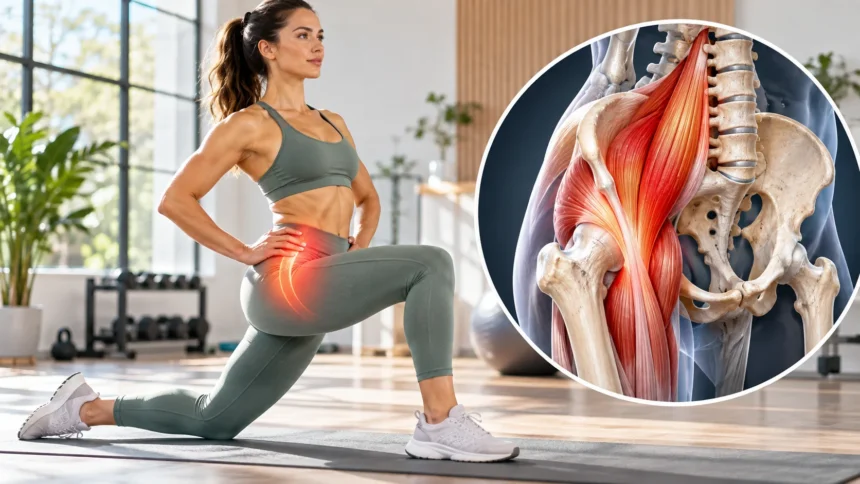
What Are the Hip Flexors?
The hip flexors are a group of muscles located around the front of the hip that help bring your thigh toward your torso. They are active during everyday movements such as walking, climbing stairs, sitting down, running, and getting into a car. Rather than being one single muscle, the term describes several muscles that work together to create and control hip flexion.
The most commonly discussed hip flexors include the iliopsoas, rectus femoris, sartorius, tensor fasciae latae, and several smaller muscles that assist with movement. Each has a slightly different role, but together they help move the hip efficiently. Some also contribute to knee movement, pelvic stability, or control of the trunk during activity.
Because the hip flexors connect the pelvis, spine, and legs, they influence more than simply lifting the knee. They contribute to posture, balance, walking mechanics, and athletic performance. Problems involving these muscles can therefore affect how comfortable you feel when standing, sitting, exercising, or performing repetitive lower-body movements.
Hip Flexor Anatomy Explained
The iliopsoas is often considered the primary hip flexor and consists of the iliacus and psoas major muscles. The psoas major begins along the lumbar spine, while the iliacus originates inside the pelvis. They come together and attach near the upper femur, allowing them to produce powerful hip flexion while also influencing pelvic and spinal positioning.
The rectus femoris is one of the four quadriceps muscles and crosses both the hip and knee joints. Because of this position, it helps flex the hip while also extending the knee. This dual function means it works during activities such as kicking, sprinting, climbing stairs, and rising from a seated position.
Other contributing muscles include the sartorius and tensor fasciae latae, often abbreviated as TFL. The sartorius assists with hip flexion, rotation, and knee movement, while the TFL helps with hip flexion and stabilization. Together, these muscles create coordinated movement rather than functioning independently during most everyday and athletic activities.
What Is the Main Function of the Hip Flexors?
The primary function of the hip flexors is to decrease the angle between the thigh and torso. This happens whenever you lift your knee toward your chest or bend forward at the hip. Walking requires repeated hip flexion as each leg swings forward, making these muscles active during nearly every step you take.
Hip flexors also contribute to controlling movement instead of simply creating it. During running or walking, they help position the leg for the next step and coordinate with the glutes, hamstrings, and core. Good movement depends on these muscle groups sharing the workload rather than one area becoming excessively dominant or fatigued.
Some hip flexors also contribute to pelvic and trunk stability, particularly during standing and single-leg activities. Their relationship with the spine and pelvis means they can influence how force moves through the lower body. Strong and well-controlled hip flexors can support efficient movement when combined with balanced strength elsewhere.
How Hip Flexors Work During Walking and Running
Walking requires the hip flexors to bring the swinging leg forward after it leaves the ground. As your foot prepares for the next step, these muscles help advance the thigh while other muscles control the knee and ankle. This repeated cycle happens automatically, but weakness, fatigue, or pain around the hip can make it feel noticeably more difficult.
Running places greater demands on the hip flexors because the legs move faster and through larger ranges. Sprinting requires particularly powerful hip flexion as the knee drives forward between strides. Athletes may therefore experience hip flexor fatigue when training volume or intensity increases more quickly than their muscles are prepared to handle.
Efficient running also depends on the glutes, hamstrings, calves, and trunk working together. Strong hip flexors alone cannot compensate for weakness or poor control elsewhere. Balanced lower-body training helps distribute force more effectively and may reduce excessive stress on any single muscle group during repetitive activities.
Hip Flexors During Squats and Lower-Body Exercise
The hip flexors contribute to several lower-body movements even when they are not the primary muscles producing force. During squatting, the hips move into flexion as you descend, while the glutes, quadriceps, and other muscles control the movement. Good mobility and control around the hip can help you reach a comfortable depth without unnecessary compensation.
Squats also involve the ankles, knees, pelvis, and trunk, which is why technique should be evaluated as a whole. Understanding the benefits of squats can help you see how hip strength and mobility fit into broader lower-body training. Hip flexors participate in the movement but should not be expected to do all the work.
Other exercises that involve hip flexion include step-ups, mountain climbers, leg raises, lunges, and certain core movements. The amount of hip flexor involvement varies depending on body position and technique. A balanced program should combine hip flexor strength with glute, hamstring, quadriceps, and core training.
What Causes Tight Hip Flexors?
Hip flexors can feel tight after long periods of sitting because the hips remain flexed for extended periods. Office work, driving, studying, and frequent screen use may contribute to this sensation. However, feeling tight does not always mean the muscles have physically shortened, because fatigue, weakness, and sensitivity can produce similar sensations.
Repetitive exercise can also make the front of the hips feel tight. Running, cycling, kicking, and high-volume core exercises may repeatedly load the hip flexors, leaving them tired or sore afterward. Sudden increases in training intensity can make this more noticeable, particularly when recovery time is limited.
Posture is often blamed for hip flexor tightness, but body position is only one part of the picture. Sleep, training load, stress, mobility, strength, and previous injury can all influence how the hips feel. If tightness repeatedly returns, strengthening and changing activity patterns may be more useful than stretching alone.
Common Signs of Hip Flexor Problems
Hip flexor discomfort is often felt at the front of the hip or near the crease where the thigh meets the pelvis. Some people notice aching or tightness when lifting the knee, climbing stairs, running, or standing after sitting for a long time. Pain may also appear after exercise that heavily involves repeated hip flexion.
A strain may cause sharper pain, tenderness, weakness, or discomfort when stretching the front of the hip. More significant strains can make walking or lifting the leg difficult. Because several muscles, tendons, joints, and nerves occupy this region, front-of-hip pain should not automatically be assumed to come from a hip flexor.
Persistent clicking, deep groin pain, swelling, numbness, or symptoms that worsen steadily deserve professional evaluation. Hip joint conditions and other problems can sometimes feel similar to muscle discomfort. A healthcare or rehabilitation professional can assess movement, strength, tenderness, and symptom patterns to identify the likely source.
How to Stretch the Hip Flexors Safely
A half-kneeling hip flexor stretch is a common option. Place one knee on the floor and the opposite foot in front, then gently shift your pelvis forward while keeping your torso upright. You should feel a mild stretch across the front of the hip on the kneeling side rather than sharp pain in the groin or lower back.
Avoid excessively arching your lower back to create the appearance of a deeper stretch. Keeping the pelvis controlled usually makes the movement more specific to the front of the hip. Hold the position comfortably while breathing normally, then release gradually instead of bouncing repeatedly at the end of your range.
Stretching should feel gentle and should not create numbness, pinching, or increasing pain. If a particular position consistently feels uncomfortable, stop and choose another movement. People recovering from surgery, significant injury, or persistent hip problems may need individualized guidance before adding deeper mobility exercises.
How to Strengthen the Hip Flexors
Hip flexors can be strengthened using controlled knee-lifting exercises. Standing marches, resisted marches, seated knee raises, and banded hip flexion can all provide a manageable starting point. Focus on lifting the thigh without leaning backward or using momentum, because compensating through the trunk can reduce the amount of work performed by the target muscles.
As strength improves, more challenging exercises can be introduced. Hanging knee raises, loaded marches, step-ups, and certain running drills place greater demands on hip flexion. Progress gradually because the muscles and tendons around the front of the hip may become irritated when training volume increases too quickly.
Strengthening should remain balanced with work for the glutes, hamstrings, quadriceps, and trunk. The goal is not to make the hip flexors dominant, but to help them perform their role efficiently. A well-rounded lower-body program usually produces better movement than focusing excessively on one muscle group.
Can Weak Hip Flexors Affect Movement?
Weak hip flexors may make certain activities feel harder, particularly movements that require repeatedly lifting the leg. Climbing stairs, hiking uphill, sprinting, and getting into high vehicles may require more effort when hip flexion strength is limited. Other muscles may compensate, which can change movement patterns or increase fatigue.
Weakness can develop after inactivity, injury, surgery, or long periods without challenging the muscles through useful ranges. However, weakness should not be diagnosed simply because the hips feel tight. A muscle can feel tight and still be weak, which is one reason stretching alone does not solve every hip-related complaint.
Strength testing and movement assessment can provide more useful information when symptoms persist. If one side feels noticeably weaker or you struggle with normal daily activities, professional evaluation may be appropriate. Gradual strengthening is usually more effective when the underlying problem is identified instead of assuming every sensation comes from limited flexibility.
When Should Hip Flexor Pain Be Checked?
Mild soreness after unfamiliar exercise may improve with rest, gentle movement, and reduced training intensity. However, pain that is sharp, persistent, or becoming progressively worse deserves more attention. A sudden injury accompanied by swelling, bruising, or difficulty bearing weight may indicate a strain or another problem that needs assessment.
Seek professional advice if pain repeatedly returns whenever you run, lift your knee, squat, or climb stairs. Ongoing symptoms may involve a tendon, joint, muscle, or another nearby structure. A clear diagnosis can help determine whether the most appropriate approach involves strengthening, mobility work, temporary activity modification, or another form of treatment.
More urgent evaluation may be necessary following a major fall or injury, especially if you cannot move the hip normally or put weight through the leg. Significant numbness, severe weakness, fever, or unexplained swelling should also be assessed. Persistent hip pain should not be managed indefinitely with stretching alone.
Conclusion
The hip flexors are a group of muscles that help move the thigh toward the torso while contributing to walking, running, posture, and lower-body control. Important members include the iliopsoas, rectus femoris, sartorius, and tensor fasciae latae. Their combined function connects movement at the hips with the pelvis, legs, and trunk.
Healthy hip function depends on more than flexibility. Strength, mobility, coordination, training load, and the condition of surrounding muscles all influence how the hip flexors perform. Stretching may help some people feel more comfortable, but strengthening and balanced lower-body exercise are equally important for long-term function.
If hip flexor pain is persistent, severe, or associated with weakness, swelling, or difficulty walking, consider professional evaluation. Several conditions can produce similar symptoms around the front of the hip. Understanding the actual cause allows you to choose exercises and treatment strategies that are appropriate rather than relying on guesswork.
FAQs
What are the main hip flexor muscles?
The main hip flexors include the iliopsoas, rectus femoris, sartorius, and tensor fasciae latae. Several additional muscles can assist with hip flexion depending on body position and movement.
What is the main job of the hip flexors?
Their primary role is lifting the thigh toward the torso. They also contribute to walking, running, climbing stairs, pelvic control, and several athletic and everyday lower-body movements.
Why do my hip flexors feel tight after sitting?
Sitting keeps the hips flexed for long periods, which can create stiffness or a sensation of tightness. Weakness, fatigue, limited movement, and sensitivity may also contribute to the feeling.
How can I strengthen weak hip flexors?
Controlled marches, seated knee raises, banded hip flexion, step-ups, and progressive leg-raising exercises can strengthen hip flexors. Begin with manageable resistance and avoid using momentum to complete repetitions.
Should I stretch my hip flexors every day?
Gentle stretching can be performed regularly if it feels comfortable, but daily stretching is not always necessary. Strengthening, regular movement, and managing prolonged sitting may be equally important for healthy hip function.