


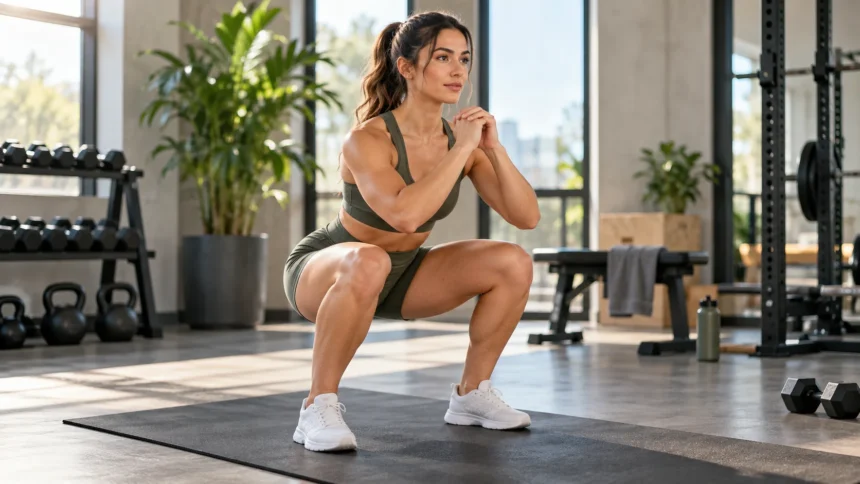
Squats are one of the most practical lower-body exercises because they strengthen muscles used in everyday movements such as sitting, standing, lifting, climbing stairs, and getting up from the floor. They can be performed with body weight alone or progressed with resistance as strength and confidence improve. This makes squats useful for beginners, experienced lifters, and many general fitness routines.
The benefits of squats go beyond building stronger legs. Good squat training can support balance, mobility, core control, lower-body coordination, and overall exercise performance. Getting those benefits depends on using suitable technique, choosing a comfortable range of motion, and progressing gradually instead of forcing your body into a position that causes pain.
What Are Squats?
A squat is a lower-body movement that involves bending your hips and knees while lowering your body toward the floor before returning to standing. The exercise resembles sitting down and standing up, which is why it transfers so naturally to everyday activities. Squats can be performed with body weight, dumbbells, barbells, kettlebells, resistance bands, or machines.
Although squats are often considered a leg exercise, they require coordination throughout the entire body. Your hips, knees, ankles, trunk, and upper body all contribute to keeping the movement controlled. The exact position may vary depending on your anatomy, stance width, mobility, equipment, and the specific squat variation you choose.
There is no single squat style that fits everyone perfectly. Some people naturally use a slightly wider stance, while others feel more comfortable with their feet closer together. The goal is to find a stable position that allows you to lower and rise with control while keeping your joints comfortable throughout the movement.
Benefits of Squats for Strength and Fitness
One of the main benefits of squats is stronger lower-body musculature. The exercise challenges the thighs, glutes, hips, and supporting muscles through a coordinated movement pattern. Regular squat training can improve your ability to produce force during lifting, running, jumping, climbing stairs, and many recreational or sporting activities.
Squats can also support functional strength for everyday life. Movements such as standing from a chair, picking something up, or lowering yourself toward the ground require similar hip and knee actions. Practicing controlled squats can help you become more comfortable and confident performing these ordinary movements as part of your daily routine.
Another advantage is flexibility in programming. Beginners can start with assisted or bodyweight squats, while experienced lifters can use heavier resistance and more demanding variations. This wide range of options allows the exercise to grow with your strength instead of becoming irrelevant once basic movement skills improve.
What Muscles Do Squats Work?
The quadriceps on the front of your thighs play a major role in straightening the knees as you rise from the bottom of a squat. The gluteal muscles help extend the hips and contribute strongly as you return to standing. Together, these muscles generate much of the force needed to complete the movement.
Your hamstrings and inner-thigh muscles also contribute to hip control and stability during squats. The calves and muscles surrounding the ankles help maintain balance while the knees and hips move through their ranges. How much each muscle contributes can change depending on stance, squat depth, resistance placement, and individual movement mechanics.
Your core works throughout the exercise as well. Abdominal and back muscles help stabilize the trunk so force can transfer efficiently between the upper and lower body. This does not make squats a replacement for every core exercise, but it does mean that maintaining trunk control is an important part of effective squat technique.
How to Perform a Squat With Proper Form
Begin by standing with your feet in a comfortable position, usually around shoulder width or slightly wider. Keep your feet firmly connected to the floor and allow your toes to point slightly outward if that feels natural. Brace your trunk gently and look forward or slightly downward rather than dramatically lifting or dropping your head.
Start the movement by bending your hips and knees together while lowering your body under control. Allow your knees to travel in the same general direction as your toes instead of forcing them into a rigid position. Keep your feet planted and descend only as far as you can while maintaining balance and a comfortable posture.
To return to standing, push through your feet and extend your knees and hips smoothly. Avoid jerking upward or allowing the movement to become uncontrolled near the top. Practice with body weight first if necessary so you can develop a consistent movement pattern before adding external resistance or more challenging squat variations.
How Deep Should You Squat?
Squat depth depends on mobility, anatomy, experience, goals, and comfort. Some people can comfortably lower their hips below knee level, while others perform better with a shallower range. A deeper squat is not automatically superior if reaching that depth causes pain, instability, or major changes in movement quality.
For strength and general fitness, use the deepest range you can control comfortably. Your heels should remain supported, and you should be able to reverse the movement without losing balance. Improving ankle and hip mobility may gradually make deeper positions more accessible, but forcing depth before your body is ready is unnecessary.
Depth can also vary between exercises. A goblet squat may feel different from a back squat because the weight position changes your balance. Use range of motion as a training variable rather than a competition, and prioritize consistent, pain-free movement over trying to match someone else’s squat depth.
Best Squat Variations for Different Fitness Levels
Bodyweight squats are a useful starting point because they allow you to practice technique without handling additional weight. Beginners can also hold onto a stable support or squat toward a chair if balance or confidence is limited. These variations make it easier to learn how the hips, knees, and ankles work together.
Goblet squats add resistance by holding a dumbbell or kettlebell in front of the chest. The front-loaded position often makes it easier to maintain an upright torso and understand proper squat mechanics. As strength increases, you can gradually use heavier loads while preserving the controlled movement pattern developed during bodyweight practice.
More advanced options include front squats, back squats, split squats, tempo squats, and single-leg variations. Each exercise changes the balance, stability demands, and muscle emphasis slightly. You do not need to perform every variation; choose movements that fit your goals, equipment, experience level, and ability to train comfortably.
How Many Squats Should You Do?
There is no universal number of squats that everyone needs to perform. Your ideal repetitions depend on training experience, resistance, goals, recovery, and the other exercises in your routine. Someone practicing bodyweight technique may perform more repetitions than someone using challenging resistance during a structured strength workout.
Beginners can often start with a few controlled sets while focusing primarily on good technique. Stop each set before form noticeably deteriorates rather than continuing simply to reach a particular number. Over time, you can increase repetitions, resistance, sets, or exercise difficulty as your body adapts and recovery remains manageable.
More is not always better. Performing hundreds of squats every day may create unnecessary fatigue without providing additional benefit, particularly when recovery is limited. A balanced program should include appropriate training stress, rest, and other movement patterns instead of relying on one exercise for all lower-body development.
Common Squat Mistakes to Avoid
One common mistake is allowing the feet to lose stable contact with the floor. If your heels repeatedly lift or weight shifts dramatically toward the toes, balance and force production can become less efficient. Adjusting stance width, reducing depth, or working gradually on ankle mobility may help create a more stable position.
Another mistake is adding heavy resistance before learning the movement. Increasing weight can exaggerate technique problems and make it harder to understand what needs correcting. Build confidence with lighter loads first, then progress slowly when you can perform repeated squats with consistent control and without sharp discomfort.
Some people also try to copy another person’s exact stance or body position. Differences in limb length, hip anatomy, ankle mobility, and training goals mean squats can look slightly different between individuals. Technique should follow useful principles while allowing enough flexibility for your body to find a comfortable and stable movement path.
How to Add Weight to Squats Safely
Add resistance only after you can perform bodyweight squats confidently through a comfortable range of motion. A goblet squat is often a practical first loaded variation because the weight remains close to your body and is relatively easy to control. Start lighter than you think you need while learning how resistance changes your balance.
Increase load gradually rather than making large jumps simply because one workout feels easy. Strength develops over time, and smaller increases can help maintain technique as the exercise becomes more challenging. Repetition quality should remain consistent rather than changing dramatically whenever additional weight is added to the movement.
Weighted squats also require appropriate recovery. Your muscles, connective tissues, and nervous system need time to adapt to increasing training demands. If soreness, fatigue, or performance begins worsening from session to session, reducing volume or allowing additional recovery may be more useful than continuing to increase the workload.
Squats, Mobility, and Joint Comfort
Squats require coordinated movement through the hips, knees, and ankles, which is why mobility can influence how the exercise feels. Limited ankle motion may make it harder to lower comfortably while keeping the feet supported. Hip stiffness can also change stance preference and the depth that feels natural for your body.
Using a controlled squat through a comfortable range can itself become a useful mobility practice. You do not always need separate stretching sessions to improve movement quality. Gradually spending time in manageable squat positions while building strength may help your body become more comfortable controlling deeper ranges over time.
Joint pain should not simply be ignored because squats are considered beneficial. Mild muscular effort is expected, but sharp knee, hip, or back pain suggests the movement, resistance, or range may need modification. Reducing depth, changing the variation, lowering the load, or seeking professional guidance may help identify a more suitable approach.
When Should You Avoid Squats or Get Help?
Temporary muscle fatigue or mild soreness after training can be normal, particularly when squats are new to your routine. However, sudden sharp pain, significant swelling, instability, or a recent injury deserves more caution. Continuing to load an injured area heavily may worsen symptoms rather than helping you become stronger.
Back discomfort during squats also deserves attention because not every type of back pain comes from exercise technique or muscle strain. Symptoms related to illness can sometimes occur alongside back discomfort; for example, this guide about UTI and back pain explains another possible context. Persistent or unexplained symptoms should not automatically be blamed on your workout.
Consider professional assessment if pain continues, becomes worse, limits normal movement, or occurs with neurological symptoms such as weakness, numbness, or tingling. A qualified healthcare or rehabilitation professional can help determine whether exercise should be modified temporarily and whether another condition needs attention before you resume heavier training.
Conclusion
Squats are a versatile exercise that can strengthen the legs and hips while supporting balance, mobility, coordination, and everyday movement. Their practical nature makes them suitable for many different fitness levels. The greatest benefits come from performing them consistently with technique and resistance that match your current abilities.
Focus on stable feet, controlled hip and knee movement, and a range of motion that feels comfortable. You do not need to squat extremely deep or lift heavy weights to make the exercise worthwhile. Gradual progression allows your muscles and movement skills to develop together without making every workout unnecessarily difficult.
Choose squat variations that support your goals and combine them with a balanced training program that includes recovery and other movement patterns. If pain appears, modify the exercise rather than automatically pushing through it. With sensible programming and good form, squats can remain a useful part of long-term strength and fitness training.
FAQs
What Are the Main Benefits of Squats?
Squats strengthen the legs, glutes, and supporting muscles while developing balance and lower-body coordination. They can also support everyday activities such as standing up, climbing stairs, lifting, and bending.
Are Squats Good for Beginners?
Yes. Beginners can start with bodyweight, chair-assisted, or supported squats to develop confidence and technique. Resistance can be added gradually once the movement feels stable, controlled, and comfortable.
Do Squats Make Your Glutes Stronger?
Squats involve the gluteal muscles, particularly when extending the hips to return to standing. Glute development also depends on resistance, training volume, range of motion, recovery, and other exercises in your program.
Is It Okay to Do Squats Every Day?
Light squat practice may be manageable for some people, but harder strength sessions require adequate recovery. Daily heavy squatting is not necessary for most general fitness goals and may create unnecessary fatigue.
How Do I Know if My Squat Form Is Correct?
Your feet should feel stable, your knees should move comfortably with your toes, and the movement should remain controlled. Sharp pain, repeated loss of balance, or major technique breakdown suggests an adjustment may be needed.