


Murder Hornets: Facts, Risks and What They Look Like
Murder hornet is the dramatic nickname that became widely associated with Vespa mandarinia, the world’s largest hornet species. The insect’s official U.S. common name is now northern giant hornet, a name adopted by the Entomological Society of America in 2022 because it is more accurate and avoids unnecessarily fear-based terminology. Northern giant hornets are formidable insect predators, but their greatest ecological concern is not that they actively hunt people. Their ability to attack and destroy honey bee colonies is what made their appearance in North America especially important. This guide explains what murder hornets are, what northern giant hornets look like, where they live, the risks they pose to bees and humans, how to distinguish them from lookalikes, and what to do if you suspect you have found one.
What Are Murder Hornets?
The term murder hornet refers to the northern giant hornet, scientifically known as Vespa mandarinia. It is a large social wasp belonging to the hornet genus Vespa and is native to parts of Asia. The sensational nickname became common in news coverage after the insect was detected in the Pacific Northwest in 2019, but entomologists generally prefer the name northern giant hornet. In July 2022, the Entomological Society of America officially adopted that common name for use in the United States. The change helps distinguish the species accurately while encouraging communication based on its biology rather than its frightening reputation.
Northern giant hornets are notable primarily because of their exceptional size and predatory behavior. Adults can reach roughly 1.5 to 2 inches in length, making them significantly larger than many wasps people commonly encounter around homes and gardens. Their large bodies, prominent orange heads, powerful jaws, and boldly striped abdomens give them an unmistakably intimidating appearance when correctly identified. They feed on a range of insects and can hunt individually during much of their seasonal activity. Later in the season, however, workers may coordinate attacks on social insect colonies. Honey bee colonies are especially vulnerable because the hornets can overwhelm large numbers of bees once an attack escalates.
Like other social hornets, northern giant hornets live in colonies organized around a queen. A colony develops seasonally, beginning when a fertilized queen emerges from overwintering and establishes a new nest. Workers eventually take over tasks such as gathering food, defending the nest, and feeding developing larvae while the queen concentrates on reproduction. Colony size increases during the warmer months, and its food requirements rise with it. Adult hornets obtain energy from sugary substances while hunting insects as protein sources for developing larvae. Understanding this colony structure helps explain why encounters near an active nest can be more hazardous than seeing a single hornet feeding away from its colony.
The northern giant hornet gained worldwide attention because its appearance in North America represented a potential invasive species problem. Invasive insects can create serious ecological or agricultural consequences when they establish populations outside their native range and encounter species that lack effective defenses. European honey bees commonly managed in North America can be particularly susceptible to coordinated giant hornet attacks. For this reason, agricultural agencies responded aggressively when the hornet was detected in Washington State. Officials used trapping, tracking, nest location, and eradication programs to prevent establishment. Those efforts ultimately eliminated the known U.S. population rather than allowing the hornet to spread broadly across the country.
The nickname can create the misleading impression that these hornets are unusually interested in attacking people. That is not an accurate description of their normal behavior. Agricultural authorities note that northern giant hornets generally do not attack people unless they feel threatened, although their large stinger and potent venom mean that an actual sting should be taken seriously. Their primary ecological targets are other insects rather than humans. The much larger concern associated with an introduced population is its potential effect on honey bees, pollination, and ecosystems. Understanding this distinction helps separate legitimate biological risks from exaggerated descriptions that developed around the “murder hornet” label.
What Do Murder Hornets Look Like?
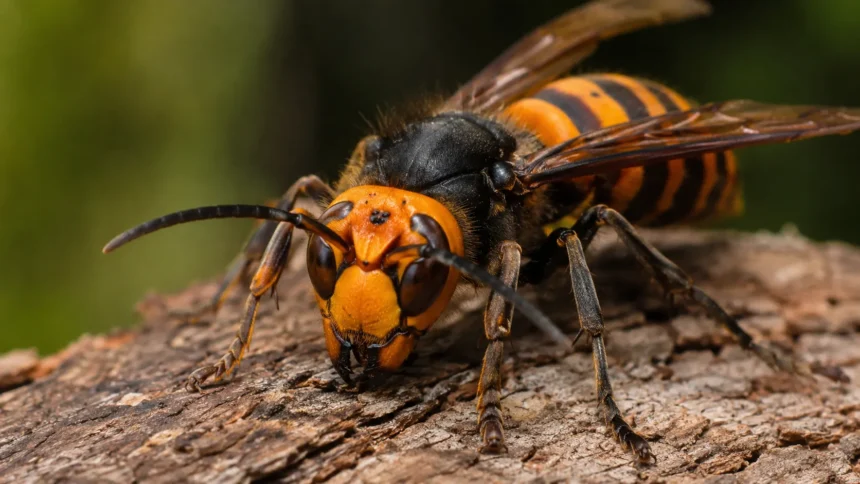
The most striking identifying feature of a northern giant hornet is its unusually large head. The head is broad and typically yellow to orange, with prominent dark eyes that stand out clearly against the surrounding coloration. Large mandibles sit at the front and are used to capture and process insect prey. The thorax behind the head is generally dark brown or nearly black, creating a strong contrast with the brighter head. This combination of a very large orange head and dark thorax is one of the most useful visual clues for recognizing the species. However, size and coloration should always be considered together because several harmless native insects can look surprisingly similar at a quick glance.
The abdomen has alternating dark and yellow-orange bands, creating the familiar striped appearance associated with many wasps and hornets. Unlike some yellowjackets, however, the northern giant hornet has a much larger overall body and broader abdominal segments. Its wings are usually translucent and may appear smoky or brownish depending on lighting. The legs are relatively long and dark, while the overall body appears heavy and robust rather than narrow and delicate. Workers are commonly around 1.5 inches long, while larger individuals can approach approximately 2 inches. Seeing an insect that looks large is not sufficient evidence by itself, because several North American wasps can also reach impressive sizes.
Another notable characteristic is the hornet’s body proportion. The head looks unusually large relative to the rest of the insect, especially when compared with cicada killers or certain large native wasps. Its face appears broad when viewed from the front, and the eyes are positioned prominently on either side. The abdomen is thick rather than extremely slender, although the body still has the narrow waist typical of wasps. When viewed from above, the combination of the orange head, dark thorax, and evenly banded abdomen creates a distinctive appearance. Identification guides often emphasize these combined characteristics because relying on only one feature, such as color, creates a high risk of misidentification.
Queens are usually larger than workers, although distinguishing caste from a brief field observation can be difficult. Their body structure remains broadly similar, but reproductive females can be especially impressive in size. Male hornets also occur later in the colony cycle and differ biologically because males do not possess functional stingers. For ordinary public identification, however, trying to determine whether an insect is a queen, worker, or male is far less important than determining the species itself. Photographing an insect from a safe distance is more useful than attempting close physical examination. People should not handle a suspected giant hornet simply to confirm features such as body length or abdominal markings.
Size is often the feature that first attracts attention, but it is also one of the most commonly exaggerated aspects of northern giant hornet reports. Photographs taken close to a camera can make insects look significantly larger than they actually are. USDA and Washington State identification materials describe northern giant hornets as approximately 1.5 to 2 inches long, not the enormous hand-sized creatures sometimes suggested by sensational online imagery. Their size is still remarkable for a hornet and makes them noticeably larger than many familiar social wasps. Accurate identification should rely on realistic measurements, the orange head, abdominal banding, body proportions, and location rather than fear generated by an unusual photograph.
Where Do Northern Giant Hornets Live?
Northern giant hornets are native to parts of Asia, where they occur in suitable temperate and forested habitats. Their natural range includes areas where seasonal conditions allow queens to overwinter and establish colonies during warmer months. Hornets commonly forage in landscapes containing forests, agricultural areas, and insect populations that provide sufficient food. Their natural ecology is very different from an insect suddenly appearing everywhere in urban North America, despite the impression sometimes created during the 2020 media cycle. Geographic context is therefore important when identifying suspected sightings. In most places outside the species’ established native range, an unusually large wasp is much more likely to be a native or already-established species than a northern giant hornet.
Nests are generally associated with protected cavities, particularly underground spaces. Queens may establish colonies in abandoned burrows or similar sheltered locations, while some nests can occur in cavities within trees or other suitable structures. Underground nesting is important from a safety perspective because a person might approach a nest without noticing it. Vibrations or disturbance near an active colony can trigger defensive behavior. Unlike conspicuous paper nests hanging from tree branches, subterranean nests can be difficult to spot until workers are actively entering and leaving. Anyone who suspects an unusual hornet colony should therefore avoid attempting to excavate, block, spray, or otherwise investigate the entrance without professional guidance.
The North American story began in 2019 when northern giant hornets were detected in British Columbia and near Blaine in Washington State. Additional confirmed detections occurred in the following years, leading Washington agricultural officials and federal partners to conduct intensive surveillance and eradication work. Four nests were located and eradicated in Whatcom County during 2020 and 2021. Importantly, the insect was not found spreading widely across the United States during this period. The confirmed U.S. detections were geographically limited, which made aggressive eradication practical. This history is important because old articles can give readers the impression that the hornet continues to spread across the country.
The current U.S. status is substantially different from the situation described in early “murder hornet” coverage. Washington officials detected no northern giant hornets from 2022 through 2024 after the known nests had been destroyed. At the end of 2024, the Washington State Department of Agriculture and USDA declared the northern giant hornet eradicated from Washington State and the United States. Current Washington information continues to describe the species as eradicated, although officials acknowledge that future accidental reintroduction remains possible. This means a large hornet photographed somewhere in the United States today should not automatically be identified as Vespa mandarinia.
Readers should also avoid confusing the northern giant hornet with the yellow-legged hornet, Vespa velutina, another invasive hornet currently receiving attention in parts of the United States. As of August 2026, USDA reports yellow-legged hornet detections in Georgia, South Carolina, and North Carolina, with trapping and nest-removal programs continuing. That is a different species with different appearance and management concerns. Northern giant hornets have a much larger body and prominent orange head, while yellow-legged hornets are smaller and have distinctive yellow ends on their legs. Keeping these species separate is important because current invasive-hornet news may concern yellow-legged hornets rather than the species popularly called murder hornets.
Life Cycle and Behavior of Northern Giant Hornets
The northern giant hornet colony follows an annual cycle typical of many temperate social wasps. A fertilized queen survives the cold season in a protected location and becomes active when conditions warm. She searches for an appropriate nesting cavity and begins constructing the first cells herself. The queen lays eggs and initially performs all the work required to support the developing larvae. After the first generation of female workers matures, those workers gradually assume responsibilities outside the nest. The queen can then focus increasingly on egg production, allowing the colony to expand much more quickly during the middle of the season.
Workers perform a variety of jobs as the colony grows. They defend the nest, gather carbohydrates for adult energy needs, hunt insects, and bring protein-rich prey back for developing larvae. Social wasps have an interesting nutritional relationship in which larvae and adults exchange resources within the colony. Workers capture prey with powerful jaws, process it, and transport usable material back to the nest. The hornets can hunt many types of insects instead of relying exclusively on honey bees. This is important because the species’ reputation is often reduced to bee attacks, even though its natural feeding ecology includes a broader range of arthropod prey.
Interactions with honey bee colonies can become particularly aggressive later in the season when the hornet colony requires large quantities of protein. Individual hornets may first hunt bees near a hive entrance. Under some circumstances, a group can progress into a coordinated attack in which hornets kill large numbers of adult bees and gain access to the brood inside the colony. Larvae and pupae provide valuable protein that can be transported back to the hornet nest. This behavior is one reason agricultural authorities treated the species as a serious threat when it appeared in Washington. A relatively small number of giant hornets can cause extensive damage to an unprotected European honey bee colony.
Northern giant hornets do not remain at peak colony size throughout the year. As the season progresses, colonies eventually produce reproductive males and new queens instead of continuing only to create workers. These reproductive adults leave the colony and mate, allowing fertilized queens to establish the next generation. Workers, males, and the original queen do not generally persist through the winter in the same functioning colony. Instead, newly fertilized queens become the key link between one year’s colony and the next. This annual cycle has important implications for invasive-species management because finding and eliminating reproducing colonies before new queens disperse can help prevent establishment.
Hornet behavior also changes depending on context, which matters when evaluating human risk. A foraging hornet away from its nest does not necessarily behave the same way as workers defending an active colony. Social wasps generally become more defensive when they perceive a threat near the nest, where their queen and developing brood are located. Disturbing soil, attempting to destroy a nest, or aggressively swatting at hornets can increase danger. The safest response is to create distance rather than testing whether an insect will attack. Understanding behavior helps replace the simplistic idea of an insect that “murders” indiscriminately with a more accurate picture of a predator that becomes defensive under specific circumstances.
Why Murder Hornets Are a Threat to Honey Bees
Honey bees are central to concerns about northern giant hornets because the hornets can attack colonies with exceptional efficiency. European honey bees, Apis mellifera, are widely managed for honey production and crop pollination across North America. They have not evolved all of the same defensive strategies found in some bee populations that naturally coexist with giant hornets in Asia. When giant hornets target a vulnerable hive, they can kill large numbers of worker bees and eventually enter the colony to take brood. USDA and Washington officials have emphasized that a small group of northern giant hornets can severely damage or destroy a honey bee colony within hours.
The attack can unfold in stages rather than beginning immediately as a full colony assault. Individual hornets may initially hunt honey bees outside the hive, capturing workers as food. A successful scout may eventually recruit nestmates to a productive colony. During an intensified attack, hornets use their strong mandibles to kill defending bees quickly. Once resistance has been reduced, they can gain access to bee larvae and pupae inside the hive. This concentrated protein source becomes valuable to the developing hornet colony. The behavior is biologically effective for the predator but potentially devastating for a managed honey bee operation that contains many colonies in a relatively small area.
The concern extends beyond individual beekeepers because honey bees provide economically important pollination services. Numerous crops benefit from or depend heavily on insect pollination, and managed honey bee colonies are transported to agricultural areas to support production. If a new predator significantly reduced colony survival in an affected region, additional pressure could be placed on commercial beekeeping and pollination systems. Native insects could also become prey because northern giant hornets do not hunt only honey bees. For this reason, invasive-species officials view the issue through both agricultural and ecological perspectives. The potential consequences are much broader than simply losing honey from damaged hives.
Honey bees in parts of the hornet’s native range have developed remarkable defensive behaviors through long-term coexistence. Certain bees can surround an attacking hornet in a dense cluster, generating conditions inside the group that help kill the predator. European honey bees do not necessarily perform the same defense effectively against northern giant hornets, which can make introduced populations vulnerable. This illustrates a common invasive-species problem: ecological relationships that are balanced within a native range can become disruptive when one organism enters a new environment. Native prey may lack specialized defenses, while predators and competitors that normally limit the invader may also be absent.
Despite these genuine risks, it is important to keep the current U.S. situation in perspective. The northern giant hornet did not become established across the United States. The known Washington nests were eliminated, surveillance continued for three years without confirmed detections, and officials declared eradication in 2024. The threat explains why the response was taken seriously, but it should not be described as an ongoing nationwide infestation. Beekeepers and members of the public can still support invasive-species surveillance by reporting genuinely suspicious hornets to appropriate authorities. Accurate identification remains essential, however, because unnecessary destruction of native wasps can harm beneficial insects without contributing to invasive-hornet control.
Are Murder Hornets Dangerous to Humans?
Northern giant hornets can sting people, and their stings can be extremely painful. Their stingers are longer than those of many familiar bees and wasps, and hornets are capable of stinging repeatedly because they do not leave a barbed stinger behind in the same way honey bees typically do. Agricultural guidance notes that standard beekeeping clothing may not provide adequate protection against certain invasive hornets because a long stinger can penetrate ordinary protective material. This makes professional protective equipment particularly important for trained personnel working directly around suspected colonies. Members of the public should never attempt to capture an active colony or approach a nest for a closer photograph.
The venom can cause localized pain, swelling, redness, and inflammation around the sting site, as happens with many stinging insects. Serious reactions become more likely when a person receives numerous stings or experiences a severe allergic response. Individual sensitivity varies significantly, meaning the number of stings alone cannot determine how a person will respond. A single sting can be medically serious for someone with a severe venom allergy, while multiple stings increase the total amount of venom delivered. Anyone experiencing breathing difficulty, widespread swelling, dizziness, loss of consciousness, or other signs of a severe allergic reaction after an insect sting requires urgent medical attention.
Calling the insect a murder hornet can create the impression that it regularly seeks out humans as prey. It does not. Humans are not part of the hornet’s normal diet, and northern giant hornets generally do not attack people unless they perceive a threat or are disturbed. Encounters become more concerning near a nest because workers have a strong biological reason to defend the colony. Accidentally approaching an underground nest can therefore create more risk than observing a solitary hornet feeding elsewhere. Giving suspected hornets space and avoiding sudden attempts to hit, trap, or handle them is far safer than provoking defensive behavior.
The actual risk to an average person in the United States is currently extremely low because northern giant hornets have been declared eradicated from the country. Many people who believe they have seen one are actually observing cicada killers, European hornets, yellowjackets, sawflies, or other large insects. During the period when northern giant hornets received intense media coverage, insect-identification services experienced increased reports involving native lookalikes. This illustrates why context matters when evaluating personal risk. A large wasp in a backyard hundreds or thousands of miles from previous confirmed detections is not automatically evidence that northern giant hornets have returned.
Risk should therefore be understood without minimizing the insect’s capabilities or exaggerating its current presence. A northern giant hornet is a large stinging insect that deserves caution, particularly around a nest. At the same time, it is not a roaming predator whose primary danger is killing people. Its significance as an invasive species comes mainly from what an established population could do to honey bees and other insects. Staying informed, identifying insects carefully, avoiding nests, and reporting credible invasive-species sightings provide a more useful response than panic. Accurate risk communication protects both people and beneficial native insects that may otherwise be killed because they resemble a highly publicized invasive hornet.
Murder Hornet Lookalikes and How to Tell the Difference
Cicada killers are among the insects most commonly mistaken for northern giant hornets in North America. These large native wasps can look intimidating because of their impressive size and bold abdominal markings. Female cicada killers hunt cicadas, paralyze them, and transport the prey into underground burrows where their young develop. Despite their appearance, they are not northern giant hornets and play a normal role in local ecosystems. Their head proportions, coloration, abdomen pattern, and overall body shape differ from Vespa mandarinia. When people see a very large wasp during summer, a cicada killer is often a much more plausible explanation than an invasive northern giant hornet.
The European hornet is another potential source of confusion, particularly in parts of the eastern United States where it is established. European hornets are large social wasps with yellow and brownish coloration, and a quick glance can make them appear similar to northern giant hornets. However, they generally have different head coloration and abdominal patterns, and their overall proportions are not identical. Geographic distribution is also useful when evaluating a suspected sighting. Official identification resources often compare these hornets side by side because visual memory alone can be unreliable. Photographing the insect rather than relying on a verbal description gives experts much more useful information.
Yellowjackets are considerably smaller but can still cause confusion because of their black-and-yellow striped bodies. Their colonies are common in many areas, and some species nest underground, creating another superficial similarity. Northern giant hornets have much larger bodies, broader orange heads, and different abdominal coloration. Yellowjackets may also appear more energetic around food, garbage, or outdoor gatherings, whereas northern giant hornets have different foraging patterns. Because yellowjackets are common and can become defensive near nests, they account for many real-world stinging encounters. Assuming any aggressive striped wasp is a murder hornet can therefore distract from the far more likely local species responsible for the encounter.
The yellow-legged hornet is particularly important to distinguish because it is currently an active invasive-species concern in parts of the United States. USDA reports detections in Georgia, South Carolina, and North Carolina as of August 2026. Yellow-legged hornets are smaller than northern giant hornets and have distinctive yellow coloration on the ends of their legs, along with a largely dark abdomen containing a prominent orange-yellow band. Their nests are often built above ground in trees or structures, unlike the commonly subterranean nesting behavior associated with northern giant hornets. Current news about invasive hornet surveillance in the Southeast may therefore involve Vespa velutina, not the species historically called murder hornet.
Other insects such as paper wasps, great golden digger wasps, sawflies, and bumblebees can generate mistaken reports as well. Some are harmless to humans, while others can sting but do not pose the same invasive-species threat. The safest identification method is to consider several characteristics simultaneously: approximate body length, head size and color, abdominal pattern, leg coloration, nesting behavior, and geographic location. One feature alone is rarely sufficient. Official agricultural agencies maintain image guides precisely because trained comparison is more reliable than online guesswork. Protecting native insects is also important, so people should avoid killing large wasps simply because they look unfamiliar or frightening.
What Should You Do If You See a Suspected Murder Hornet?
If you think you have found a northern giant hornet, the first step is to keep a safe distance. Do not attempt to catch the insect with your bare hands, follow it into vegetation, disturb a suspected nest entrance, or spray a colony yourself. A clear photograph taken from a safe location can be extremely useful for identification. If possible without increasing risk, note the exact location, date, approximate size, behavior, and direction in which the insect traveled. These details can help specialists determine whether further investigation is appropriate. Safety is more important than obtaining perfect evidence, especially if several hornets are present or an active nest may be nearby.
In the United States, a suspected invasive hornet can generally be reported to the relevant state department of agriculture, state plant regulatory official, extension service, or invasive-species program. Reporting procedures differ by state, so residents should use official local channels rather than sending specimens indiscriminately. Washington continues to maintain invasive-hornet reporting resources even though northern giant hornets were declared eradicated. USDA also directs people in affected areas to state authorities for current invasive-hornet concerns. Reports that include photographs are particularly helpful because specialists can often eliminate common native lookalikes without requiring someone to approach the insect physically.
Do not destroy a suspected nest before experts have had an opportunity to evaluate it. Attempting to treat an underground social wasp colony can provoke multiple defenders, creating far greater sting risk than observing workers from a distance. Improvised control methods may also fail to kill the colony and could cause surviving insects to disperse. If the insect were genuinely an invasive hornet, authorities might need information about the nest and surrounding activity to support surveillance or eradication. Professional teams have specialized protective equipment and methods designed for these situations. Ordinary household pest-control actions are not an appropriate substitute for an invasive-species response when identification remains uncertain.
If you find a dead insect that appears suspicious, avoid unnecessary handling and follow local guidance regarding specimen submission. A photograph beside a ruler or another scale reference can help show its actual dimensions without requiring close contact with a living insect. Capturing a live hornet simply to provide proof is unnecessary and potentially dangerous. Identification experts may ask additional questions or request a specimen if they believe the report is credible. Most reports are likely to involve native species, especially given the current eradicated status of northern giant hornet in the United States. Even so, reporting a genuinely unusual insect can contribute valuable information to surveillance programs.
People outside regions where the species has historically occurred should keep geographic probability in mind while remaining observant. A suspected hornet does not become Vespa mandarinia simply because it is large, orange, or frightening. Compare the insect with reliable government identification materials rather than viral social-media posts, where perspective and mislabeling can create confusion. Current invasive-species information should also be checked because status changes over time. As of the latest U.S. government and Washington information available in 2026, northern giant hornets remain declared eradicated from the United States. Responsible reporting combines caution with accurate identification rather than assuming every large wasp represents a renewed infestation.
Murder Hornet Facts, Myths and Misconceptions
One persistent myth is that murder hornets are currently spreading throughout the United States. That was never an accurate description of confirmed detections, which were concentrated in a limited area of northwest Washington after initial North American findings in 2019. Officials found and destroyed four nests in Whatcom County during 2020 and 2021, followed by three years without confirmed detections. The species was officially declared eradicated from Washington and the United States at the end of 2024. Reintroduction remains theoretically possible, which is why surveillance awareness still matters. However, describing the country as currently experiencing a northern giant hornet invasion is outdated.
Another misconception is that these hornets received the nickname murder hornet because they regularly hunt humans. Their natural predatory behavior is directed primarily toward insects, and their well-documented threat involves attacks on honey bee colonies. Humans can certainly be stung, particularly when a nest is disturbed, and the sting should not be dismissed as harmless. But that is different from actively targeting people as prey. The Entomological Society of America specifically noted that the murder hornet name can create unnecessary fear and interfere with accurate understanding of the insect. Using northern giant hornet provides a clearer and scientifically preferred way to discuss the species.
A third myth is that any extremely large striped wasp must be a northern giant hornet. North America contains several large native insects that can look alarming to people unfamiliar with them. Cicada killers are a particularly common example and can approach a size that causes immediate concern. European hornets, paper wasps, yellowjackets, digger wasps, and even some sawflies can also be misidentified from poor photographs. Accurate identification requires checking several anatomical features together with geographic location. Mistaken identity matters because native insects can provide ecological benefits and should not be destroyed unnecessarily simply because their appearance resembles a widely publicized invasive species.
It is also incorrect to assume that eradication means officials can permanently stop paying attention to the species. International shipping and movement of goods can unintentionally transport organisms outside their native ranges. A new introduction could theoretically occur even after an earlier population has been eliminated. Washington’s current information notes that reintroduction of northern giant hornets or other invasive hornet species remains possible. Continued awareness and rapid reporting therefore provide value without implying that a current infestation exists. Successful invasive-species management often depends on detecting a new population while it is still small enough to control, rather than waiting until it has become widely established.
Finally, northern giant hornets should be understood as an ecological and agricultural issue rather than an insect horror story. Their biology is impressive: they are exceptionally large social predators capable of coordinated attacks on other insects, including honey bees. Those traits can create serious problems when the species enters an ecosystem where vulnerable prey has limited defenses. At the same time, exaggerated claims can cause unnecessary fear, encourage people to kill harmless lookalikes, and make accurate public communication harder. The successful U.S. eradication effort illustrates the value of science-based monitoring, public reporting, and targeted intervention. Knowing the facts is therefore more useful than remembering the dramatic nickname that first made the insect famous.
Frequently Asked Questions About Murder Hornets
Are murder hornets still in the United States?
Northern giant hornets were declared eradicated from Washington State and the United States at the end of 2024 after no confirmed detections from 2022 through 2024. Officials continue to recognize that future reintroduction is possible, so credible suspected sightings can still be reported.
What does a murder hornet look like?
A northern giant hornet is approximately 1.5 to 2 inches long and has a very large orange or yellow-orange head, dark thorax, and an abdomen with dark and orange-yellow bands. Its unusually large head and robust body are useful identification features, but several native insects can look similar.
Can murder hornets kill people?
Northern giant hornet stings can be medically serious, particularly after multiple stings or in someone with a severe venom allergy. However, the hornets do not normally hunt humans and generally become dangerous when threatened, handled, or disturbed near a nest.
Why are murder hornets dangerous to bees?
Northern giant hornets can attack honey bee colonies, kill large numbers of worker bees, and enter hives to obtain developing brood as food. European honey bee colonies can be particularly vulnerable, which is why potential establishment was treated as an agricultural and ecological concern.
Is “murder hornet” the correct name?
The scientifically preferred U.S. common name is northern giant hornet for Vespa mandarinia. The Entomological Society of America adopted that name in 2022 and recommends moving away from “murder hornet,” which it considers unnecessarily fear-inducing and less useful for accurate communication.