


Resistance training exercises are an effective way to build strength, improve muscular endurance, support joint stability, and make everyday movements feel easier. You do not need an advanced gym setup to start because resistance can come from dumbbells, resistance bands, machines, kettlebells, or simply your own body weight. The key is choosing movements that match your current ability and performing them with controlled technique.
A well-designed resistance training routine can support people with different goals, from beginners wanting better overall fitness to experienced lifters working toward greater strength. Proper form, gradual progression, recovery, and consistency matter more than lifting the heaviest weight possible. Understanding these fundamentals can help you train safely while getting more value from every workout.
What Is Resistance Training?
Resistance training is a form of exercise in which your muscles work against an external force. That resistance may come from free weights, exercise machines, resistance bands, cable systems, or your body weight. When muscles repeatedly overcome resistance, they gradually adapt by becoming stronger and more capable of handling physical demands.
The term includes many familiar exercises such as squats, push-ups, rows, lunges, shoulder presses, and deadlifts. Although strength is a major goal, resistance workouts can also improve balance, coordination, posture, and muscular endurance. The exact benefits depend on the exercises, resistance level, repetition range, training frequency, and consistency of your program.
Resistance training can be adapted for almost every fitness level. Beginners might start with bodyweight movements and light resistance bands, while experienced trainees may use barbells, heavier dumbbells, or advanced machines. Progress should happen gradually so your muscles, connective tissues, and movement skills have enough time to adapt to increasing training demands.
Benefits of Resistance Training Exercises
One of the biggest benefits of resistance training is increased muscular strength. Stronger muscles make daily tasks such as carrying groceries, climbing stairs, lifting objects, and getting up from a chair easier. Greater strength can also support athletic performance because many sports depend on producing force efficiently through the legs, core, shoulders, and upper body.
Resistance exercise can also help maintain muscle mass as people age. Muscle naturally changes over time, but regular strength-focused activity gives the body a reason to preserve and develop functional tissue. Maintaining strength can support independence, movement confidence, and the ability to continue performing everyday activities comfortably throughout different stages of life.
Strength training may also support bone health, joint stability, body composition, and metabolic fitness. Because muscles work around the joints, improving strength can make certain movements feel more controlled. Resistance exercise should still be matched to individual circumstances, especially when pain, injury, or existing mobility limitations affect how comfortably particular exercises can be performed.
Squats for Lower-Body Strength
Squats are one of the most useful resistance training exercises because they strengthen several major muscle groups at once. The movement primarily involves the quadriceps, glutes, and hamstrings while also requiring the core to help stabilize the torso. Squatting patterns are relevant to everyday activities such as sitting down, standing up, and lifting objects from lower positions.
To perform a basic squat, stand with your feet approximately shoulder-width apart and keep your chest comfortably upright. Push your hips back while bending your knees, lowering only as far as you can maintain control. Keep your feet firmly planted and allow your knees to follow the direction of your toes rather than forcing them inward.
Beginners can practice bodyweight squats before adding external resistance. Dumbbells, kettlebells, barbells, or resistance bands can increase difficulty once the basic movement feels stable. Avoid rushing to heavier loads because depth, balance, and controlled movement are more important than simply increasing weight before your technique is ready.
Lunges for Balance and Leg Strength
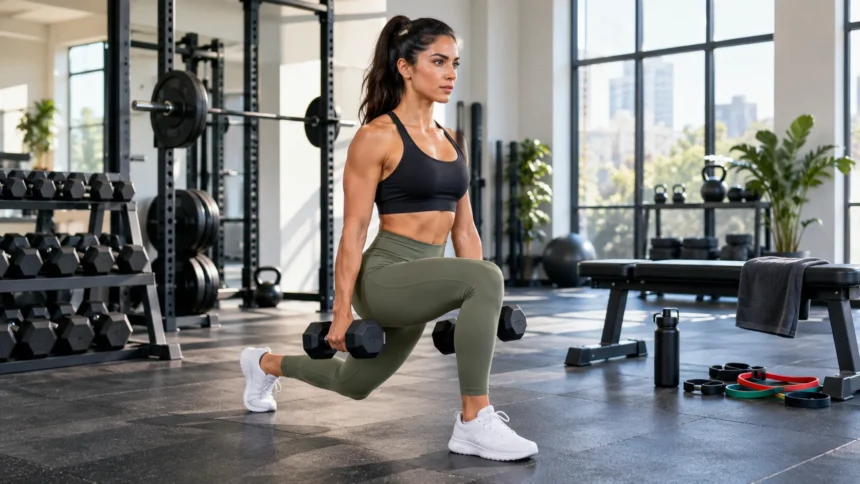
Lunges strengthen the legs while challenging balance and coordination more than many two-legged exercises. They primarily target the quadriceps and glutes, with the hamstrings and calves contributing to control. Because each side works somewhat independently, lunges can also help reveal differences in strength or stability between the left and right legs.
Start by standing tall before stepping one foot forward into a comfortable stance. Lower your body by bending both knees while keeping your front foot planted and your torso controlled. Push through the front foot to return to the starting position, then repeat on the same side or alternate legs depending on your preferred variation.
Reverse lunges can feel easier for some beginners because stepping backward may provide greater control. Walking lunges, lateral lunges, and weighted lunges can be introduced as strength and confidence improve. If balance is challenging, holding a stable surface temporarily can help you learn the movement pattern before adding resistance or more advanced variations.
Push-Ups for Chest, Shoulders, and Arms
Push-ups are a convenient upper-body resistance exercise requiring no equipment. They primarily train the chest, shoulders, and triceps while also engaging the core to keep the body stable. Because they can be modified easily, push-ups work well for beginners, home workouts, experienced trainees, and people who want practical bodyweight strength exercises.
Begin with your hands slightly wider than shoulder width and create a straight line through your torso. Bend your elbows as you lower your chest toward the floor while keeping your core engaged. Press through your hands to return to the starting position without allowing your hips to sag or your shoulders to become excessively elevated.
If a traditional push-up is too difficult, elevate your hands on a wall, bench, table, or sturdy surface. As strength improves, gradually lower the surface until floor push-ups become manageable. More advanced trainees can make the exercise harder by slowing the lowering phase, adding pauses, elevating the feet, or introducing external resistance carefully.
Rows for Back Strength and Better Posture
Rows target the muscles of the upper and middle back while also involving the biceps and rear shoulders. These muscles contribute to pulling movements and help support controlled upper-body positioning. Rows can be especially valuable in balanced resistance programs because many people naturally perform more pushing exercises than pulling movements during their workouts.
Dumbbell rows can be performed by supporting one hand on a bench while holding a weight in the opposite hand. Keep your back controlled and pull the weight toward your torso by driving the elbow backward. Lower the weight slowly instead of allowing gravity to drop it, keeping the movement smooth throughout each repetition.
Resistance-band rows and cable rows provide alternatives for people who prefer different equipment. The main goal is to move through a comfortable range while avoiding excessive shoulder shrugging or twisting. Concentrate on controlled pulling rather than using momentum, and select a resistance level that allows consistent technique from the first repetition to the last.
Deadlifts for Full-Body Strength
Deadlifts are a compound resistance exercise that trains the hips, hamstrings, glutes, back, core, and grip. The movement develops the hip-hinge pattern used when lifting objects from the floor. Learning to hinge through the hips while maintaining controlled trunk positioning can make deadlifts useful for both strength development and practical movement skills.
Start with a light weight positioned close to your body. Push your hips backward, bend your knees as needed, and grip the weight while keeping your torso stable. Drive through your feet and extend your hips until standing tall, then reverse the movement by pushing your hips backward as the weight returns toward the floor.
Technique is particularly important with deadlifts because using too much weight can encourage poor movement patterns. Beginners may find kettlebell deadlifts or elevated dumbbell deadlifts easier to learn than traditional barbell variations. Increase resistance gradually only when you can consistently perform the movement without relying on momentum or losing control of your posture.
Shoulder Presses for Upper-Body Strength
Shoulder presses strengthen the shoulders and triceps while requiring the core to stabilize the body. They can be performed with dumbbells, resistance bands, machines, kettlebells, or barbells depending on experience and available equipment. Pressing strength supports many everyday movements involving placing objects on shelves or lifting items above shoulder level.
For a dumbbell shoulder press, hold the weights near shoulder height with your wrists comfortably aligned. Brace your torso and press the weights upward without excessively arching your lower back. Lower them slowly to the starting position, maintaining control throughout the movement rather than allowing the weights to drop quickly.
Seated presses may provide additional stability for beginners, while standing variations challenge the trunk more strongly. Start with a resistance level that allows a smooth range of motion without shoulder discomfort. If pressing overhead causes pain or significant restriction, another exercise variation may be more appropriate until the underlying movement limitation has been evaluated.
Resistance Band Exercises for Beginners
Resistance bands are affordable, portable, and versatile tools for strength training. They can be used for rows, chest presses, lateral walks, biceps curls, triceps extensions, squats, and many other movements. Because bands come in different resistance levels, beginners can start lightly and progress gradually without needing a large collection of traditional gym equipment.
Band resistance usually increases as the material stretches, creating a slightly different feeling from dumbbells or machines. Movements should remain slow and controlled so the band does not snap back suddenly. Before each session, inspect bands for cracks, thinning areas, or other damage that could increase the chance of them breaking during an exercise.
Bands can also help people train at home, while traveling, or in spaces where larger equipment is unavailable. They are particularly useful for adding resistance to lower-body movements and smaller accessory exercises. Combining bands with bodyweight training can create a surprisingly complete workout covering most major muscle groups without requiring a traditional gym membership.
How to Use Proper Form During Resistance Training
Proper form means performing an exercise through a controlled movement pattern appropriate for your body and the specific exercise. Good technique helps place resistance on the intended muscles while reducing unnecessary stress created by uncontrolled motion. It is usually better to use a lighter resistance correctly than to lift heavier weight by swinging, bouncing, or shortening the movement excessively.
Move at a controlled pace and pay attention to your posture, breathing, and joint alignment. Avoid holding your breath unnecessarily through long sets, and stop repetitions when your technique begins changing noticeably because of fatigue. Recording your exercises or working with a qualified fitness professional can sometimes help identify movement mistakes that are difficult to notice yourself.
Joint comfort should also guide exercise selection. If hand or finger discomfort makes gripping weights difficult, it may be useful to understand common arthritis signs and seek appropriate guidance when symptoms persist. Resistance training should challenge muscles, but sharp, worsening, or unexplained joint pain is not something to simply push through.
How Many Sets and Reps Should You Do?
Beginners do not need complicated set and repetition schemes to make progress. Starting with approximately one to three sets of each exercise can provide enough practice and muscular stimulus while allowing technique to develop. A moderate repetition range often works well because it lets people use manageable resistance without turning every set into a maximum-effort challenge.
The ideal repetition range depends on your goals and experience. Heavier resistance with fewer repetitions is commonly associated with strength-focused training, while moderate and higher repetitions can effectively develop muscular endurance and muscle growth when sets are challenging enough. There is no single repetition range that every person must follow for every exercise.
Rest between sets should be long enough to let you perform the next set with good technique. Large compound movements may require more recovery than small accessory exercises such as curls or band movements. Rather than rushing through a workout, focus on consistent repetition quality and gradually adjust volume as your fitness level and recovery capacity improve.
Tips for Progressing Safely
Progressive overload means gradually increasing the challenge placed on your muscles over time. This can involve adding weight, performing more repetitions, increasing sets, improving range of motion, or using a harder exercise variation. Progress does not need to happen during every workout, and trying to increase everything too quickly can interfere with technique and recovery.
Allow your body enough time to recover between demanding sessions for the same muscle groups. Sleep, nutrition, hydration, overall activity levels, and life stress can all affect how quickly you feel ready to train again. Mild muscle soreness can occur after unfamiliar training, but severe or persistent discomfort may indicate that exercise volume or intensity increased too quickly.
Consistency usually produces better long-term results than repeatedly performing extremely difficult workouts followed by long breaks. Track your exercises, repetitions, and resistance so you can see gradual improvement over time. Small increases that preserve good form can accumulate into meaningful strength gains without requiring dramatic changes to your program every week.
Conclusion
Resistance training exercises can improve muscular strength, movement confidence, balance, endurance, and everyday physical function. Squats, lunges, push-ups, rows, deadlifts, shoulder presses, and resistance-band exercises provide a strong foundation for a balanced routine. You do not need advanced equipment or extremely heavy weights to begin experiencing benefits from consistent strength training.
Good form should remain the priority as resistance increases. Moving with control, selecting appropriate exercises, resting between sessions, and progressing gradually can make workouts more sustainable. Training should feel challenging, but it should not require sacrificing movement quality simply to lift heavier weights or complete additional repetitions.
The most effective routine is one that matches your current fitness level and can be followed consistently. Start with manageable movements, learn the basic patterns, and build difficulty as your strength improves. With patience and regular practice, resistance training can become a practical part of maintaining physical fitness and supporting everyday activity.
FAQs
How often should beginners do resistance training?
Beginners can often start with two or three resistance training sessions per week. Allowing recovery between sessions helps muscles adapt while giving you enough opportunities to practice important movement patterns consistently.
Can I do resistance training without weights?
Yes. Push-ups, squats, lunges, planks, and other bodyweight exercises provide resistance without equipment. Resistance bands can also increase difficulty while remaining affordable, portable, and suitable for home workouts.
How long should a resistance training workout last?
Many effective sessions can be completed in approximately 30 to 60 minutes. Workout length depends on the number of exercises, sets, rest periods, training experience, and individual fitness goals.
Should resistance training make my muscles sore?
Mild soreness can occur after unfamiliar or challenging exercises, but soreness is not required for progress. Severe, sharp, or persistent pain should not be treated as a normal sign of an effective workout.
Is resistance training suitable for older adults?
Resistance training can be valuable for maintaining strength and physical function as people age. Exercise selection, resistance, and progression should match individual ability, mobility, medical considerations, and professional guidance when appropriate.