


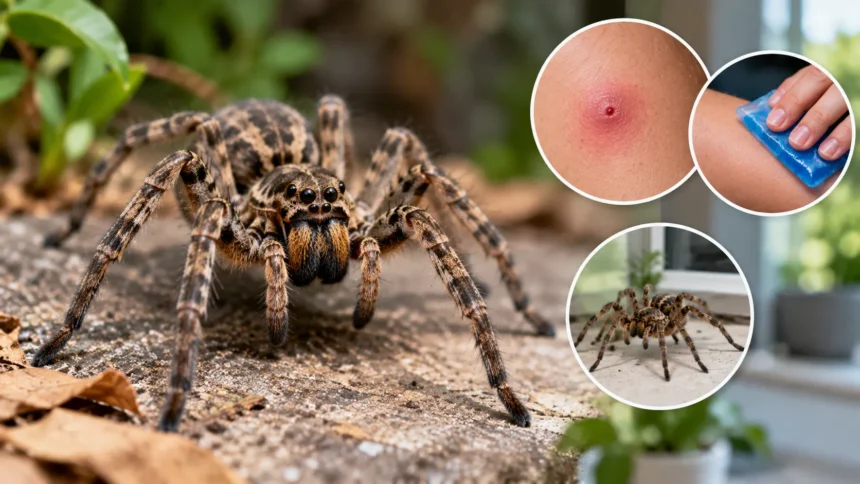
Are Wolf Spiders Poisonous? Bites & Safety Explained
Wolf spiders can look intimidating because of their relatively large bodies, fast movements, hairy appearance, and habit of appearing unexpectedly on floors, patios, garages, and gardens. Their appearance often leads people to wonder whether wolf spiders are poisonous or whether a bite could cause serious harm. The more accurate term is venomous, because wolf spiders use venom delivered through their fangs to immobilize insects and other small prey. They are not considered poisonous simply because touching one does not normally expose a person to a toxin. More importantly, wolf spider venom is generally not considered medically significant to healthy people. Most encounters end without a bite because these spiders usually prefer escaping rather than confronting humans.
Wolf spiders belong to the spider family Lycosidae, a large and widespread group found in many parts of the world. Unlike classic web-building spiders that wait for prey to become trapped, wolf spiders are active hunters that search for insects on the ground. This hunting behavior explains why people sometimes see them running quickly across lawns, basements, sheds, garages, or indoor floors. They may enter homes accidentally while looking for shelter or pursuing prey, particularly when outdoor conditions change. Their speed can make them appear aggressive even when they are simply trying to escape. Understanding normal wolf spider behavior makes it easier to respond calmly rather than assuming every fast-moving spider presents a serious threat.
A wolf spider bite can cause pain, redness, tenderness, or localized swelling, much like many other minor arthropod bites. Most uncomplicated symptoms improve with basic wound care and monitoring rather than requiring specialized medical treatment. However, suspected spider bites should not automatically be blamed on wolf spiders because skin infections, insect bites, allergic reactions, and other conditions can produce similar-looking lesions. Anyone who develops severe pain, breathing difficulty, widespread swelling, rapidly worsening symptoms, or signs of infection should obtain medical attention. This guide explains whether wolf spiders are dangerous, how to recognize them, what bites may feel like, appropriate first aid, and practical ways to reduce encounters around the home.
Are Wolf Spiders Poisonous or Venomous?
Wolf spiders are venomous because they possess venom glands and use their fangs to inject venom into prey. Venom helps them subdue insects, small arthropods, and other animals they capture while hunting. Calling them poisonous is technically inaccurate because poison generally causes harm when it is eaten, touched, or otherwise absorbed rather than deliberately injected. This venom-versus-poison distinction applies to many spiders, snakes, insects, and other animals. A wolf spider therefore has venom, but that fact alone does not mean it is highly dangerous to people. Toxicity depends on what the venom does to humans, not simply on whether venom exists.
Wolf spider venom is primarily adapted for capturing the relatively small animals these spiders normally eat. Humans are not natural prey, and the venom is generally not considered highly medically significant to healthy adults. When bites occur, the effects are usually limited to the area around the bite rather than producing severe whole-body poisoning. Pain, redness, mild swelling, itching, or tenderness can develop shortly after the bite. Symptoms often improve with time and simple supportive care. Individual reactions can vary, however, so an unusually severe response should still be evaluated rather than dismissed simply because the spider appeared to be a wolf spider.
A spider possessing venom should not automatically be classified as dangerous because most spider species use venom during feeding. The vast majority do not possess venom that commonly creates serious medical problems in humans. Body size and frightening appearance are also poor indicators of venom potency. Wolf spiders can look large compared with many household spiders, yet their bites are generally of much less medical concern than bites from certain smaller species. This distinction is useful because fear is often driven by appearance rather than actual risk. Identifying the spider’s behavior and understanding typical bite effects provide a more realistic safety assessment than judging it by size alone.
Wolf spiders do not normally wander around searching for people to bite. Their first response when approached is often to remain still, hide, or run toward nearby cover. Bites are more likely when a spider becomes trapped against the skin, squeezed inside clothing, handled directly, or prevented from escaping. Someone moving boxes, gardening, putting on stored shoes, or reaching into clutter may accidentally press against a hidden spider. Even then, biting is a defensive reaction rather than predatory behavior toward the person. Leaving a wolf spider enough space to escape significantly reduces the likelihood of an unpleasant encounter.
Children, older adults, people with significant medical conditions, and anyone with an unusual sensitivity to bites may require more cautious monitoring after an incident. The fact that wolf spider venom is typically mild does not mean every person’s reaction will be identical. Allergic responses to animal venoms are possible, although they should not be assumed from ordinary localized redness alone. Infection can also develop when damaged skin becomes contaminated, regardless of which insect or spider originally caused the wound. For these reasons, bite safety involves watching the person’s symptoms rather than focusing exclusively on the spider species. Worsening or systemic symptoms deserve medical evaluation even when a bite initially seems minor.
How to Identify a Wolf Spider
Wolf spiders generally have sturdy bodies, relatively long legs, and colors that help them blend into soil, leaves, bark, rocks, or indoor surfaces. Brown, gray, black, tan, and mottled patterns are common, although appearance varies considerably among the many species in the family. Their bodies are often covered with visible hairs, which contributes to the intimidating appearance people frequently associate with them. Depending on the species and life stage, body size can range from fairly small to noticeably large. The leg span can make an individual appear much bigger than its actual body. Size alone, however, should never be used as the only method for identifying a wolf spider.
One of the most useful identification characteristics is the arrangement of the spider’s eight eyes. Wolf spiders have a distinctive pattern that includes two particularly large forward-facing eyes, which can sometimes reflect light strongly at night. Above these are another pair of eyes, while smaller eyes occupy the lower portion of the face. This arrangement supports the excellent vision needed by an active hunting spider. People should not attempt to place their face close to an unfamiliar spider just to inspect its eyes. Photographs taken from a safe distance can be more useful when identification is genuinely necessary.
Another important clue is that wolf spiders typically hunt rather than building large sticky webs for catching flying insects. They may use silk for retreats, egg sacs, or other purposes, but they generally roam across the ground to search for prey. Seeing a large brown spider running rapidly across a patio or basement floor therefore fits typical wolf spider behavior. Grass spiders and some other common spiders can look similar at first glance, making casual identification difficult. Web structure, body proportions, spinnerets, and eye arrangement can help distinguish these groups. When medical decisions depend on identification, appearance alone should be treated cautiously.
Female wolf spiders show one of the most memorable parenting behaviors found among spiders. A female attaches her egg sac to the spinnerets at the rear of her abdomen and carries it while continuing to move around. After the spiderlings hatch, they climb onto their mother’s abdomen and remain on her back temporarily. A female carrying dozens of tiny spiderlings can look alarming to someone encountering her unexpectedly. However, this behavior does not mean the spider is unusually aggressive toward people. It is simply a distinctive reproductive strategy that helps protect the young during their earliest stage of life.
Wolf spiders are sometimes mistaken for brown recluse spiders because both can be brown and may enter buildings. The resemblance is much weaker when identification features are examined carefully, since the two belong to different spider families and have different body characteristics. Wolf spiders often look hairier and more robust, while brown recluse identification requires more than simply finding a brown spider with markings. Many harmless spiders are incorrectly labeled as recluses after casual visual inspection. Geographic range also matters because not every potentially concerning spider occurs naturally in every location. When identification is uncertain, safely capturing a clear photograph can be more useful than guessing from color.
Where Wolf Spiders Live and Why They Enter Homes
Wolf spiders inhabit an enormous range of environments, including grasslands, forests, gardens, deserts, agricultural fields, wetlands, and suburban landscapes. Different species have adapted to different climates and ground conditions, which explains their widespread distribution. Many hide under stones, logs, leaf litter, landscape materials, or vegetation during periods when they are less active. Others use natural crevices or burrows as retreats. Because they hunt living prey, areas containing abundant insects can be particularly attractive. A healthy outdoor ecosystem may therefore contain wolf spiders even when homeowners rarely notice them.
Homes can provide temporary shelter, especially when weather conditions outside become unfavorable. Changes in temperature, heavy rain, drought, or seasonal movement may increase the number of spiders seen indoors at certain times. Wolf spiders can enter through gaps beneath doors, cracks around foundations, openings around pipes, damaged screens, and other small access points. They may also be carried inside accidentally with firewood, storage boxes, outdoor furniture, or gardening equipment. Finding one indoors does not automatically mean a large hidden infestation exists. Because wolf spiders generally roam independently, a single individual may simply have wandered inside.
Basements, garages, crawl spaces, sheds, and ground-level rooms are common places for indoor encounters because these areas offer darkness, hiding spaces, and insect prey. Cluttered storage can provide numerous protected locations where a spider can remain unnoticed. Wolf spiders may also become trapped in sinks or bathtubs after entering smooth-sided surfaces they cannot easily climb out of. People sometimes interpret these discoveries as evidence the spider came through the drain, although it may simply have fallen in from elsewhere. Reducing clutter and sealing structural gaps can make these spaces less attractive. Controlling insect prey can also indirectly reduce spider activity.
Outdoor lighting may contribute to spider activity around buildings because lights attract moths, flies, and other insects that spiders eat. Wolf spiders themselves may then hunt around porches, patios, doors, and exterior walls where prey becomes concentrated. Changing unnecessary nighttime lighting or using outdoor lights thoughtfully can reduce insect accumulation near entrances. Keeping vegetation and stacked materials slightly away from the foundation can also remove hiding places. These changes are often more useful than repeatedly spraying broad areas with pesticides. Habitat modification addresses why spiders are present instead of treating each individual spider as an isolated problem.
Seeing wolf spiders around a property can actually indicate that natural predators are helping control insect populations. They consume crickets, cockroaches, beetles, and numerous other small creatures that people may consider pests. Outdoors, there is usually little reason to remove a wolf spider simply because it exists in a garden or lawn. Indoor individuals can often be relocated safely without killing them when the person feels comfortable doing so. A cup placed over the spider and a piece of stiff paper slid underneath can create a simple temporary container. The spider can then be released outdoors away from frequently used entrances.
What Does a Wolf Spider Bite Feel Like?
A wolf spider bite may cause an immediate sharp sensation because the spider’s fangs physically penetrate the skin. Some people compare the initial discomfort with a small sting, pinprick, or other minor bite, although experiences vary. The area may become red, mildly swollen, tender, or itchy afterward. Two tiny puncture marks are sometimes discussed with spider bites, but they are not always visible and cannot reliably identify the responsible species. The appearance of a lesion alone therefore provides limited diagnostic value. Many suspected “spider bites” occur without anyone actually seeing a spider bite them.
Localized symptoms are generally more typical of wolf spider bites than severe systemic illness. Pain may be strongest shortly after the bite and gradually improve as the local reaction settles. Mild swelling or redness can persist for a period while the skin recovers from the physical injury and venom exposure. Itching sometimes develops during healing, particularly if the person has a more noticeable inflammatory reaction. Scratching should be minimized because breaking the skin further increases the opportunity for bacterial contamination. Keeping the area clean and observing changes is usually more useful than repeatedly touching or squeezing it.
Severe tissue destruction is not considered a normal feature of wolf spider bites. Stories describing dramatic skin necrosis after unidentified brown spiders are often difficult to verify because many medical conditions can resemble spider envenomation. Bacterial skin infections, inflammatory conditions, vascular problems, and bites from other arthropods may all be blamed incorrectly on spiders. If a wound develops increasing redness, drainage, warmth, significant swelling, or tissue breakdown, medical evaluation is appropriate regardless of the original cause. The priority should be diagnosing and treating the actual condition rather than proving which spider was responsible. Saving a spider specimen is unnecessary if doing so requires risking another bite.
The emotional response to a bite can sometimes feel more intense than the physical reaction, especially for someone who is afraid of spiders. Anxiety may make normal sensations such as tingling, awareness of heartbeat, or mild discomfort feel more alarming. This does not mean symptoms should be ignored, but it does highlight the value of assessing objective changes calmly. Breathing difficulty, facial swelling, faintness, severe widespread symptoms, or rapidly worsening pain are different from ordinary localized tenderness. These more serious features deserve prompt medical attention. When uncertainty is high, professional guidance is more reliable than trying to diagnose severity from photographs found online.
A person who did not actually see a wolf spider bite them should be cautious about assigning the diagnosis later. Skin bumps can result from mosquitoes, fleas, mites, bed bugs, ticks, infections, allergic reactions, irritation, or many non-bite conditions. Even clinicians often cannot determine a spider species based solely on the appearance of a skin lesion. Knowing that a wolf spider lives somewhere around the house does not prove it caused a particular mark. Treatment decisions should therefore focus on symptoms, progression, and the person’s overall health. Accurate identification matters less than obtaining appropriate care when a wound becomes concerning.
What to Do After a Wolf Spider Bite
The first step after a suspected wolf spider bite is to move away from the spider and avoid trying to handle it with bare hands. Once safe, gently wash the affected area with soap and clean water to remove surface dirt and reduce contamination. Pat the skin dry instead of scrubbing an already irritated area. Remove tight jewelry or clothing near the bite if swelling begins to develop. Basic wound hygiene is often sufficient for uncomplicated bites. There is generally no need to cut the skin, squeeze the wound, or attempt to remove venom manually.
A cool compress can help with local pain and swelling. Wrap ice or a cold pack in a clean cloth rather than placing frozen material directly against bare skin. Apply it for short periods and give the skin breaks between applications to avoid cold injury. Elevating a bitten arm or leg may also help if mild swelling is present. These simple measures focus on comfort while the local reaction improves naturally. Excessive pressure, tight tourniquets, burning, or other aggressive home remedies should be avoided because they can create additional injury without providing meaningful benefit.
Over-the-counter medication may sometimes be appropriate for pain or itching when the person can normally take that product safely. Follow the package directions and consider medical or pharmacist advice if there are questions about allergies, pregnancy, chronic disease, or interactions with existing medications. Children require products and amounts appropriate for their age and weight rather than adult treatment assumptions. The purpose is to manage ordinary symptoms, not to mask a rapidly worsening reaction. If pain becomes unexpectedly severe despite basic care, the bite should be reassessed. Increasing symptoms may indicate another diagnosis or complication rather than a typical wolf spider reaction.
Monitor the bite area over the following hours and days instead of repeatedly manipulating it. Taking a photograph can help document whether redness or swelling is actually expanding. Some people lightly mark the outer edge of significant redness to observe progression, although any rapidly enlarging area should prompt professional advice. Watch for drainage, increasing warmth, worsening pain, fever, or red streaking because these can suggest infection or another inflammatory problem. Most straightforward wolf spider bites should trend toward improvement rather than steadily becoming more severe. A worsening lesion deserves evaluation even when the initial incident seemed minor.
If the spider can be photographed safely without touching or chasing it, an image may help with later identification. Do not risk another bite just to capture a specimen, particularly if the spider is already moving away. Medical professionals can often make appropriate treatment decisions based on symptoms without having the animal available. If you live in an area containing spiders of greater medical concern and are uncertain what bit you, mention that uncertainty when seeking advice. Geographic location can help clinicians understand which species are plausible. Safety should always take priority over obtaining perfect identification.
When Should You Seek Medical Care for a Spider Bite?
Most uncomplicated wolf spider bites can be monitored at home, but certain symptoms warrant prompt medical attention. Breathing difficulty, swelling of the lips or tongue, widespread hives, fainting, severe weakness, or rapidly developing generalized symptoms may indicate a serious allergic reaction. These symptoms should not be managed simply by waiting to see whether they disappear. Emergency medical care may be necessary because severe allergic reactions can progress quickly. The identity of the spider becomes secondary when breathing or circulation is affected. Anyone experiencing life-threatening symptoms should use local emergency services rather than driving themselves if doing so is unsafe.
Increasing pain, redness, warmth, swelling, or drainage over time can indicate infection or another medical problem that needs assessment. Skin infections are sometimes mislabeled as spider bites because both can begin as painful red bumps. A healthcare professional can examine the area and determine whether treatment directed at infection or another diagnosis is appropriate. Fever, chills, red streaks extending away from the wound, or feeling generally unwell are additional reasons to seek care. Do not assume these changes represent normal venom activity. A typical mild bite should gradually improve rather than become progressively more inflamed.
Medical advice is also reasonable when the person bitten is very young, elderly, medically fragile, immunocompromised, or has a history of severe allergic reactions. These factors do not guarantee a serious outcome, but they can lower the threshold for professional assessment. A bite close to the eye, inside the mouth, or in another particularly sensitive location may also deserve more cautious evaluation. Similarly, multiple bites can create more discomfort than a single localized reaction. Providing accurate information about symptoms and timing helps clinicians make better decisions. Avoid exaggerating certainty about the spider species if identification was never confirmed.
Anyone who believes the biting spider might have been a medically significant species should seek region-appropriate medical advice rather than treating it automatically as a wolf spider bite. In the United States, black widow and brown recluse spiders are among the species commonly discussed because their bites can require greater medical attention under certain circumstances. Other countries have different medically important spiders, making geographic context essential. Internet photographs are not a reliable substitute for expert identification. If a spider was captured without risk, professionals may be able to examine it. Otherwise, treatment can still proceed based on the clinical picture.
Persistent symptoms that do not improve as expected also justify medical review even if nothing initially seemed severe. A wound that remains painful, continues enlarging, develops unusual discoloration, or fails to heal may have another underlying cause. People sometimes delay evaluation because they assume a spider bite must simply “run its course.” That assumption can allow treatable infections or skin disorders to worsen unnecessarily. Medical assessment is not an admission that the situation is dangerous; it is a way to clarify uncertainty. When symptoms are moving in the wrong direction, obtaining a professional diagnosis is usually more useful than continuing home remedies.
Wolf Spiders vs. More Medically Significant Spiders
Wolf spiders are frequently feared because they can be large and fast, but appearance does not correspond neatly with medical danger. In the United States, black widow spiders have venom capable of causing more substantial systemic effects than typical wolf spider bites. Their bites can produce significant pain, muscle cramping, sweating, and other symptoms that may require medical assessment. Wolf spider bites, by comparison, are more commonly associated with localized discomfort. This difference demonstrates why knowing which spider groups occur locally can be useful. Large, hairy spiders should not automatically be considered more hazardous than smaller, less dramatic-looking species.
Brown recluse spiders receive considerable attention because confirmed bites can occasionally produce significant local tissue injury and other complications. However, brown recluse bites are also frequently overdiagnosed in areas where the spiders are uncommon or absent. Many skin lesions blamed on recluses are caused by infections or other medical conditions. Wolf spiders may sometimes be mistaken for brown recluses simply because both are brown. Accurate identification requires considering eye arrangement, body shape, markings, behavior, and geographic distribution rather than color alone. Assuming every brown spider is a recluse can lead to unnecessary fear and improper pest-control decisions.
Wolf spiders generally appear more robust and hairy than brown recluses, and their eye arrangement is dramatically different. Brown recluses are commonly associated with a characteristic marking on the front portion of the body, but relying on that feature alone can still produce misidentification. Many spider species have lines or dark patterns that people interpret as the famous “violin” shape after learning about it online. Expert identification is therefore preferable when a medically relevant distinction genuinely matters. A clear photograph can sometimes help knowledgeable professionals. Attempting to capture an uncertain spider by hand is never worth the additional exposure.
Another difference involves behavior and hunting strategy. Wolf spiders actively roam in search of prey and can therefore appear suddenly in open areas, creating the impression that they are chasing people. Their rapid movement is usually directed toward shelter or prey rather than a human target. Brown recluses tend to favor sheltered, relatively undisturbed locations and earn their common name from this tendency to remain hidden. Black widows are typically associated with webs in protected areas rather than actively running across rooms. Behavior alone cannot confirm identification, but it provides useful context alongside physical characteristics.
The most practical lesson is not to memorize a long list of frightening spider species but to understand which medically significant spiders actually occur in your region. Local university extension programs, public-health agencies, museums, and qualified pest professionals can often provide reliable regional information. This approach is more useful than assuming every unfamiliar spider poses an equal threat. Wolf spiders are widespread and highly visible, which makes them frequent targets of unnecessary concern. Their presence usually creates far less medical risk than their size suggests. Respecting them without handling them provides an appropriate balance between safety and unnecessary fear.
How to Keep Wolf Spiders Out of Your Home
Preventing indoor wolf spider encounters begins with closing the small openings they use to enter buildings. Inspect gaps beneath exterior doors and replace worn weather stripping or install door sweeps where necessary. Seal cracks around windows, utility lines, foundations, pipes, and other structural penetrations using materials appropriate for the building. Repair torn screens and make sure doors close securely. These measures can reduce spiders while also limiting the insects they hunt. Exclusion is generally more sustainable than repeatedly killing individual spiders after they have already entered.
Reducing clutter makes indoor spaces less attractive to wandering spiders. Cardboard boxes, piles of clothing, stored bags, and rarely moved objects create dark protected areas where spiders and insects can remain hidden. Use organized storage containers where practical and keep frequently used floors relatively clear. Basements, garages, sheds, and utility rooms deserve particular attention because they often contain both entry points and shelter. Vacuuming around corners, baseboards, storage spaces, and beneath furniture can remove insects, silk, and occasional spiders. Regular cleaning also makes new activity easier to notice.
Outdoor landscaping can influence how many spiders and prey insects gather immediately beside a house. Move firewood, boards, stones, and dense piles of debris away from the foundation when practical. Trim vegetation that rests directly against siding or creates heavily sheltered areas near doors and windows. Keep unnecessary clutter away from exterior walls. These changes do not make a property spider-free, nor should that necessarily be the goal. They simply create a buffer between natural spider habitat and indoor living spaces.
Managing insect prey is another effective strategy because spiders remain where food is available. Repair screens, clean food spills, manage rubbish properly, and address persistent indoor insect problems that could attract hunting spiders. Exterior lighting can also be adjusted if large numbers of flying insects regularly gather around entryways at night. Positioning lights farther from frequently opened doors or turning off unnecessary fixtures may reduce insect concentration. Pesticides should not automatically be the first response to occasional wolf spiders. Improving exclusion and reducing prey often addresses the underlying reason they are entering.
When a wolf spider is already indoors, physical removal is often enough. If comfortable, place a container over the spider, slide stiff paper underneath, and carry the covered container outside before releasing it away from the doorway. Keep fingers away from the spider throughout the process and avoid pressing against it. A vacuum can be an alternative for people who cannot safely capture one, although relocation is preferable when practical. Frequent indoor sightings may justify checking for structural gaps or abundant insect prey. Occasional sightings, particularly during seasonal changes, do not necessarily indicate a major pest problem.
Frequently Asked Questions About Wolf Spiders
Are wolf spiders poisonous to humans?
Wolf spiders are not considered poisonous; they are venomous because they inject venom through their fangs. Their venom is generally not medically significant to healthy people, and most bites cause only localized symptoms.
What happens if a wolf spider bites you?
A wolf spider bite can cause temporary pain, redness, tenderness, itching, or mild swelling around the bite site. Most uncomplicated reactions improve with basic wound cleaning, cold compresses, and monitoring.
Can a wolf spider bite kill you?
Wolf spider bites are not generally considered life-threatening to healthy humans. Severe allergic symptoms, significant worsening, or an uncertain spider identification should still receive appropriate medical attention.
Do wolf spiders chase people?
Wolf spiders are fast active hunters, which can make it appear as though they are chasing someone when they suddenly run across an open area. They normally hunt small prey and are more interested in escaping or finding shelter than attacking humans.
Should I kill wolf spiders in my house?
Killing a wolf spider is usually unnecessary because it can often be captured and released outdoors without direct contact. Sealing entry points and reducing insect prey are better long-term solutions when wolf spiders repeatedly appear inside.
