


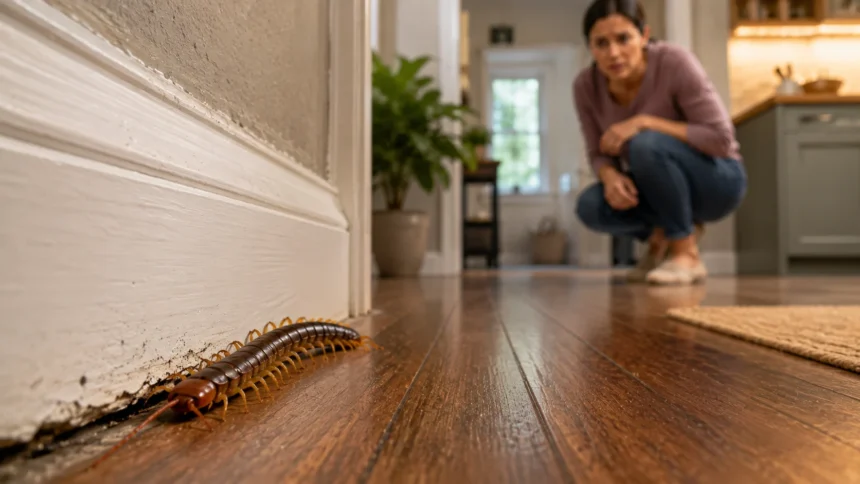
Centipede in the House? Why It Happens & What to Do
Seeing a centipede suddenly sprint across a bathroom floor or disappear beneath furniture can be unsettling, especially when you are not sure why it is inside. House centipedes are fast-moving arthropods with many long legs, flattened bodies, and a preference for dark, humid places. Their appearance may look alarming, but they are usually more interested in hunting small insects than interacting with people. In fact, a centipede indoors can sometimes indicate that other pests, such as spiders, silverfish, cockroaches, or small insects, are available as food. Understanding why centipedes enter homes makes controlling them much easier. The best solution usually involves reducing moisture, removing prey insects, and sealing potential entry points.
One centipede does not automatically mean that your house has a major infestation. Individual centipedes can wander indoors through gaps around doors, foundations, pipes, vents, and windows while searching for food or shelter. However, repeated sightings may suggest that your home provides favorable conditions such as humidity, hiding places, or a reliable food supply. Killing every centipede you see may reduce immediate encounters, but it does not address the conditions attracting them. Long-term centipede control therefore focuses on changing the environment inside and around your home. This guide explains why centipedes appear indoors, whether they are dangerous, where they hide, how to remove them, and how to prevent them from returning.
What Does It Mean When You Find a Centipede in Your House?
Finding a centipede inside usually means that the animal has discovered suitable shelter, moisture, food, or a combination of these conditions. Centipedes are predators rather than household scavengers, so they do not normally enter because they want crumbs, furniture, clothing, or stored food. Instead, they hunt smaller arthropods that may already be living in or passing through the home. Bathrooms, basements, utility rooms, garages, and crawl spaces often provide the damp and sheltered environments centipedes prefer. A single sighting may simply involve a wandering individual. Frequent sightings, however, can provide useful clues about moisture levels and other insect activity within the building.
House centipedes are particularly well adapted to indoor environments compared with many outdoor centipede species. Their long legs allow them to move quickly across floors and walls, while their flattened bodies help them hide inside narrow cracks and gaps. During the day, they often stay out of sight beneath objects, behind baseboards, inside wall voids, or in other protected spaces. They become more active at night when people are less likely to disturb them. This explains why homeowners sometimes see a centipede suddenly appear after turning on a bathroom or basement light. The centipede may have been living nearby for much longer than the brief encounter suggests.
A house centipede sighting can also be a sign that other small pests are present. Centipedes eat a variety of insects and arthropods, including silverfish, flies, moths, cockroaches, spiders, and other small prey they can overpower. If prey is abundant, centipedes have a reason to remain in the area. This does not mean every home containing a centipede has a serious insect infestation. Even clean houses contain occasional spiders, flies, or other tiny arthropods. However, repeated centipede activity may justify inspecting the home for hidden pest populations instead of focusing only on the centipedes themselves.
Moisture is another major factor because centipedes lose water relatively easily through their bodies and prefer humid environments. A damp basement, leaking pipe, poorly ventilated bathroom, or persistently wet crawl space can create ideal conditions. Homeowners sometimes notice more centipedes during rainy periods because soil and outdoor hiding places become saturated, encouraging arthropods to move into buildings. Seasonal temperature changes can also influence indoor movement. Reducing moisture often makes a property considerably less attractive to centipedes and many of the insects they eat. Moisture management therefore provides benefits that go beyond controlling one unwanted arthropod.
It is also worth distinguishing house centipedes from larger outdoor centipede species that occasionally wander indoors. House centipedes generally have extremely long, delicate-looking legs and move remarkably quickly, while other centipedes may have shorter, sturdier legs and heavier bodies. Identification can influence how concerned a homeowner needs to be because species differ in size and defensive behavior. Most indoor encounters involve animals trying to escape rather than attack. If you regularly see large unfamiliar centipedes or live in an area with medically significant species, local pest professionals can provide more specific identification. For ordinary house centipedes, environmental control is usually more important than aggressive treatment.
Why Do Centipedes Come Inside the House?
Food is one of the main reasons centipedes remain inside a home. These predators rely on other small animals for survival, so an indoor population of cockroaches, spiders, silverfish, carpet beetles, flies, moths, or similar insects can create an attractive hunting ground. A centipede does not need large amounts of prey to survive, especially when hiding places are plentiful. Basements and storage rooms often support small insect populations that homeowners rarely notice. Centipedes can hunt these insects quietly at night and remain hidden during the day. Removing their food supply is therefore one of the most effective long-term strategies for making an indoor environment less suitable.
High humidity is another powerful attraction. Centipedes prefer environments where they can maintain body moisture, which is why bathrooms, laundry rooms, crawl spaces, and basements frequently produce sightings. Condensation on pipes, water seepage through foundations, poor drainage, and plumbing leaks can all maintain damp conditions. Even rooms that do not appear visibly wet may have high relative humidity that supports centipedes and their prey. A dehumidifier can help in chronically humid spaces when ventilation alone is not enough. Repairing the underlying moisture source is even more important because persistent dampness can also contribute to mold growth, structural deterioration, and other pest problems.
Weather conditions can push centipedes indoors even when a house normally provides little attraction. Heavy rain may flood outdoor hiding places beneath leaves, stones, logs, mulch, or soil, encouraging centipedes to seek drier shelter. Hot, dry weather can have the opposite effect by driving moisture-dependent arthropods toward cooler, more humid indoor environments. Cooler temperatures may also increase movement toward protected spaces around foundations and buildings. These seasonal movements help explain why a homeowner may suddenly notice several centipedes within a short period despite rarely seeing them previously. Weather-related invasions may decrease naturally, but entry-point repairs can reduce future episodes.
Centipedes can enter through surprisingly small openings around the exterior of a home. Common routes include foundation cracks, gaps beneath exterior doors, damaged weatherstripping, poorly sealed utility penetrations, basement windows, vents, and spaces where pipes or cables enter walls. They may also move through floor drains, crawl spaces, or connected wall voids depending on building construction. Older homes often have more cracks and gaps simply because materials shift and age over time. Sealing these openings reduces centipede access while also limiting entry for many insects that serve as prey. Exterior exclusion is therefore one of the most efficient pest-control improvements a homeowner can make.
Outdoor landscaping can also create conditions that bring centipedes close to the foundation. Thick leaf litter, dense groundcover, stacked firewood, stones, boards, compost, and heavy mulch provide damp hiding places for centipedes and insects. When these materials sit directly against exterior walls, centipedes have only a short distance to travel before finding cracks into the house. Keeping a clearer, drier zone around the foundation can reduce pressure from outdoor arthropods. Firewood should ideally be stored away from the building rather than leaning against exterior walls. Good yard drainage also helps because constantly damp soil near the foundation can support a wide range of moisture-loving pests.
Are House Centipedes Dangerous to People or Pets?
House centipedes look intimidating because of their many legs and extraordinary speed, but they generally avoid people whenever possible. They are predators equipped with modified front appendages that can inject venom into small prey, yet encounters with humans rarely result in bites. A centipede is more likely to run beneath furniture or into a crack than approach someone intentionally. Bites are more likely if a centipede is trapped against the skin, picked up with bare hands, or otherwise handled. For this reason, direct handling is unnecessary even when the animal appears harmless. Using a container or vacuum is a safer method for removing an unwanted centipede.
When a house centipede does bite, symptoms are usually localized rather than severe. A person may experience temporary pain, redness, swelling, itching, or a burning sensation around the site. Reactions vary depending on the size of the centipede, the amount of venom delivered, and individual sensitivity. Washing the area with soap and water and applying a cool compress may help with mild discomfort. Significant swelling, severe pain, spreading symptoms, breathing problems, dizziness, or signs of an allergic reaction deserve prompt medical attention. Anyone bitten by a large or unidentified centipede should also consider professional medical advice if symptoms are concerning.
Children should be taught not to touch centipedes or other unfamiliar arthropods they find indoors or outdoors. Curiosity can lead a child to trap or squeeze an animal that would otherwise have escaped, increasing the possibility of a defensive bite. The same principle applies to pets that chase fast-moving insects across floors. Cats may swat at centipedes, while dogs may attempt to mouth or eat them. Most house-centipede encounters are unlikely to cause serious pet problems, but irritation or injury can occur. If a pet develops facial swelling, excessive drooling, vomiting, breathing difficulty, or another unusual symptom after interacting with a centipede, contact a veterinarian.
Centipedes are not known for spreading human diseases through food contamination in the way cockroaches, flies, or rodents can. They do not seek pantry items, pet food, or kitchen scraps because they hunt living prey. They also do not damage wood, clothing, furniture, books, or building materials to obtain food. This makes them structurally less destructive than termites, carpenter ants, or certain beetles. Their main problem in homes is psychological discomfort and the possibility that their presence indicates another pest or moisture issue. From an ecological perspective, they can actually reduce populations of several less desirable household pests.
Large outdoor centipede species can produce more painful bites than the common house centipede, so homeowners should avoid assuming that every centipede has identical risk. Geographic location matters because species diversity differs substantially between regions. If you encounter a large, brightly colored, heavy-bodied centipede that does not resemble the typical long-legged house species, avoid handling it directly. Photographing it from a safe distance can help with later identification. Pest-control professionals, local extension services, or other regional experts may be able to identify unfamiliar species. For most indoor house-centipede encounters, however, the appropriate response is calm removal and environmental prevention rather than fear.
Where Do Centipedes Hide and What Do They Eat?
Centipedes prefer dark, protected locations where moisture levels remain relatively stable. Basements are common hiding areas because they often contain unfinished surfaces, storage boxes, cracks, pipes, and higher humidity than upper floors. Crawl spaces can provide similar conditions and may allow centipedes to enter through openings around plumbing or foundations. Bathrooms are another frequent location because showers and sinks increase humidity while cabinets, baseboards, and pipe openings provide shelter. Laundry rooms, utility closets, garages, and boiler rooms can also support centipede activity. Finding them repeatedly in one room can help identify where moisture or prey populations are concentrated.
During daylight hours, house centipedes often remain concealed in cracks, crevices, wall voids, or spaces beneath stored objects. Cardboard boxes, piles of clutter, stacked materials, and rarely moved furniture create excellent hiding places because disturbances are infrequent. At night, centipedes emerge to hunt and may travel considerable distances through the building. Their speed allows them to chase prey rather than relying entirely on passive ambush. Homeowners may therefore see a centipede in a bedroom even when the primary hiding area is located elsewhere. Observing where sightings occur most often can still help narrow down the parts of the house that deserve closer inspection.
House centipedes feed on a broad range of small arthropods. Silverfish are common prey because they also prefer humid, protected spaces and frequently occur in basements, bathrooms, and storage areas. Centipedes may also eat small cockroaches, moths, flies, beetle larvae, spiders, and other insects they encounter. They capture prey with specialized front appendages and use venom to immobilize it before feeding. Because they hunt other pests, some homeowners choose to tolerate occasional house centipedes rather than remove every individual. Whether that is acceptable depends entirely on personal comfort and the frequency of sightings.
Food availability helps determine whether a centipede simply passes through or remains in the home. An area containing many silverfish or cockroach nymphs provides repeated hunting opportunities, while a clean, dry space with little prey is less likely to support centipedes for long. This means that centipede control often overlaps with broader insect management. Sticky monitoring traps can help reveal which small pests are active in basements, kitchens, or utility areas. Inspecting stored food, cardboard, drains, and moisture-prone spaces may uncover another infestation that had gone unnoticed. Removing prey can gradually reduce centipede activity even without directly treating every hiding place.
Outdoor centipedes typically hide beneath logs, stones, bark, leaves, mulch, compost, and other materials that protect them from dryness and sunlight. These same habitats often contain insects and other small animals that provide food. When outdoor conditions become unsuitable, centipedes may move toward foundations and eventually enter nearby structures. Reducing excessive mulch depth and removing unnecessary debris close to the home can make the perimeter less attractive. This does not require eliminating every natural area from the yard. The goal is simply to avoid creating constantly damp, undisturbed habitat directly against exterior walls where arthropods can easily find openings indoors.
How to Get Rid of a Centipede in the House Right Away
If you see a single centipede and want it removed immediately, the simplest option is often a container and a stiff piece of paper or cardboard. Place the container over the centipede, carefully slide the paper beneath it, and carry the animal outdoors away from entry points. This method avoids direct contact and does not require pesticide use. House centipedes move quickly, so approaching slowly and having the container ready improves the chances of success. Avoid grabbing the centipede with bare fingers because defensive biting is possible when the animal is restrained. Release it in a sheltered outdoor location where it can continue feeding on other arthropods.
A vacuum cleaner is another practical option when the centipede is too fast to capture manually. Use the hose attachment to remove the animal from floors, walls, or corners without touching it. If the vacuum uses a disposable bag, sealing and discarding the bag afterward can prevent the centipede or other collected pests from escaping. Bagless vacuum containers can be emptied outdoors and cleaned according to the manufacturer’s instructions. Vacuuming also helps remove spider webs, insect remains, egg cases, and debris that may support other pest populations. Regular cleaning therefore contributes to both immediate centipede removal and broader pest management.
Sticky traps can be useful when centipedes are being seen repeatedly but their hiding place is unknown. Place traps along walls, behind appliances, beneath shelving, near basement corners, and in other areas where centipedes or prey insects are likely to travel. These traps provide information as well as control because they reveal what types of arthropods are active inside the home. If traps capture many silverfish, cockroaches, or spiders along with centipedes, the underlying food source becomes easier to identify. Keep traps away from children and pets according to product instructions. Monitoring works best when combined with moisture reduction and exclusion rather than used as the only solution.
Indoor pesticide use is not always necessary for occasional centipede sightings. Spraying large areas of the home without understanding where the animals are coming from may provide temporary reduction while leaving moisture, prey, and entry routes unchanged. Pesticides can also create unnecessary exposure when physical removal and environmental changes would solve the problem. If a labeled household insecticide is used, follow all directions regarding application areas, ventilation, protective measures, children, and pets. Never assume that using more product creates better control. Targeted treatment around known cracks or pest-harboring areas is generally more rational than repeatedly spraying visible floors.
Avoid dangerous home remedies promoted online, especially mixtures involving flammable liquids, excessive chemicals, or products not labeled for indoor pest control. Essential oils and household cleaners may have strong odors without reliably eliminating the source of a centipede problem. Pouring chemicals into drains can damage plumbing, create fumes, or introduce environmental hazards without addressing where centipedes are actually living. The safest immediate response is physical removal followed by inspection. Once the centipede is gone, check nearby areas for moisture, insects, and cracks. Solving those conditions makes another encounter less likely and provides much more value than simply killing the individual animal.
How to Prevent Centipedes From Coming Back
Moisture control is one of the most effective ways to make a house less attractive to centipedes. Repair leaking pipes, faucets, water heaters, and air-conditioning systems rather than allowing small leaks to persist. Improve bathroom ventilation by using an exhaust fan during and after showers when appropriate. Basements with chronic humidity may benefit from a properly sized dehumidifier, especially during warm or rainy seasons. Crawl-space moisture may require improved drainage, vapor barriers, ventilation changes, or professional evaluation depending on construction. Keeping indoor humidity under control also discourages silverfish, cockroaches, and other prey insects that help support centipede populations.
Sealing exterior entry points can dramatically reduce the number of centipedes and insects entering the building. Inspect exterior doors for worn weatherstripping and install door sweeps where visible gaps exist beneath them. Seal cracks around foundations, utility penetrations, plumbing lines, cables, and window frames using materials appropriate for the particular surface. Repair damaged screens and make sure vents are protected while still providing necessary airflow. Basement windows and crawl-space access points deserve special attention because they are close to ground-level arthropod habitat. Exclusion works best when performed systematically rather than sealing only the crack nearest the last centipede sighting.
Reducing clutter eliminates hiding places and makes pest activity easier to detect. Basements and garages often accumulate cardboard boxes, newspapers, unused furniture, fabric piles, and stored materials that remain undisturbed for years. Switching from cardboard to sealed plastic storage containers can reduce hiding opportunities for several insects. Keep stored items slightly away from walls when practical so the perimeter remains visible for inspection and cleaning. Vacuuming corners, baseboards, and rarely disturbed areas removes webs, insect debris, and potential prey. An organized storage space is not automatically pest-free, but it is much easier to monitor and maintain.
Exterior landscaping should also be managed so damp habitat does not extend directly to the foundation. Remove excessive leaf litter, boards, stones, and other debris resting against exterior walls. Keep firewood elevated and stored at a reasonable distance from the house. Mulch is valuable for gardens, but overly deep or constantly saturated mulch beside the foundation can create ideal shelter for centipedes and other arthropods. Correct gutters and downspouts that dump water near the building, and improve grading if rainwater regularly collects around the foundation. A drier perimeter reduces both centipede habitat and the moisture conditions that can contribute to structural or mold problems.
Finally, control other household pests because eliminating prey reduces the reason centipedes remain indoors. Store food in closed containers, clean spills and crumbs, repair plumbing problems, and address cockroach or silverfish activity promptly. Inspect incoming cardboard packages and secondhand items when pest exposure is possible. Use monitoring traps to identify patterns rather than waiting for populations to become obvious. If prey insects disappear, centipedes have fewer opportunities to feed and may leave or die out naturally. Prevention works best as an integrated system involving moisture management, sanitation, exclusion, clutter reduction, and targeted pest control rather than relying on one spray or repellent.
Does Seeing Centipedes Mean You Have an Infestation?
Seeing one centipede does not necessarily indicate an infestation. Individual house centipedes can enter from outside or travel from a hidden area without establishing a large population inside the home. Seasonal changes may produce several sightings close together even when long-term numbers remain low. A homeowner who sees one centipede every few months may simply be encountering occasional wanderers. The situation becomes more meaningful when centipedes appear repeatedly in multiple rooms or are observed at different life stages. Frequent sightings suggest that the home may provide enough food, moisture, and shelter to support ongoing activity.
The number of prey insects present is often more important than the number of visible centipedes. Because centipedes are predators, a reliable food supply allows them to remain in a building. If several centipedes appear within a basement, inspect for silverfish, cockroaches, spiders, small flies, beetles, or other arthropods. Sticky traps can help estimate activity that remains hidden during daylight hours. Discovering numerous prey insects may reveal that centipedes are a symptom rather than the primary pest problem. Treating only the predator while leaving hundreds of prey insects untouched is unlikely to produce long-term results.
Young centipedes can provide another clue because seeing different sizes repeatedly may indicate reproduction nearby. House centipedes can complete their life cycle indoors when temperature, moisture, shelter, and food remain suitable. However, homeowners rarely see every stage because these animals spend much of their time concealed. Finding a single small centipede does not conclusively prove an indoor breeding population because young individuals can also enter from outside. Patterns over time matter more than one isolated observation. Keeping simple notes about where and when sightings occur can help determine whether activity is increasing, stable, or disappearing.
Repeated sightings near one bathroom or basement wall may point toward a local moisture issue rather than a house-wide infestation. A leaking pipe behind a wall, damaged drain connection, wet crawl space, or condensation problem can create a small favorable habitat supporting both centipedes and prey. Addressing that single condition may cause sightings to drop quickly. If centipedes appear throughout several floors, broader entry routes or prey populations may be involved. Inspection should therefore follow the pattern instead of assuming every room requires pesticide treatment. Understanding where activity is concentrated saves time and helps identify the actual environmental cause.
The word infestation can also create more fear than the situation deserves. House centipedes do not form colonies in the same way as ants, termites, or social wasps, and they are generally solitary hunters. A home can contain several individuals without supporting an organized nest or colony. The practical question is whether their numbers are increasing and whether environmental conditions are encouraging them to stay. If sightings remain occasional, basic prevention may be sufficient. If they become frequent, investigate moisture and prey insects before deciding that aggressive treatment is necessary.
When Should You Call a Pest Control Professional?
Professional pest control may be useful when centipede sightings continue despite reasonable moisture reduction, cleaning, and entry-point repairs. An experienced technician can inspect basements, crawl spaces, utility penetrations, foundation gaps, and other areas that homeowners may overlook. The inspection should ideally focus on understanding why centipedes are present rather than simply applying pesticide throughout the building. Professionals can also identify prey insects that may be sustaining the population. If cockroaches, silverfish, or another pest is found, controlling that source may provide more lasting centipede reduction. Ask the company what evidence supports its treatment recommendation before agreeing to repeated applications.
A professional inspection is especially valuable when the home has significant moisture or structural problems. Persistent basement dampness, crawl-space condensation, leaking foundations, and drainage problems may require repairs beyond ordinary pest treatment. Pest professionals can point out areas of concern, but plumbers, contractors, waterproofing specialists, or other trades may be necessary to correct the underlying condition. Killing insects without repairing chronic moisture can create a repeating cycle in which pests return after every treatment. Long-term pest control often depends on building maintenance. A good pest management plan therefore combines environmental correction with targeted treatment where needed.
Call for help sooner if you are seeing large numbers of centipedes together with evidence of cockroaches or another significant household pest. Cockroach infestations, for example, can involve hidden populations that reproduce quickly and require coordinated control. Centipedes may simply be benefiting from the abundant prey. Treating the cockroach problem can eventually reduce both pests. The same principle applies when silverfish are damaging books, paper, or stored belongings in damp areas. A professional can identify which problem deserves priority and select treatment methods accordingly. Accurate identification prevents money from being spent on the wrong target.
Professional assistance may also be appropriate when the centipede species is unfamiliar or unusually large. Most common house centipedes are relatively easy to recognize, but other species vary according to climate and geography. Some larger centipedes can deliver more painful defensive bites, making direct handling particularly undesirable. A pest professional can identify likely species and determine whether indoor breeding is occurring or whether the animals are simply wandering in from outside habitat. If possible, take a clear photograph without handling the animal. Identification allows control recommendations to reflect the biology of the actual species rather than generic advice.
Ultimately, most occasional house-centipede sightings can be managed without major intervention. A dry, well-sealed home with limited insect prey naturally provides fewer reasons for centipedes to enter or remain. Professionals become most valuable when the pattern persists, the source cannot be located, another pest infestation is suspected, or structural conditions make prevention difficult. Effective pest control should reduce both immediate sightings and the environmental factors supporting them. Ask about exclusion, sanitation, moisture, and monitoring rather than focusing entirely on chemicals. The goal is not simply to kill the centipede you saw tonight, but to make your home less attractive to the next one.
Frequently Asked Questions
Why am I suddenly seeing centipedes in my house?
Sudden sightings can result from increased indoor humidity, heavy rain, seasonal temperature changes, or a growing population of insects that centipedes use as food. They may also be entering through newly opened cracks or gaps around doors, foundations, plumbing, and windows.
Are house centipedes dangerous?
House centipedes usually avoid people and rarely bite unless they are trapped or handled. A bite can cause temporary pain, redness, or swelling, while severe or allergic symptoms require medical attention.
Should I kill house centipedes?
You do not have to kill them because house centipedes prey on cockroaches, silverfish, spiders, and other small household pests. If you do not want them indoors, capture and release them outside or remove them with a vacuum while addressing the conditions attracting them.
What attracts centipedes to a house?
Moisture, dark hiding places, small entry gaps, and populations of prey insects are the main attractions. Damp basements, bathrooms, crawl spaces, cluttered storage areas, and wet landscaping near foundations commonly support centipede activity.
How do I permanently reduce centipedes in my home?
Reduce humidity, repair leaks, seal cracks and door gaps, remove clutter, improve exterior drainage, and control other insects that serve as food. If frequent sightings continue after these changes, a professional pest inspection can help identify hidden moisture, entry points, or prey infestations.