


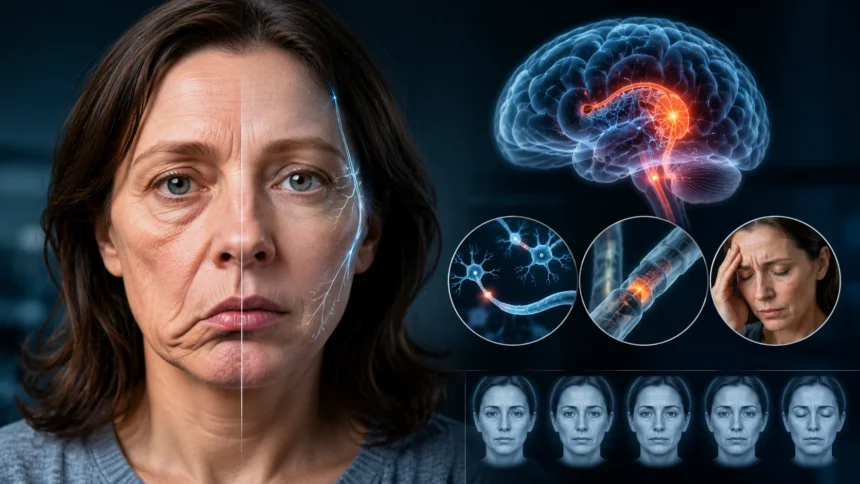
Demon Face Syndrome: What It Is, Symptoms & Causes
Seeing another person’s face suddenly appear stretched, twisted, swollen, displaced, or frightening can be deeply unsettling. The phenomenon sometimes described online as demon face syndrome is more accurately known as prosopometamorphopsia, commonly abbreviated as PMO. It is a rare visual-perception disorder in which a person sees distortions in faces even though the actual face has not physically changed. Depending on the individual, facial features may appear enlarged, narrowed, drooping, melting, rotating, or positioned incorrectly. The distortion may involve an entire face or only one side of it. Importantly, PMO is a neurological or visual-perceptual phenomenon rather than evidence that the people being viewed have actually changed appearance.
Interest in demon face syndrome increased considerably after researchers described an unusual case in which a man reported that people’s faces looked dramatically distorted when viewed in person. In that particular case, photographs and faces displayed on screens appeared normal, allowing researchers to create computer-generated images approximating what the patient experienced. The case attracted attention because the distorted faces were described as having an unusually frightening or exaggerated appearance. However, the term demon face syndrome is informal and does not describe every person’s experience with PMO. Other patients may perceive relatively subtle changes such as enlarged eyes, shifted mouths, stretched cheeks, or one-sided facial distortion. Researchers emphasize that prosopometamorphopsia can vary substantially from one individual to another.
Because PMO is extremely rare, much remains unknown about exactly why it develops and why the distortions differ between patients. Research has linked some acquired cases with neurological events or abnormalities affecting brain regions involved in visual and facial processing. Symptoms may sometimes appear after stroke, brain injury, seizures, migraine-related events, or other neurological conditions, although the cause is not always obvious. Recent research has also documented an unusual early-emerging form in a person who had experienced facial distortions throughout much of life without a known acquired brain injury. This guide explains what demon face syndrome really means, the symptoms people may experience, possible causes, diagnosis, treatment considerations, and when unusual facial distortions deserve urgent medical attention.
What Is Demon Face Syndrome?
Demon face syndrome is an informal expression sometimes used to describe prosopometamorphopsia, a disorder in which faces appear visually distorted. The medical name combines concepts relating to faces and altered visual perception. A person with PMO may look directly at someone and see individual features change shape, position, size, color, or overall appearance even though the other person’s face is completely normal. These distortions arise from how visual information is being processed rather than from changes in the eyes of the person being observed. Researchers describe PMO as an exceptionally rare disorder of higher visual perception. Reviews of published cases show that only a relatively small number have been scientifically documented over more than a century.
The phrase demon face syndrome became especially visible after a widely discussed 2024 case reported by Dartmouth researchers. A 58-year-old man experienced unusual distortions in which real faces appeared dramatically altered, while faces seen in photographs or on computer screens appeared normal. Researchers were therefore able to compare a real person’s face with a photograph and modify the digital image according to the patient’s instructions. This allowed them to create unusually realistic representations of the distortions he perceived. His experience included exaggerated facial features that gave people what he described as a frightening appearance. Although this case helped the public understand PMO, it represents only one possible presentation of the disorder.
Not everyone with prosopometamorphopsia sees frightening or monster-like faces. Some people may perceive one eye as larger than the other, a mouth as stretched sideways, a cheek as swollen, or part of a face as displaced. Others have described facial features as drooping, twisting, shrinking, expanding, or changing position. Distortions may remain relatively stable or appear to move dynamically while the individual continues looking at the face. The effect may involve familiar people, strangers, the person’s own reflection, or different combinations depending on the case. Research indicates that PMO can influence facial shape, texture, positioning, and color. This wide variation explains why a single dramatic nickname cannot capture every person’s experience.
Another important point is that PMO does not necessarily mean a person cannot recognize who they are looking at. Some patients can identify familiar people despite seeing distorted facial features, while others may experience additional problems with facial recognition. The brain performs several different tasks when processing a face, including detecting that an object is a face, analyzing individual features, interpreting expressions, and identifying the person. Prosopometamorphopsia appears capable of disrupting some parts of this processing while leaving others relatively intact. This makes the condition particularly interesting to neuroscience researchers studying how the brain represents faces. It also helps explain why symptoms can look very different across patients.
The duration of demon face syndrome can vary considerably. Some documented individuals have experienced distortions temporarily, while others have continued seeing altered faces for months or years. Dartmouth researchers note that PMO episodes have been reported across periods ranging from days and weeks to much longer durations. Symptoms may also change in severity or appearance over time depending on the underlying neurological process. Because the disorder is so uncommon, there is no single typical course that applies to every patient. Anyone who suddenly begins seeing faces as distorted should therefore seek medical evaluation rather than assuming the symptom will disappear by itself.
Symptoms of Demon Face Syndrome
The defining symptom of prosopometamorphopsia is seeing distortions in human faces that are not actually present. A person’s eyes might appear unusually large, narrow, misplaced, or stretched, while their nose or mouth may look shifted from its normal position. Facial features can appear to droop downward, bulge outward, rotate, shrink, or expand. Some people report that the entire face appears warped, while others notice distortion only in selected features. These changes can remain fixed or appear to move as the person continues looking. Medical descriptions emphasize that the distortions may affect shape, size, position, texture, or color rather than following one universal pattern.
Some patients experience hemi-prosopometamorphopsia, meaning the distortion affects only one side of a face. For example, the left half might appear stretched or melted while the right half looks relatively normal. Interestingly, research suggests that in certain cases the same perceived half of faces may remain distorted even when faces are viewed from different positions or orientations. This finding provides clues about how the brain organizes facial information rather than simply processing each visible feature independently. Dartmouth researchers have studied such cases to better understand how facial representations are created within the visual system. For the person experiencing the symptom, however, the effect can simply feel strange, confusing, or frightening.
Distortions do not always occur under every viewing condition. A person might see altered faces when looking directly at someone but perceive the same face normally in a photograph, mirror, or digital screen. The well-known 2024 Dartmouth case was particularly unusual because real faces appeared distorted while photographs and screen images did not. Other patients may experience distortions in photographs as well as real-life faces. Symptoms may also depend on viewing distance, visual-field position, orientation, lighting, or whether individual facial features are viewed separately. This variation makes careful symptom description extremely important during medical evaluation.
People with PMO may experience emotional reactions even when they understand logically that the distorted faces are not real. Sudden changes in another person’s appearance can naturally cause fear, anxiety, discomfort, confusion, or social withdrawal. Someone may become hesitant to make eye contact or enter crowded environments because seeing many distorted faces at once becomes overwhelming. Children or people unfamiliar with visual-perception disorders may have particular difficulty explaining what they are experiencing. The emotional response should not be mistaken for the cause of the distortion itself. Reassurance may help, but persistent or sudden facial distortion still deserves neurological and visual assessment.
Other neurological symptoms may or may not accompany prosopometamorphopsia depending on its cause. Someone whose symptoms develop after a stroke, seizure, head injury, or another neurological event could also experience weakness, numbness, speech difficulties, headaches, confusion, visual-field changes, or other abnormalities. In other cases, PMO may appear as the most noticeable symptom. This variability is one reason self-diagnosis from pictures or online descriptions is unreliable. The same complaint of distorted faces can arise in different neurological or ophthalmological circumstances. Medical professionals therefore look at the complete symptom pattern rather than diagnosing PMO from one description alone.
What Causes Demon Face Syndrome?
There is no single established cause responsible for every case of demon face syndrome. Prosopometamorphopsia appears to result from disruption somewhere within the complex systems responsible for processing faces and visual information. A review of 81 cases found associations between different patterns of facial distortion and lesions affecting particular brain regions involved in visual processing and communication between hemispheres. Bilateral distortions were especially associated with right-sided or bilateral occipital abnormalities, while certain one-sided distortions were associated with other pathways and the splenium of the corpus callosum. However, not every person with PMO has the same type or location of neurological abnormality. The precise neural mechanisms therefore remain an active area of research.
Stroke is one possible cause documented in medical literature. A stroke can interrupt blood flow to a region of the brain and damage networks responsible for interpreting visual information. Case reports have described prosopometamorphopsia after infarction involving areas such as the splenium of the corpus callosum, which helps connect information between the brain’s hemispheres. One reported patient with PMO after such an infarct gradually improved and experienced complete symptom resolution by approximately one year. More recent research has continued documenting uncommon cases associated with splenial infarction. Sudden facial distortion accompanied by possible stroke symptoms should therefore always be treated as a medical emergency.
Brain injury is another possible contributor because damage can interrupt networks involved in face perception even when a person’s basic eyesight remains intact. Traumatic brain injuries can affect different brain regions depending on the location and severity of the injury. Someone may be able to see objects clearly while experiencing unusual problems interpreting particular categories of visual information. Prosopometamorphopsia illustrates how vision depends not only on the eyes but also on extensive processing inside the brain. Damage involving occipital, temporal, parietal, or connecting pathways has been discussed in published PMO cases. The presence of facial distortion after a head injury should therefore be discussed promptly with a medical professional.
Seizures, migraine-related neurological disturbances, and other temporary disruptions of brain activity have also appeared in descriptions of prosopometamorphopsia and related visual distortions. The first documented PMO-like case described in the scientific literature dates back to 1904 and involved facial distortion after epileptic seizures. Temporary changes in electrical or visual-processing activity may therefore produce unusual distortions even without permanent structural damage. However, experiencing a migraine or seizure does not mean a person will develop PMO, and most people with those conditions never experience it. The relationship depends on individual neurological circumstances. Doctors must distinguish PMO from more common visual disturbances that can occur during migraine or seizure activity.
Not every case develops after an obvious neurological event. Recent research published in 2025 described the first comprehensive study of an early-emerging form of PMO in a young person who reported lifelong dynamic facial distortions. Structural MRI did not identify a conventional lesion, although researchers found differences in certain face-selective brain areas and white-matter measures. This case suggests that facial distortion can occasionally emerge early rather than being acquired after stroke, injury, or illness. It also demonstrates why researchers remain cautious about claiming one universal cause. PMO appears to be a symptom pattern that can potentially arise through several different disruptions within the visual face-processing network.
Different Types and Patterns of Prosopometamorphopsia
Prosopometamorphopsia can be broadly described according to whether distortions affect the entire face or only part of it. In bilateral PMO, distortions may occur across both sides of the face, creating changes in several facial features simultaneously. Eyes, noses, mouths, cheeks, or the overall outline of the face may appear altered. Some individuals describe the changes as relatively symmetrical, while others experience complex combinations of distortions. Research indicates that bilateral patterns have sometimes been associated with particular visual-processing regions in the brain. Understanding whether one or both sides are affected can therefore provide useful information during neurological assessment.
Hemi-prosopometamorphopsia is a form in which only one half of a person’s face appears distorted. The dividing line may follow the perceived center of the face surprisingly closely. Someone might look at several different people and repeatedly see abnormalities on the same side of each face. Experimental research suggests that certain hemi-PMO patients maintain this distortion pattern despite changes in facial orientation, indicating that the brain may organize facial information according to internal face-centered representations. This phenomenon has provided researchers with valuable clues about normal facial perception. For patients, it may create unusual experiences in which one half of a familiar person’s face seems normal while the other appears dramatically altered.
Some people experience static distortions, meaning the altered appearance remains relatively stable while they look at a face. An eye might consistently appear enlarged, or one side of a mouth might appear displaced without continuously changing. Other individuals experience dynamic distortions in which features seem to move, stretch, rotate, expand, disappear, or transform while being viewed. The 2025 early-emerging PMO study described complex dynamic changes involving movement, shrinking, expansion, rotation, and disappearance of facial features. Dynamic symptoms may be particularly difficult to describe because the perceived face does not remain visually consistent. Keeping notes about exactly what occurs can therefore help when discussing symptoms with clinicians.
Face distortions may also be selective according to viewing format or context. Some patients perceive abnormalities in both real faces and images, whereas others show surprising differences between physical and pictured faces. The Dartmouth patient whose experience generated widespread public interest perceived dramatic distortions in people standing in front of him but not in photographs or computer displays. Other PMO cases demonstrate that distance, orientation, visual-field position, or presentation of individual features can influence distortion severity. These findings reinforce the idea that PMO is not simply blurred eyesight. It involves higher-level processing of facial information after the basic visual image has entered the nervous system.
The parts of the face affected can also vary significantly. One person may mainly notice distortions around the eyes, while another may see altered mouths, noses, ears, cheeks, or complete facial shapes. Color and texture can sometimes appear different in addition to geometry. Certain people can still recognize facial identity accurately, while others experience misrecognition or difficulty connecting a face with the correct person. The 2025 early-emerging case included both visual distortions and episodes of identity misrecognition, demonstrating that face-processing symptoms can overlap. These different patterns help explain why specialists need detailed descriptions rather than simply asking whether faces look strange.
How Demon Face Syndrome Is Diagnosed
There is no simple home test that can reliably diagnose prosopometamorphopsia. Evaluation begins with a detailed description of what the person sees, when the distortions started, how long they last, and whether they involve all faces or only certain viewing situations. A clinician may ask whether the problem affects real people, photographs, mirrors, television images, or the person’s own face. They may also ask whether distortions affect one side or both sides and whether individual features appear enlarged, moved, colored, or warped. These details can help distinguish PMO from other visual or neurological problems. A timeline of symptoms is especially important when onset has been sudden.
A neurological examination may be performed to look for additional signs that could suggest stroke, seizure disorders, brain injury, or another neurological condition. Clinicians may assess strength, sensation, coordination, speech, eye movements, visual fields, memory, and other neurological functions. The absence of obvious neurological abnormalities does not necessarily rule out PMO because some patients can otherwise function normally. However, additional symptoms can help identify an underlying cause requiring immediate treatment. Medical history is equally important, particularly previous strokes, seizures, migraines, head injuries, neurological illnesses, or new medications. The goal is to determine both what the visual experience represents and why it may have developed.
Eye examinations may also be appropriate because visual distortions can sometimes arise from problems affecting the eyes or retina rather than higher-level facial processing. An eye specialist can assess visual acuity, retinal health, eye movements, and other aspects of vision. Prosopometamorphopsia is particularly unusual because distortions may be disproportionately specific to faces even when ordinary objects appear normal. Researchers have described PMO in association with both neurological and retinal abnormalities, illustrating the need for a broad assessment. If only faces look distorted while surrounding objects remain unchanged, that pattern should be explained clearly to the clinician.
Brain imaging may be recommended depending on how symptoms began and what other findings are present. Magnetic resonance imaging, commonly called MRI, can help clinicians look for structural abnormalities such as stroke-related injury, tumors, inflammation, trauma, or lesions in brain regions involved in visual processing. Computed tomography may sometimes be used in emergency situations or when MRI is not immediately available. Researchers studying PMO have used advanced MRI techniques to examine face-selective brain regions and white-matter connections. Imaging results can be normal in some unusual cases, so diagnosis does not depend on finding one specific lesion. The complete clinical picture remains important.
Specialized neuropsychological or visual-perception testing can further explore how a person recognizes and processes faces. A clinician or researcher may compare performance for face identity, facial emotion, age, sex, objects, or other visual categories. Tests may also examine whether distortion changes with viewing distance, face orientation, visual-field location, or isolated facial features. Such testing can reveal that certain face-processing abilities remain surprisingly intact despite severe subjective distortions. Research into PMO frequently uses these differences to understand how normal facial perception is organized. For ordinary clinical care, however, evaluation is tailored to symptoms and the suspected underlying medical cause.
Treatment and Management of Demon Face Syndrome
There is currently no single treatment designed specifically for every case of prosopometamorphopsia. The condition is too rare and too variable for one standardized therapy to have been established. Management generally focuses on identifying and treating the underlying neurological, ophthalmological, or medical problem when one can be found. For example, PMO associated with stroke requires appropriate stroke management and follow-up, while seizure-related symptoms may require neurological treatment directed at seizure control. Migraine-associated visual phenomena may be managed differently again. Treatment should therefore be based on the patient’s complete diagnosis rather than the visual distortion alone.
Some cases may improve as the underlying neurological condition stabilizes or recovers. A published case involving prosopometamorphopsia after an infarct of the corpus callosum reported that symptoms improved over time and had completely resolved at one-year follow-up. However, this outcome cannot be assumed for every person because reported cases have lasted for very different periods. Some people experience temporary symptoms, whereas others may have persistent distortions over years. Dartmouth researchers similarly note that reported PMO can last days, weeks, or substantially longer. Prognosis therefore depends heavily on the individual case and underlying cause.
Doctors may also focus on reducing associated symptoms or helping patients adapt when facial distortions remain persistent. If particular viewing conditions make faces easier to interpret, patients may naturally begin using those conditions during everyday interactions. For example, an unusual case in which screen images remained normal demonstrated that visual context can substantially change the experience of PMO. That does not mean screens represent a universal treatment because many patients also perceive distortions in photographs and digital images. Rather, clinicians may explore which situations reduce or increase symptoms for a particular person. Personalized coping strategies can make communication and social interactions less stressful.
Psychological support may be useful when persistent distortions cause anxiety, embarrassment, social avoidance, or fear, even though PMO itself is fundamentally a visual-perceptual phenomenon. Repeatedly seeing familiar people appear distorted can be emotionally exhausting, especially before someone understands that the experience has a neurological explanation. Counseling can help individuals manage the emotional response and explain the condition to family, friends, employers, or teachers. Support should never substitute for neurological evaluation when symptoms are new or unexplained. Instead, psychological care can complement medical assessment when the visual disturbance affects daily functioning. Understanding the condition can itself reduce some of the fear surrounding unusual visual experiences.
Because knowledge about PMO remains limited, follow-up may be important when symptoms persist. Doctors may monitor whether distortions change over time or whether additional neurological symptoms appear. Repeat examinations or imaging may occasionally be appropriate depending on the original suspected cause. Patients can help by recording when symptoms occur, how long they last, which faces are affected, and whether particular lighting or viewing conditions change the distortion. Videos cannot record the distortion itself because it exists in the viewer’s perception, but written descriptions or carefully created drawings may help communicate the experience. Detailed observations can make future medical evaluations more informative.
Demon Face Syndrome vs Other Visual Disorders
Prosopometamorphopsia is different from prosopagnosia, commonly called face blindness. A person with prosopagnosia has difficulty recognizing familiar faces even though those faces may look visually normal. Someone with PMO, by contrast, sees the face itself as distorted or altered. The two conditions involve different aspects of facial processing, although they can occasionally coexist. Research on PMO has shown that some individuals retain strong facial-recognition abilities despite distortions, while others experience identity-recognition difficulties as well. Understanding this distinction helps prevent the two rare disorders from being incorrectly treated as interchangeable.
PMO is also different from an ordinary visual hallucination. Hallucinations generally involve perceiving something that is not present, whereas prosopometamorphopsia typically involves a real face whose appearance is perceptually distorted. The person is genuinely looking at another individual, but aspects of that individual’s face appear changed because the visual representation has been altered. Many people with PMO remain aware that what they are seeing cannot reflect the person’s true appearance. This preserved awareness can help distinguish certain cases from psychiatric conditions involving impaired reality testing. However, only a qualified clinician can determine what type of visual disturbance a particular person is experiencing.
The disorder should also be distinguished from simple blurred vision or refractive errors. Nearsightedness, farsightedness, astigmatism, or cataracts can make visual information less clear, but they do not typically cause faces alone to appear systematically twisted or repositioned. PMO can occur even when other objects look relatively normal and basic visual acuity is adequate. That selective nature suggests higher-level interpretation rather than merely poor image quality reaching the eye. Still, retinal disorders and other eye conditions can occasionally contribute to complex distortions. For this reason, ophthalmological evaluation may remain part of the diagnostic process.
Another related term sometimes mentioned is Alice in Wonderland syndrome, a neurological phenomenon involving distortions in perceived size, distance, body shape, time, or surrounding objects. Some descriptions use the phrase loosely alongside facial distortions, but the conditions should not automatically be considered identical. Prosopometamorphopsia specifically centers on distorted facial appearance, whereas Alice in Wonderland syndrome includes a broader range of perceptual changes. A 2025 report noted that informal labels including demon face syndrome and Alice in Wonderland syndrome have sometimes been used in discussion of facial distortion phenomena. Precise medical terminology helps clinicians communicate more clearly about what the patient actually experiences.
Migraine aura can also cause temporary visual changes such as flashing lights, blind spots, zigzag patterns, unusual shapes, or visual distortion. Some neurological reports connect migraine states with unusual perceptual phenomena, including facial distortion, but typical migraine aura is not the same thing as persistent prosopometamorphopsia. Similar confusion can occur with seizure-related visual symptoms because seizures may temporarily alter perception. The timing, duration, associated symptoms, medical history, and imaging findings all help doctors separate these possibilities. Because several neurological conditions can produce unusual visual experiences, online symptom matching cannot reliably identify the cause. New or unexplained distortions deserve professional evaluation.
When to Seek Medical Help for Facial Distortions
A sudden onset of facial distortion should be taken seriously, particularly when it begins without an obvious explanation. Prosopometamorphopsia has been documented in association with stroke and other neurological abnormalities, so abruptly seeing faces differently can potentially represent a neurological warning sign. A person should not simply wait several days to see whether dramatic new visual symptoms disappear. Prompt medical assessment is particularly important when the change is completely new. Even if the eventual explanation is less serious, ruling out urgent neurological causes should take priority.
Emergency care is especially important when facial distortion occurs with weakness, facial drooping, numbness, difficulty speaking, severe imbalance, confusion, sudden vision loss, or an abrupt severe headache. These symptoms can occur with serious neurological conditions such as stroke and require immediate assessment. Seizures, loss of consciousness, or significant changes in awareness also warrant urgent evaluation. The person should avoid driving themselves if vision or neurological functioning is suddenly impaired. Emergency services or another safe transportation option may be more appropriate. Speed matters when certain neurological disorders are responsible because treatment can be time-sensitive.
Symptoms following a recent head injury also deserve prompt medical attention. A person may initially feel relatively well after trauma before developing neurological or visual abnormalities later. New facial distortion, double vision, confusion, worsening headache, repeated vomiting, weakness, or excessive sleepiness after an injury should not be dismissed. Even mild-looking accidents can sometimes cause clinically important brain injuries. Tell the healthcare professional exactly when the injury occurred and when visual symptoms began. Connecting the timeline can help doctors determine whether imaging or additional monitoring is needed.
Persistent distortions that develop gradually also deserve evaluation even when there are no emergency warning signs. Someone who repeatedly sees faces as warped for days or weeks should schedule an appointment rather than adapting without investigation. Start with a healthcare professional who can determine whether neurological, ophthalmological, or other specialist assessment is appropriate. Keep notes describing whether the problem affects one or both sides of faces and whether photographs, mirrors, or screens look different. Mention headaches, seizures, medications, previous neurological conditions, vision problems, and recent illnesses. Detailed information can make a rare symptom easier for clinicians to investigate.
Children or adolescents describing unusual facial distortions should also be taken seriously rather than automatically being assumed to have an active imagination. Recent research demonstrates that early-emerging PMO is possible, although it appears extraordinarily uncommon. A young person may struggle to describe exactly what is changing or may assume everyone sees faces the same way. Parents can ask neutral questions about what the child sees without suggesting frightening explanations. Medical evaluation can help distinguish visual-perception problems from eye conditions, neurological disorders, and other possibilities. Early documentation is particularly valuable when symptoms may have been present for a long period.
Living With Prosopometamorphopsia
Living with persistent prosopometamorphopsia can affect far more than vision because faces are central to everyday social interaction. People naturally rely on faces to identify family members, read emotions, interpret social cues, and feel connected during conversation. When those faces appear distorted, even ordinary activities such as work meetings, family dinners, or shopping can become uncomfortable. The person may know intellectually that everyone looks normal while still receiving a powerful contradictory visual impression. Over time, this mismatch can become mentally tiring. Understanding that PMO is a recognized perceptual phenomenon can therefore provide meaningful reassurance.
Communication with family members and friends can make daily life easier. Explaining that the distortion is caused by visual processing rather than by the other person’s actual appearance can reduce misunderstandings. Someone with PMO may need extra time during conversations or may occasionally avoid direct eye contact when symptoms become overwhelming. Loved ones should avoid repeatedly asking whether their face currently looks frightening unless the person wants to discuss the symptom. Constant attention to the distortion can make social interactions feel more stressful. Practical understanding is generally more helpful than fascination with the unusual visual experience.
Workplace or educational accommodations may become useful when symptoms interfere with communication or concentration. For example, someone whose symptoms vary between in-person and screen-based faces might find certain meeting formats easier than others. Others may need breaks from visually crowded environments or flexibility while undergoing medical investigations. The appropriate adjustment depends entirely on the person’s individual pattern because PMO varies considerably. A healthcare professional may be able to document functional limitations when formal accommodations are required. The goal is to maintain participation rather than unnecessarily withdrawing from work, school, or social life.
Keeping a symptom diary can provide valuable information over time. Record the date, duration, severity, and type of facial distortion as well as any headaches, sleep changes, stress, medications, illness, seizures, or other neurological symptoms occurring around the same period. Note whether real faces, photographs, mirrors, videos, or individual facial features appear differently. Changes in viewing distance or lighting can also be worth recording. This information may reveal patterns that are difficult to remember accurately during an appointment. It can also help healthcare professionals understand whether symptoms are becoming more frequent, less severe, or otherwise changing.
Perhaps most importantly, people experiencing PMO should avoid assuming that the frightening appearance of a face indicates anything about the person being viewed. The distortion is produced by visual perception, not by another individual’s intentions, personality, or physical features. The popular phrase demon face syndrome can make the condition sound mysterious or supernatural, but current research places it within the scientific study of face perception and neurological processing. Using the medical term prosopometamorphopsia can help remove unnecessary stigma and fear. Although much remains to be learned, documented cases continue to improve scientists’ understanding of how the human brain constructs the faces we see.
FAQs About Demon Face Syndrome
Is demon face syndrome real?
Yes, the visual-perception condition behind the term is real and is medically known as prosopometamorphopsia, or PMO. “Demon face syndrome” is an informal nickname rather than an official diagnostic term, and not everyone with PMO sees faces as frightening or demon-like.
What do people with demon face syndrome see?
People with PMO may see faces as stretched, twisted, swollen, drooping, displaced, enlarged, shrinking, or otherwise distorted. The changes can involve an entire face, individual features, or only one side of the face, and experiences vary considerably between patients.
What causes prosopometamorphopsia?
Reported causes and associations include stroke, brain lesions, traumatic brain injury, seizures, migraine-related neurological disturbances, retinal conditions, and abnormalities affecting brain networks responsible for facial perception. In rare cases, symptoms may develop early in life without a clearly identified acquired neurological event.
Can demon face syndrome go away?
It can improve or disappear in some cases, particularly when symptoms are temporary or related to an underlying condition that recovers. However, other people can experience PMO for months or years, so the outlook depends on the individual cause and neurological circumstances.
Should I see a doctor if faces suddenly look distorted?
Yes. Sudden unexplained facial distortion should be medically evaluated, particularly if it occurs with weakness, numbness, difficulty speaking, confusion, severe headache, seizure activity, or other neurological symptoms. Those combinations can indicate a potentially urgent neurological condition requiring immediate assessment.