


20 Amazing Things to Do in Rome, Italy
Rome is a city where a simple walk can unexpectedly place you beside a two-thousand-year-old temple, a Baroque fountain, a Renaissance palace, or a neighborhood restaurant serving recipes deeply connected with Roman tradition. That concentration of history makes planning exciting, but it can also leave first-time visitors wondering which Rome attractions genuinely deserve their limited vacation time. The best things to do in Rome combine famous landmarks with experiences that reveal how the city actually feels between those monuments. Ancient ruins, Vatican masterpieces, atmospheric piazzas, local food, parks, archaeological roads, churches, and panoramic viewpoints all belong in a balanced Rome itinerary. You do not need to see everything on one trip to understand why Rome remains one of Europe’s most rewarding destinations. What matters is choosing experiences that reveal different layers of the Eternal City.
Rome is also a destination where thoughtful planning improves the experience considerably. Major attractions such as the Colosseum, Vatican Museums, Galleria Borghese, and archaeological sites may require advance reservations or benefit strongly from them, while other landmarks can be enjoyed spontaneously during a walk. Several visitor rules have changed in recent years, including paid admission at the Pantheon and a 2026 ticket system for the closest area around Trevi Fountain. Summer heat, cobbled streets, queues, and long museum routes make realistic pacing equally important. Instead of scheduling five major attractions every day, combine one or two demanding visits with squares, neighborhoods, gardens, meals, or sunset walks. This approach creates a Rome vacation that feels memorable rather than exhausting.
The following twenty Rome experiences work for first-time visitors while still offering enough depth for travelers returning to the city. They include essential ancient landmarks such as the Colosseum and Roman Forum, masterpieces inside Vatican City, celebrated Baroque spaces, lesser-known archaeological layers, food-focused neighborhoods, and outdoor areas beyond the historic center. Natural LSI keywords such as Rome sightseeing, places to visit in Rome, Rome tourist attractions, Rome itinerary ideas, ancient Rome, Vatican City, Roman food, historic center, and Rome travel tips are woven throughout the guide. Each section explains what makes the experience special and how to enjoy it more thoughtfully. Whether you have three days or a full week, these are twenty amazing things to do in Rome, Italy.
1. Explore the Colosseum
The Colosseum is the natural starting point for many first-time Rome itineraries because few monuments represent the city so immediately. Built during the Flavian period, this enormous amphitheater once hosted gladiatorial contests, animal hunts, public spectacles, and elaborate events designed to entertain vast crowds. Walking through its surviving corridors reveals that the building was much more sophisticated than the ruined exterior initially suggests. Different seating areas reflected Roman social hierarchy, while circulation routes helped enormous numbers of spectators move efficiently through the structure. The underground spaces once supported scenery, animals, equipment, and performers before they appeared in the arena above. Seeing these elements together transforms the Colosseum from a famous photograph into a complex piece of Roman engineering and political theater.
Give yourself enough time to explore rather than treating the monument as a quick stop before the Forum. From interior terraces, you can study the arena, exposed underground structures, surrounding archaeological landscape, and modern streets that now circle the ancient building. A guided tour is useful for travelers who want historical context, although independent visitors can also use official interpretation resources. Some ticket types include specialized areas such as the arena, underground sections, or upper viewpoints, while standard admission follows a more conventional route. Read exactly what your ticket includes because similarly named experiences can provide significantly different access. Visitors fascinated by gladiatorial history may find upgraded routes worthwhile, while others will be completely satisfied with standard entry and longer time around the Forum.
Advance booking is particularly important because official Colosseum admission uses timed entry. For 2026, standard ticket sales with a compulsory Colosseum time-slot reservation open 30 days before the intended visit, and tickets are issued in the visitor’s name. The archaeological park also asks visitors to have identification available when entering, so the name used during purchase should match the person attending. Current opening hours change seasonally, with longer days during warmer months and earlier closing during winter. (colosseo.it) Buying through official channels helps reduce confusion over what is included and avoids paying unnecessary markups. If seeing the Colosseum is essential to your trip, reserve it before building the rest of your Rome sightseeing schedule.
Morning entry is often comfortable because temperatures and crowds may feel more manageable, particularly from late spring through early autumn. Much of the surrounding archaeological area is exposed to the sun, and summer heat can become tiring after several hours on stone surfaces. Wear supportive shoes because stairs, uneven flooring, and long periods of standing are part of the experience. Carry water and sun protection, but check current security rules before bringing larger bags or unnecessary items. Avoid scheduling another fixed attraction immediately after your planned finish because queues, security, and the temptation to stay longer can disrupt a tightly timed day. Rome becomes far more enjoyable when reservations guide your itinerary without controlling every minute of it.
Return to the Colosseum exterior after sunset if your accommodation and schedule make it practical. Architectural lighting creates a completely different impression, and the surrounding area can feel more dramatic once daytime sightseeing has slowed. Walk around several sides rather than photographing the same angle as everyone arriving from the metro station. Nearby viewpoints reveal how the amphitheater relates to the Forum, Temple of Venus and Rome, and surrounding hills. The building becomes even more impressive when you consider that it has remained an urban reference point through centuries of political, religious, and architectural change. Among all the top attractions in Rome, the Colosseum remains the most powerful place to begin understanding the scale and ambition of the ancient city.
2. Walk Through the Roman Forum
The Roman Forum allows you to walk through what was once the political, ceremonial, religious, and commercial center of ancient Rome. Today, columns, arches, walls, foundations, and reconstructed sections occupy the valley between major Roman hills, but the landscape originally contained dense public architecture. Senators debated nearby, religious ceremonies took place at temples, victorious generals passed through triumphal routes, and ordinary citizens conducted legal or commercial business. Understanding this history prevents the Forum from becoming an indistinguishable collection of stones. Each structure belonged to a functioning civic environment rather than an archaeological display created for modern visitors. The more you imagine crowds, statues, speeches, processions, and decorated buildings filling the space, the more extraordinary the ruins become.
Important structures help first-time visitors understand the layout. The Curia is associated with meetings of the Roman Senate, while the Via Sacra formed a major ceremonial route through the Forum. Triumphal arches commemorate military victories and imperial authority, while surviving temples demonstrate how closely religion and public life were connected. Basilica ruins reveal that the Roman meaning of a basilica originally referred to large civic buildings rather than specifically Christian churches. Look back toward the Colosseum at different points because the changing view helps connect separate ancient attractions into one urban landscape. Reading a little beforehand or using a guide can prevent archaeological fatigue because the meaning of partial walls is not always obvious without interpretation.
The Forum is commonly visited together with Palatine Hill and the Colosseum because official ticket products connect these areas. The current standard Colosseum ticket provides one entrance to the amphitheater and one entrance to the Roman Forum-Palatine archaeological area within its defined validity period. (colosseo.it) Specialized tickets may include additional spaces, so travelers particularly interested in ancient Rome should compare options before purchasing. Allow two or three hours for the Forum and Palatine rather than assuming the whole archaeological area is a quick extension of the Colosseum. Moving slowly reveals details that disappear when you race directly toward the exit. If history is one of your main interests, dedicate most of one day to this ancient district.
Physical preparation matters because the Roman Forum involves uneven surfaces, exposed areas, slopes, and considerable walking. Summer visitors should carry water and use sun protection because shade can be inconsistent across the archaeological zone. Winter and rainy-season visits require footwear with good grip because ancient stone may become slippery. A compact guide or downloaded information is useful because phone reception and battery life should not determine whether you understand what you are viewing. Take breaks rather than trying to absorb every monument continuously for several hours. Archaeological sites become mentally tiring when every stone receives equal attention, so select several structures that interest you most. A slower pace often creates stronger memories than attempting to identify everything.
The Forum becomes particularly beautiful when softer light reaches the ruins during the later part of the day. From elevated areas, ancient columns and temples overlap with medieval churches, Renaissance buildings, and modern Rome beyond the archaeological boundaries. This layering demonstrates something fundamental about the city: Rome rarely erased its past completely, but instead continued building around and upon it. Visiting the Forum early in your vacation also changes the way you see later neighborhoods because you begin recognizing ancient fragments throughout the city. Columns reused in churches or walls suddenly feel connected with a much larger historical system. For travelers who want more than photographs of famous monuments, walking through the Roman Forum is one of the most meaningful things to do in Rome.
3. Climb Palatine Hill
Palatine Hill rises directly above the Roman Forum and is traditionally associated with the earliest story of Rome itself. According to Roman legend, Romulus founded the city in this area, while later generations transformed the hill into one of the most prestigious residential districts in the ancient capital. Emperors eventually created vast palace complexes here, giving rise to the modern word “palace” through the hill’s historical associations. Today, visitors walk among monumental foundations, gardens, palace remains, courtyards, and viewing areas overlooking central Rome. Compared with the concentrated crowds around the Colosseum, parts of Palatine can feel unexpectedly spacious and reflective. That quieter atmosphere makes it worth treating as a destination rather than simply the path between other archaeological attractions.
The ruins require imagination because imperial residences were once far more decorated than the brick and stone structures visible today. Marble, fountains, mosaics, sculpture, gardens, painted interiors, and ceremonial spaces would have transformed the hill into an environment designed to express status and imperial power. Archaeological remains associated with different rulers demonstrate how buildings changed as successive emperors expanded or altered the residential complex. Looking down toward the Circus Maximus also helps explain why the hill was such a commanding location. Political leadership, entertainment venues, temples, and the civic Forum were all closely connected within the surrounding landscape. Few places in Rome offer such a useful lesson in ancient urban geography simply through their views.
Palatine Hill is included within common Roman Forum ticket arrangements, so you generally do not need to plan it as an entirely separate attraction. The official archaeological park currently provides standard and expanded tickets that combine Forum and Palatine access, with some options also covering additional SUPER sites. (colosseo.it) Check which archaeological spaces are open on your date because individual houses or exhibition areas can operate on specific schedules. Travelers interested in ancient domestic life may find these smaller spaces particularly rewarding because they create contrast with public monuments below. Build at least an hour into your archaeological day specifically for Palatine, and longer if you enjoy ruins, gardens, or photography. Rushing uphill only for one panoramic photograph misses most of what makes the site valuable.
The climb and uneven terrain mean sensible footwear makes a noticeable difference. During summer, the higher ground can feel hot despite occasional shade from trees and landscaped sections, so morning visits are particularly attractive. Bring water and pace yourself because many visitors reach Palatine only after already spending several hours at the Colosseum and Forum. If possible, schedule a relaxed lunch afterward rather than another demanding museum reservation. The hill is one of those attractions where sitting quietly for ten minutes can improve your experience more than walking quickly to another ruin. Look across the Forum, toward the Colosseum, and over the Circus Maximus while thinking about how those spaces once interacted. Rome is best understood through relationships between places rather than isolated monuments.
Palatine Hill also provides some of the most atmospheric photography opportunities in the ancient center. Gardens, arches, ruins, umbrella pines, and distant domes create compositions that feel very different from the crowded viewpoints around better-known landmarks. Late afternoon light can soften the brick architecture and produce long shadows across ancient walls. Travelers who love landscape photography should leave enough time to wander without following only the shortest route toward the exit. Even visitors who know little about Roman emperors often appreciate the combination of history and green space. Palatine demonstrates that the best Rome attractions are not necessarily the ones you recognize instantly from postcards. Sometimes the most memorable moment comes from standing above the city and finally understanding how its ancient heart fitted together.
4. Tour the Vatican Museums and Sistine Chapel
The Vatican Museums contain one of the world’s most extraordinary concentrations of art, archaeology, architecture, and religious history. Rather than functioning like a single modern gallery, the museum complex leads visitors through collections assembled by generations of popes across centuries. Classical sculptures, tapestries, maps, Renaissance paintings, decorative rooms, archaeological objects, and ceremonial spaces appear one after another in an almost overwhelming sequence. First-time visitors often make the mistake of trying to examine everything, which quickly turns wonder into museum fatigue. A better strategy is to choose several priorities and allow yourself to move more quickly through areas that interest you less. The Raphael Rooms, Gallery of Maps, major sculptures, and Sistine Chapel form a strong first-visit framework.
The Sistine Chapel is naturally the highlight for many travelers because Michelangelo’s ceiling and Last Judgment are among the most influential works in Western art. Seeing the paintings at their architectural scale feels dramatically different from looking at reproductions. Figures interact with the curved ceiling, architectural divisions, and surrounding frescoes to create a complete visual environment rather than a collection of separate images. The chapel is also a sacred space connected with major Catholic ceremonies, including papal conclaves, which changes the way visitors are expected to behave. Photography and other visitor rules should be respected according to current instructions. Learning the broad story of Michelangelo’s work before entering can help you appreciate the room without trying to read extensive explanations while surrounded by crowds.
Reservations through official channels are strongly recommended because the Vatican Museums remain among Rome’s most heavily visited attractions. Current museum information lists standard opening hours from Monday through Saturday from 8:00 a.m. to 8:00 p.m., with final entry at 6:00 p.m., plus limited last-Sunday openings under specific conditions. The Vatican Museums also warn that their own ticket portal is the only official online site and caution visitors about similar-looking resale websites charging higher prices. (museivaticani.va) Check the 2026 closure calendar before finalizing your itinerary because religious holidays and special dates can alter normal schedules. Booking early is especially important during popular spring, summer, and holiday periods.
Allow at least three hours for a focused visit, although serious art enthusiasts can easily stay much longer. Wear comfortable shoes because the route involves considerable walking and standing even before you reach the Sistine Chapel. Clothing should respect Vatican requirements, particularly around shoulders and knees, because sacred environments form part of the visit. Lightweight layers work well during hot weather when outdoor Rome demands cooler clothing but museum and church rules require greater coverage. A guided tour can make the enormous collection more coherent, while independent travelers may prefer an audio guide and a predetermined list of highlights. Avoid scheduling the Colosseum or another massive museum immediately afterward because concentration becomes more difficult once you are physically and visually tired.
The best Vatican Museum memories are not always the works travelers expected to love before arriving. A sculpture in a quiet gallery, a ceiling overlooked by rushing crowds, an ancient map, or an unexpected window view may become more memorable than the famous masterpieces. Give yourself permission to pause when something genuinely interests you instead of following the movement of the crowd automatically. The museum becomes more personal once you stop measuring success by how many rooms you completed. After leaving, spend some time outside rather than immediately entering another indoor attraction. A relaxed lunch or walk toward St. Peter’s Square helps you process what you have seen. For art, religion, Renaissance history, and sheer cultural scale, the Vatican Museums remain an essential Rome experience.
5. Visit St. Peter’s Basilica
St. Peter’s Basilica is one of the most visually overwhelming churches in the world, and its scale becomes clear only after you step inside. Monumental columns, chapels, mosaics, marble floors, sculpture, and Michelangelo’s enormous dome create an interior designed to communicate spiritual and institutional grandeur. The famous Pietà is one of Michelangelo’s most moving sculptures, yet visitors should avoid concentrating on a single masterpiece. Bernini’s monumental baldachin above the papal altar creates another visual focus, while tombs and religious monuments throughout the basilica connect different periods of church history. Even travelers without a religious motivation can appreciate the engineering, art, and architectural ambition. The building is not merely another cathedral but one of the defining achievements of Renaissance and Baroque Rome.
St. Peter’s Square deserves significant attention before you enter. Bernini’s curving colonnades create a vast ceremonial space that appears to embrace visitors approaching the basilica. The central obelisk and fountains organize the square visually while the enormous façade provides a monumental background. Arriving through Via della Conciliazione gives you a gradual reveal of the basilica and helps communicate its relationship with surrounding Rome. Early morning may provide a calmer atmosphere, while evening lighting makes the square beautiful even when you are no longer planning to enter the church. Major papal ceremonies and religious events can dramatically change access and crowd levels. Check the Vatican schedule if your travel dates coincide with important Catholic celebrations or public audiences.
Security screening is a practical part of visiting because entry lines can become long during popular periods. The basilica remains an active place of worship, so clothing and behavior should reflect the religious setting rather than ordinary outdoor sightseeing. Shoulders and knees should generally be covered, and quiet respect is appropriate around prayer areas and services. Travelers arriving during the hottest months may find a lightweight scarf or additional layer useful for meeting dress expectations without wearing heavy clothing all day. Do not schedule a nonrefundable attraction immediately afterward because security lines, services, or special events can affect timing. An early start often provides the simplest solution. Patience at the entrance is rewarded by an interior that deserves far more than a hurried fifteen-minute walk.
Climbing toward the dome can turn a standard basilica visit into one of Rome’s best panoramic experiences. Depending on current arrangements, visitors may use a lift for part of the ascent, but reaching the highest accessible areas still involves stairs and narrow passages. Inside the dome, you can view decorative details and mosaics from a perspective impossible from the basilica floor. Higher up, the panorama reveals St. Peter’s Square, Vatican buildings, historic Rome, and countless church domes spreading toward the horizon. People with claustrophobia, mobility concerns, or difficulty climbing should research the route before buying access. For physically comfortable travelers, however, the climb adds a memorable sense of scale to an already extraordinary architectural experience.
St. Peter’s Basilica and the Vatican Museums are often combined on the same day, but doing both comfortably requires realistic pacing. Museum visitors may already have walked for several hours before reaching the square, so a meal or substantial break can prevent the rest of the day from becoming exhausting. Some travelers prefer separating the basilica and museums across different mornings, particularly during a four- or five-day Rome itinerary. After St. Peter’s, walk toward the Tiber and Castel Sant’Angelo instead of immediately disappearing into public transportation. Looking back at the dome as you move away creates one of Rome’s most recognizable urban views. Whether your interest is faith, architecture, sculpture, history, or photography, St. Peter’s is one of the places in Rome that should be experienced rather than simply checked off.
6. Stand Under the Pantheon’s Dome
The Pantheon is one of Rome’s most remarkable ancient buildings because it survives as a functioning interior rather than a fragmented archaeological site. Its massive classical portico dominates Piazza della Rotonda, yet the exterior gives only a partial impression of what waits inside. Passing through the doors reveals an enormous circular space beneath a concrete dome that still feels technologically astonishing nearly two thousand years after its construction. The open oculus at the center provides the main source of natural light, creating a moving beam that changes the atmosphere throughout the day. Unlike reconstructed ruins, the Pantheon allows visitors to experience ancient Roman architecture almost bodily. Its proportions feel harmonious, calm, and surprisingly modern despite the building’s extraordinary age.
The dome deserves patient attention because its design demonstrates how sophisticated Roman engineering could be. Coffers reduce weight while creating a strong visual rhythm leading toward the central oculus. Because the opening is genuinely exposed to the sky, sunlight, clouds, and even rain become part of the architecture rather than outside conditions hidden by a roof. Drainage within the floor helps accommodate water that enters during rain. Later Christian use preserved the building and added another historical layer, while tombs and religious elements connect it with Renaissance and modern Italian history. Raphael is among the important figures buried inside. The result is not a frozen ancient monument but a structure that has continued changing meaning across centuries.
Travelers should update older assumptions about admission because entry is no longer generally free for ordinary sightseeing. Following a new management agreement, the standard full Pantheon ticket increased to €7 from July 1, 2026, while existing reductions and exemptions remain in place. Official information states that tickets are available through Musei Italiani channels or on site and specifically notes that standard “skip-the-line” admission is not offered. (direzionemuseiroma.cultura.gov.it) Ticket release and calendar arrangements can be managed by period, so check current information close to your visit. Because the Pantheon remains a basilica, religious use may also influence access. Rely on official information instead of old travel posts describing outdated prices.
Most visitors need roughly thirty to sixty minutes inside unless they have a particular interest in architecture or history. That relatively short visit makes the Pantheon easy to combine with several nearby Rome attractions. Piazza Navona lies within a comfortable walk, while Trevi Fountain, Campo de’ Fiori, and numerous churches can be connected through the surrounding historic streets. Avoid rushing between them on the fastest possible route because central Rome rewards detours. Small courtyards, fountains, cafés, ancient columns, and churches constantly appear along side streets. Early morning is excellent for seeing the Pantheon exterior with fewer people, while evenings create a lively atmosphere in Piazza della Rotonda. Consider returning after dark even if you toured the interior earlier.
The strongest Pantheon experience often comes from standing close to the center and simply looking upward for several minutes. Photographs flatten the dome, but physically standing beneath it communicates the enormous scale and mathematical balance far more effectively. The light passing through the oculus gives the structure a sense of movement despite the monumental stone and concrete surrounding you. Architecture enthusiasts can spend considerable time studying the relationship between the cylinder, dome, portico, and interior decoration. Everyone else can appreciate the remarkable fact that such an ambitious ancient building remains usable today. Rome contains larger ruins and more elaborate churches, but few structures compress so much architectural history into one accessible space. The Pantheon is therefore one of the most rewarding stops on any Rome itinerary.
7. Toss a Coin at the Trevi Fountain
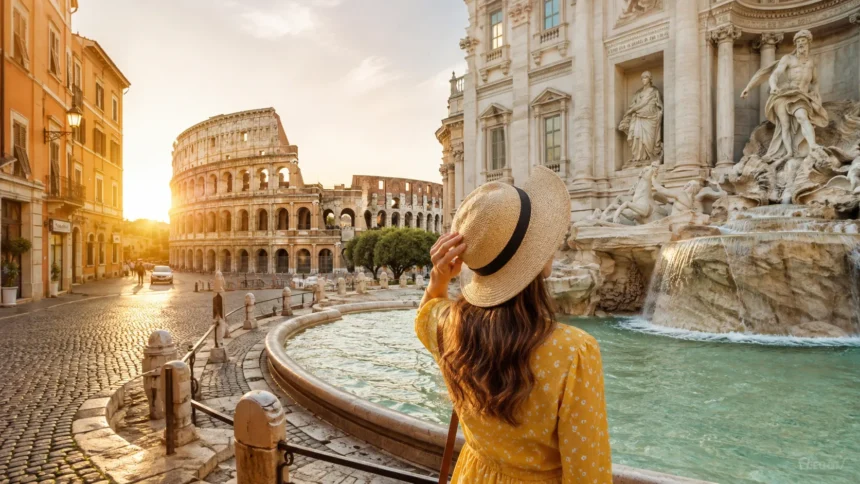
Trevi Fountain is one of Rome’s most theatrical landmarks because visitors usually reach it through narrow streets before the monumental composition suddenly fills the square. Designed principally by Nicola Salvi and completed in the eighteenth century, the fountain integrates sculpture, architecture, rock formations, and moving water across the façade of Palazzo Poli. Oceanus dominates the center while horses and allegorical figures create a sense of movement around him. The monument feels even larger because Piazza di Trevi provides relatively little open space from which to observe it. You often hear the rushing water before you see the entire fountain. That combination of sound, surprise, and scale explains why even travelers who expect Trevi to feel overly touristy are often impressed when they arrive.
The coin-tossing tradition adds a playful ritual to the visit. Popular custom associates throwing a coin backward over your shoulder with eventually returning to Rome, and countless travelers participate regardless of whether they believe the legend. During crowded periods, patience matters because everyone wants a photograph near the same section of water. Take your moment without occupying the edge unnecessarily, then move back to appreciate the full architectural composition. The fountain often looks better from farther away because you can see how sculptures, palace façade, rocks, and water work together. Early morning offers the calmest atmosphere for many photographers, while evening illumination emphasizes the pale stone and constantly moving water. Visiting twice can reveal completely different moods.
A significant visitor change took effect in 2026. From February 2, tourists and non-residents need a €2 ticket to enter the controlled basin area closest to Trevi Fountain, with standard ticketed access currently operating daily from 9:00 a.m. to 10:00 p.m. Rome’s official tourism information explains that the system applies specifically to the closest area and was introduced to improve protection, maintenance, and crowd management. (turismoroma.it) Wider views of the fountain should not be confused with paid access to this basin zone. Hours can vary for maintenance or public-order requirements, so check current information before visiting. Older Rome guides may not mention this change.
Crowds around Trevi can become intense because several pedestrian streets funnel visitors into the relatively compact square. Keep wallets, phones, cameras, and bags secure while moving through dense groups, particularly when you are distracted by photographs. Summer afternoons can also feel uncomfortably hot, making early morning or later evening visits preferable for both atmosphere and comfort. The Spanish Steps, Pantheon, and Piazza Navona are close enough to connect through a long historic-center walk. This approach reduces transportation time and turns several famous attractions into one cohesive experience. Stop for coffee, gelato, or lunch away from the most congested blocks rather than insisting on eating directly beside the fountain. A short detour often produces a calmer and more enjoyable meal.
Trevi becomes more interesting when you think of it as part of Rome’s water story rather than only a romantic photo location. Monumental fountains historically celebrated aqueducts and water supply while also providing opportunities for rulers and patrons to create dramatic public architecture. Trevi’s theatrical appearance turns practical infrastructure into civic spectacle, which is very characteristic of Baroque Rome. Stand at different points around the square and notice how the monument changes as surrounding buildings restrict your viewing distance. Return at night if possible because the illuminated stone and dark water create one of Rome’s classic evening scenes. Despite crowds and commercialization, Trevi Fountain remains an extraordinary urban composition. With smart timing, it fully deserves a place among the best things to do in Rome.
8. Relax in Piazza Navona
Piazza Navona demonstrates that some of Rome’s finest attractions require no museum ticket at all. The elegant oval square follows the form of the ancient Stadium of Domitian, preserving the footprint of a Roman entertainment venue beneath a distinctly Baroque urban landscape. Today, fountains, church façades, palaces, cafés, visitors, artists, and pedestrian activity fill the space throughout the day. Bernini’s Fountain of the Four Rivers creates the dramatic centerpiece, while Sant’Agnese in Agone provides an impressive architectural backdrop. The square manages to feel monumental and social at the same time. Sitting here for thirty minutes can reveal more about Roman public life than rushing through another gallery simply because it appears on a checklist.
The Fountain of the Four Rivers deserves a slow walk around all sides. Large sculpted figures symbolize major rivers associated with different parts of the world as understood during the seventeenth century, while an obelisk rises dramatically above the rocky center. Bernini used stone to create movement and instability, making the fountain seem almost theatrical despite its enormous weight. Smaller fountains at opposite ends of the piazza complete the long visual composition. Morning light creates cleaner architectural views, while later hours bring stronger social energy and restaurant activity. Rather than photographing only the central fountain, look at the relationship between sculpture, church façade, surrounding palaces, and the unusual shape of the square. Piazza Navona works best as an environment rather than a single monument.
The square is ideally positioned for a walking day through Rome’s historic center. The Pantheon sits only a short distance away, while Campo de’ Fiori, Trevi Fountain, the Tiber, and numerous churches can also be reached comfortably on foot. Instead of following only direct navigation instructions, take occasional side streets and allow yourself to discover small courtyards, fountains, artisan shops, and quieter cafés. These transitions between headline Rome attractions often become some of the most memorable parts of the trip. A good first-time itinerary should therefore include unstructured walking time around Piazza Navona. You are unlikely to become truly lost for long in the compact historic center, and wandering helps the city feel more personal. Rome rewards curiosity constantly.
Dining directly on Piazza Navona can be expensive because part of what you are paying for is the view. There is nothing wrong with choosing a café terrace for atmosphere, particularly if a leisurely drink beside one of Rome’s most beautiful squares is part of the experience you want. Travelers prioritizing food quality or value, however, may prefer walking several streets away before selecting a restaurant. Look for focused menus offering recognizable Roman dishes rather than enormous tourist menus trying to serve every possible cuisine. Carbonara, amatriciana, cacio e pepe, artichokes in season, and supplì are among the foods worth trying somewhere during your stay. Meals should slow your sightseeing pace rather than become another logistical task squeezed between attractions.
Evening is a particularly enjoyable time to return to Piazza Navona. Warm architectural lighting, moving water, restaurant terraces, conversations, and occasional performers create an atmosphere completely different from the morning. Families can use the open space as a natural break from museums, while couples and solo travelers may enjoy simply people-watching without planning another activity. If your day has involved the Vatican or Colosseum, spending an unstructured evening here can provide welcome mental relief from intensive historical sightseeing. Piazza Navona reminds visitors that Rome is still a living city rather than an archaeological theme park. The greatest pleasure may be doing nothing more complicated than ordering a drink, watching people cross the square, and appreciating several centuries of architecture surrounding everyday urban life.
9. Climb the Spanish Steps
The Spanish Steps create one of Rome’s most recognizable urban scenes by connecting Piazza di Spagna below with the church of Trinità dei Monti above. Built in the eighteenth century, the staircase uses broad flights, curves, terraces, and changing perspectives to transform a steep slope into an elegant piece of public architecture. At the bottom, the Barcaccia fountain adds another distinctive element, while luxury shopping streets extend outward from the square. The area presents a completely different version of Rome from the ancient Forum or monumental Vatican. Fashion, architecture, café culture, and people-watching dominate the atmosphere. For first-time visitors, the Spanish Steps are most enjoyable as part of a broader walking route rather than an isolated attraction requiring a special journey.
Start at the lower square and look upward before climbing because the full design is easiest to appreciate from Piazza di Spagna. As you ascend, stop occasionally and look behind you because the view expands gradually across surrounding rooftops and busy streets. The church above provides the architectural endpoint, creating a carefully framed relationship between upper and lower levels. Rome’s official tourism material describes the staircase as an eighteenth-century masterpiece connecting the Pincio area with the piazza below. The steps are especially photogenic in softer morning light, when fewer people may be moving across the structure. Seasonal flower displays can also change the visual atmosphere around springtime. Whatever the season, remember that the staircase is a protected monument rather than ordinary public seating.
The surrounding streets deserve time because they contain some of central Rome’s best-known shopping areas. Via dei Condotti is associated with international luxury brands, while side streets offer cafés, hotels, churches, smaller boutiques, and historic architecture. Travelers with little interest in designer shopping can still enjoy the neighborhood for photography and people-watching. From the top of the steps, continuing toward Villa Borghese creates a pleasant transition into green space. Alternatively, walking toward Trevi Fountain connects two famous landmarks without requiring public transportation. The Spanish Steps therefore work particularly well within a morning or evening walking itinerary. Rome’s historic center becomes much easier to understand when you connect attractions on foot instead of treating each one like a separate destination.
Timing is important because the steps can become extremely busy during peak daytime periods. Sunrise or early morning provides the strongest opportunity for uncrowded photographs and a calmer appreciation of the architecture. Evening is attractive for a different reason, as shop windows and surrounding buildings create a polished urban atmosphere after the heat of the day has faded. During summer, climbing the staircase around midday may feel surprisingly tiring when combined with several hours of walking elsewhere. Bring water and take advantage of nearby cafés rather than forcing yourself through an unnecessarily packed schedule. Travelers should also follow posted preservation rules because local authorities protect the steps from behavior that can damage the monument. Respectful use keeps the site enjoyable for everyone.
The Spanish Steps belong on a Rome itinerary not because they require hours of sightseeing but because they help connect several different parts of the historic center. A route beginning at Piazza di Spagna can continue toward Trevi Fountain, the Pantheon, and Piazza Navona, creating an excellent half-day walk through Baroque and later Rome. Alternatively, heading upward toward Villa Borghese and the Pincian Terrace introduces parks and panoramic views after crowded central streets. These connections make the steps strategically useful as well as visually attractive. Spend twenty minutes or an hour depending on your interests, but avoid approaching the landmark only for one photograph. The pleasure lies in observing the square, climbing gradually, and using the experience as a doorway into another part of Rome.
10. See Bernini and Caravaggio at Galleria Borghese
Galleria Borghese offers one of Rome’s most concentrated art experiences within the former villa of the powerful Borghese family. The museum contains masterpieces by Bernini, Caravaggio, Raphael, Titian, Canova, and other major artists, yet its manageable scale feels very different from the enormous Vatican Museums. Sculptures and paintings remain surrounded by elaborate ceilings, decorative walls, marble, and architectural details that reinforce the atmosphere of an aristocratic collection. Bernini’s sculptures are especially astonishing because marble appears to become skin, hair, fabric, leaves, and movement under his carving. Caravaggio provides an equally dramatic contrast through intense lighting and psychologically charged figures. Art lovers should consider this one of the most important things to do in Rome rather than an optional extra.
Bernini’s Apollo and Daphne is a highlight because the sculpture captures transformation in progress rather than presenting a static figure. Fingers become branches, hair merges with leaves, and the narrative changes as you physically move around the work. The Rape of Proserpina offers another extraordinary display of technique, particularly in the illusion of fingers pressing into marble flesh. Caravaggio’s paintings feel darker and more immediate, using intense contrasts of light to focus attention on emotion and action. Even travelers without formal art knowledge can respond to these works because their physical effect is so direct. Reading a short introduction before the visit is useful, but avoid spending the entire museum staring at your phone. The works deserve your full attention.
Reservations are essential rather than merely recommended. Galleria Borghese currently requires booking for all ticket categories, including free admissions, and standard visits operate within controlled two-hour time periods. The museum is open Tuesday through Sunday from 9:00 a.m. to 7:00 p.m., with the final entry at 5:45 p.m., according to current official visitor information. (galleriaborghese.cultura.gov.it) The controlled system helps prevent the galleries from becoming as overcrowded as museums with continuous admission. Book several weeks ahead when traveling during popular periods because desirable time slots can disappear. Arrive early enough for required ticket and bag procedures so your limited gallery time is not reduced by avoidable delays.
Two hours is enough to see the collection thoughtfully because the gallery is intentionally structured around timed visits. Instead of racing through every room, choose several works that particularly interest you and spend more time viewing them from different angles. Sculptures by Bernini reward physical movement because narratives unfold as you circle them. The surrounding architecture should also receive attention because ceilings, floors, wall decoration, and room proportions formed part of the original artistic environment. Guided tours can provide useful historical context for visitors unfamiliar with the Borghese family or Baroque art. Independent travelers may prefer to read about a handful of highlights beforehand. Either approach works better than arriving without any idea which works you most want to see.
After your museum session, step directly into Villa Borghese rather than returning immediately to dense central streets. The park creates a refreshing contrast after concentrated gallery viewing and allows your eyes and mind to rest. Walk toward the lake, explore tree-lined avenues, or continue toward the Pincian Terrace for panoramic city views. Pairing art with outdoor time turns the Borghese area into one of Rome’s most balanced half-day experiences. This is especially useful after several days dominated by stone ruins, church interiors, and crowded piazzas. Galleria Borghese demonstrates that Rome’s cultural importance did not end with antiquity. The city continued producing extraordinary art through Renaissance and Baroque patronage, and few places communicate that story as beautifully.
11. Slow Down in Villa Borghese
Villa Borghese provides welcome breathing room in a city where sightseeing often means standing on stone, climbing stairs, and moving through crowded historic streets. The large public park contains tree-lined paths, fountains, sculptures, gardens, museums, recreational areas, and quiet spaces that feel surprisingly removed from central Rome despite their convenient location. Rome’s tourism authority notes that the park includes historic buildings, monuments, ponds, gardens, and substantial open spaces developed over centuries. (turismoroma.it) Visitors can spend an hour recovering between attractions or devote most of an afternoon to wandering. The park works particularly well for families, couples, solo travelers, and anyone whose feet need a break from cobbled streets. Rome becomes easier to enjoy when you intentionally include green space.
One of the most charming areas is the Garden of the Lake, where the Temple of Aesculapius creates a picturesque neoclassical scene beside the water. Small boats may be available to rent, turning a sightseeing break into a relaxed activity that requires almost no historical preparation. Elsewhere, avenues lead past statues, fountains, museums, and landscaped sections that reflect different periods of the park’s development. You do not need to follow a strict route because wandering is part of the appeal. Bring a drink or simple picnic when weather conditions are pleasant and give yourself permission to sit without planning the next landmark immediately. Rome’s parks remind visitors that a successful vacation should contain recovery time. Constant sightseeing eventually makes even extraordinary monuments feel ordinary.
Villa Borghese pairs naturally with Galleria Borghese, but the park should not be considered merely a waiting area before or after the museum. Other cultural institutions and attractions occupy the broader landscape, while family-friendly facilities make it one of central Rome’s most versatile outdoor destinations. Rome’s official tourism material describes Villa Borghese as containing multiple museums alongside gardens, fountains, ponds, and recreational spaces. (turismoroma.it) Travelers interested in art can therefore spend much of a day in the area without returning to crowded streets. Those with children can balance museum time with open space and movement. The park’s flexibility is precisely what makes it valuable within a tightly scheduled Rome itinerary.
Walking from Villa Borghese toward the Pincian Terrace provides one of the park’s best transitions back into the historic city. The terrace overlooks Piazza del Popolo and reveals a broad skyline filled with domes, rooftops, and distant landmarks. Sunset can be especially attractive when the light softens and people gather around the viewpoint. From there, you can descend toward Piazza del Popolo or continue toward the Spanish Steps depending on your evening plans. This route connects green space with major central attractions without requiring a bus or taxi. Photographers should arrive before sunset rather than exactly at the final moment because changing light creates several different scenes. Even cloudy evenings can produce atmospheric views across Rome’s layered rooftops.
Villa Borghese is most useful when you resist the urge to turn every corner into another attraction. Buy coffee, sit beneath trees, watch people cycling, or read for half an hour without feeling that vacation time is being wasted. After intense visits to the Vatican or archaeological sites, this slower experience can restore your curiosity for the city. Families may appreciate the freedom especially because children can move more naturally than inside churches and galleries. Couples can create an inexpensive romantic afternoon without booking another tour. Solo travelers gain a calm place for journaling or planning the next day. Among all Rome itinerary ideas, intentionally scheduling unstructured time in Villa Borghese may be one of the simplest ways to make an ambitious city break feel sustainable.
12. Explore Castel Sant’Angelo
Castel Sant’Angelo has one of the most unusual histories of any major monument in Rome. It began as the mausoleum of Emperor Hadrian before later generations converted the massive cylindrical structure into a fortress, military stronghold, prison, papal refuge, and eventually museum. Each transformation left architectural evidence, so walking through the castle feels like moving between completely different periods of Roman history. Ancient masonry exists beneath medieval defensive spaces, Renaissance rooms, courtyards, ramps, and terraces. The building’s position beside the Tiber also gives it an unforgettable external appearance, especially when approached across Ponte Sant’Angelo. Visitors interested in political history often find the castle more engaging than expected because survival depended on constant adaptation rather than preservation in one original form.
The internal route gradually climbs upward through passages and courtyards before reaching more decorative spaces associated with papal use. Frescoed rooms contrast dramatically with the fortress-like structure surrounding them, reminding visitors that Castel Sant’Angelo served both defensive and ceremonial purposes. The historic Passetto di Borgo connected the fortress with the Vatican area and allowed popes to reach safety during dangerous periods. Current guided access to the Passetto operates through specific arrangements rather than automatically forming part of every ordinary museum visit. (direzionemuseiroma.cultura.gov.it) If this passage is a priority, check availability when planning your visit. Otherwise, the standard castle route still provides several hours of varied architecture and history.
The upper terrace is one of the strongest reasons to visit. From here, St. Peter’s Basilica appears impressively close while the Tiber, bridges, domes, rooftops, and historic center stretch in several directions. Late afternoon can produce particularly attractive light, making the castle a smart choice for travelers who enjoy photography. The bronze angel above the fortress adds a distinctive silhouette and reflects the later legend that gave the monument its current name. Allow time to stay on the terrace rather than reaching the top only to begin descending immediately. Views help connect locations you have already visited and reveal how compact central Rome actually is. Seeing the city from above provides geographical understanding that street-level sightseeing often cannot.
Visitors should be aware of important 2026 ticket changes. From July 1, full-price admission to Castel Sant’Angelo increased to €18, and current official information recommends advance booking, particularly on holidays and weekends. The museum also introduced special first-Monday afternoon openings beginning in August 2026, with separate conditions and a reduced special ticket for those dates. (direzionemuseiroma.cultura.gov.it) Regular access may also be affected by ongoing works intended to improve accessibility, so current notices are worth checking before arrival. Tickets are personal under current rules, and identification requirements may apply. These details are useful when coordinating the castle with a Vatican day.
The most enjoyable approach is often on foot from St. Peter’s Square. Walk along Via della Conciliazione, continue toward the Tiber, and gradually watch the cylindrical fortress become more prominent. After visiting, cross Ponte Sant’Angelo and continue toward Piazza Navona or the Pantheon, creating a natural transition into the historic center. The bridge itself is worth slowing down for because its angel sculptures and river views form part of the experience. Castel Sant’Angelo is particularly valuable on a four- or five-day Rome trip when you have already seen the essential ancient landmarks. It combines imperial, medieval, Renaissance, military, and papal history inside one structure. Few attractions illustrate Rome’s ability to reuse its own past so vividly.
13. Wander Through Trastevere
Trastevere is one of Rome’s most atmospheric neighborhoods, filled with narrow lanes, warm-colored buildings, small squares, restaurants, bars, churches, and everyday residential details. Located across the Tiber from much of the historic center, the neighborhood feels connected to central Rome while maintaining a recognizable personality of its own. Visitors often arrive for dinner, but Trastevere deserves exploration before evening crowds fill the most popular streets. Morning reveals deliveries, residents, cafés, laundry, and quieter corners that become harder to notice later. Wandering without a strict route is one of the best ways to experience the district. You are not looking for one monumental attraction but for the relationship between streets, food, churches, and local urban life.
The Basilica of Santa Maria in Trastevere provides a useful focal point for exploring the neighborhood. The church’s mosaics and long history make it culturally significant, while the surrounding piazza functions as one of the area’s main gathering spaces. From there, narrow lanes branch toward restaurants, artisan shops, bars, and quieter residential sections. Travelers should avoid assuming every street in Trastevere remains untouched by tourism because the neighborhood’s popularity has changed parts of its commercial character considerably. Moving a few blocks away from the busiest restaurant corridors can reveal calmer spaces and often better dining value. The goal is not to find a mythical “secret Rome” but to enjoy a neighborhood where historic fabric still shapes everyday movement.
Food is one of the main reasons people spend evenings in Trastevere. Traditional Roman dishes such as carbonara, amatriciana, cacio e pepe, gricia, tripe, and seasonal artichokes appear on menus throughout the area. Tourist demand also means quality varies, so avoid choosing a restaurant only because someone is enthusiastically inviting customers inside. Look at menus, recent feedback, and the overall focus of the kitchen before deciding. Reservations may be useful for well-regarded restaurants, particularly during weekends and busy travel seasons. A simple aperitivo followed by dinner can easily become an entire evening activity. Rome’s food culture is best appreciated slowly, with enough time between courses to talk, observe the neighborhood, and enjoy the street atmosphere.
Trastevere also provides easy access to the Janiculum and Botanical Garden area, making it possible to combine neighborhood exploration with greenery and panoramic views. Begin lower in the streets, visit a church or café, then gradually climb toward higher ground if the weather is comfortable. The elevation offers a useful escape from dense evening crowds and reveals another perspective over central Rome. Alternatively, cross toward Tiber Island and the Jewish Ghetto for a longer cultural walk. These connections make Trastevere particularly useful for travelers who enjoy exploring on foot rather than following fixed sightseeing routes. Comfortable shoes remain important because uneven stones and long days of walking can become tiring. Give yourself several hours rather than treating Trastevere only as a dinner address.
Late evening brings the neighborhood’s busiest atmosphere, especially around popular squares and bar streets. Travelers interested in nightlife may enjoy that energy, while those seeking quieter dining should arrive earlier or move farther from central gathering areas. Keep normal awareness around belongings and transportation when streets become crowded, particularly after drinking. The neighborhood remains enjoyable precisely because it can serve several different travel styles within one day. Morning belongs to cafés and quiet streets, afternoon to wandering and churches, and evening to restaurants and social life. Spending time here adds human scale to a Rome itinerary dominated by imperial ruins and monumental religious architecture. Trastevere reminds you that the Eternal City is also a collection of neighborhoods where people continue living ordinary lives.
14. Browse Campo de’ Fiori and Nearby Streets
Campo de’ Fiori is one of central Rome’s most recognizable squares because its personality changes significantly between morning and evening. During daytime hours, market stalls traditionally occupy the square, creating a colorful setting of produce, flowers, spices, foods, and visitor-oriented products. As the day progresses, restaurants and bars become more prominent and the area shifts toward a social gathering place. At the center stands the dark monument to Giordano Bruno, whose execution here in 1600 gives the lively square a much more serious historical dimension. This contrast between market activity and memory makes Campo de’ Fiori more interesting than a simple shopping stop. It is a place where daily life and difficult history occupy the same public space.
Visit earlier in the morning if seeing the market matters most to you. The atmosphere is generally more connected with daytime commerce before restaurant seating and evening activity dominate the square. Not every stall is aimed at residents, so approach souvenirs and packaged products with the same judgment you would use in any heavily visited market. Rather than purchasing the first item you see, walk around and observe the mixture of food, flowers, specialty products, and tourism-oriented offerings. The streets surrounding the square are often just as interesting as the market itself. Bakeries, delis, small shops, cafés, and architectural details continue through the surrounding historic blocks. A morning visit works particularly well before walking toward Piazza Navona or the Jewish Ghetto.
The monument to Giordano Bruno adds historical depth that many visitors overlook while concentrating on food stalls. Bruno was a philosopher and Dominican friar whose ideas and conflicts with religious authorities eventually led to his execution in Campo de’ Fiori. The statue was erected centuries later and became a symbol associated with free thought and the complicated relationship between intellectual inquiry and authority. You do not need a detailed philosophical background to appreciate how unusual it is for a busy market square to center on such a somber memorial. Pause before moving on and consider the dramatically different events the space has hosted through history. Rome continually places ordinary life beside monuments to the past. Campo de’ Fiori makes that layering particularly visible.
Food-focused travelers can use the surrounding neighborhood as a starting point rather than expecting the market itself to provide their best meal. Nearby bakeries, salumerie, cafés, restaurants, and takeaway counters offer opportunities to try pizza bianca, cured meats, cheese, pastries, or other Roman foods. Research a few options beforehand but leave room for spontaneous discoveries because opening hours and queues can influence your choices. A guided food walk can also connect Campo de’ Fiori with the Jewish Ghetto or Trastevere while providing historical context around Roman cuisine. This approach turns eating into cultural sightseeing rather than simply another restaurant reservation. Portion sizes and tasting stops can add up quickly, so arrive hungry. Rome is a city where food history deserves as much curiosity as architectural history.
Evening produces a completely different atmosphere as bars and restaurants attract younger crowds and visitors. Some travelers enjoy the energy, while others may find it too busy or tourist-oriented and prefer returning to quieter nearby streets. If nightlife is not your priority, visit in the morning and continue elsewhere before the character changes. Campo de’ Fiori works best as one stop within a larger historic-center walk rather than an attraction requiring several hours on its own. Combine it with Piazza Navona, the Pantheon, Largo di Torre Argentina, or the Jewish Ghetto depending on your route. The square’s greatest value comes from contrast: commerce, nightlife, memory, food, and architecture all share a surprisingly compact space. That complexity makes it worth experiencing at least once.
15. Discover the Capitoline Museums
The Capitoline Museums are essential for travelers who want ancient Rome presented with more context than an outdoor archaeological site can provide. Located around Piazza del Campidoglio, the museum complex contains classical sculpture, inscriptions, paintings, archaeological objects, and iconic works associated with Roman history. Its institutional roots stretch back to 1471, when Pope Sixtus IV donated important bronzes to the people of Rome, a history that has led the museums to be described among the world’s earliest public museum collections. (museicapitolini.org) The setting itself adds to the experience because Michelangelo’s redesign of the Campidoglio created one of Rome’s great civic spaces. Museum and architecture therefore work together before you even enter the galleries.
Among the collections, visitors encounter celebrated sculptures such as the Capitoline Wolf, the Dying Gaul, the Capitoline Venus, and imposing portraits of Roman emperors. Displays help transform names encountered at the Forum into actual faces, objects, inscriptions, and visual culture. The museum also contains paintings and later works, so it should not be understood only as an archaeological collection. One of the strongest experiences comes from galleries overlooking the Roman Forum, where museum interpretation suddenly connects with the physical ruins below. This relationship is especially useful if you visit the museum after exploring the Forum earlier in your trip. Objects that once seemed abstract gain geographical meaning. Travelers interested in Roman history can easily spend several hours here without running out of important material.
Current visitor information lists the Capitoline Museums as open daily from 9:30 a.m. to 7:30 p.m., with the final admission one hour before closing and modified hours on several holiday dates. (museicapitolini.org) Temporary closures can affect individual rooms, and 2026 notices show that restoration work has occasionally restricted access to specific sections. (museicapitolini.org) Check current notices if there is one masterpiece or gallery you particularly want to see. Because the museum is central and usually easier to fit into an itinerary than highly restricted attractions, it can also serve as an excellent flexible choice for poor weather. Online planning still saves time during busy periods.
Piazza del Campidoglio deserves attention before or after the museum. The elegant arrangement of façades, staircase, paving, and central equestrian monument creates a civic space that feels remarkably controlled despite the chaotic urban history surrounding it. Walk toward the rear of the complex for elevated views over sections of the Roman Forum. This is particularly attractive near sunset, when ancient ruins begin changing color under softer light. The nearby Victor Emmanuel II Monument and Piazza Venezia create additional possibilities for continuing your walk. Instead of taking transportation immediately after leaving the museum, explore the hill and surrounding streets. The Capitoline area demonstrates how Renaissance Rome reframed and physically overlooked its ancient predecessor.
The Capitoline Museums work especially well for travelers who find the Forum fascinating but difficult to interpret. Inside, sculptures, inscriptions, maps, and archaeological material provide the context that outdoor ruins cannot always communicate clearly. They also introduce Roman portraiture, mythology, civic symbolism, and political propaganda in a way that deepens later sightseeing elsewhere. Give yourself at least two hours, and consider three if you enjoy museums. Families with older children can focus on famous sculptures rather than attempting every gallery. Art lovers will discover more than they expected beyond the archaeological highlights. Among all Rome museums, the Capitoline collection offers one of the strongest bridges between the ancient city’s physical ruins and the people, objects, and images that once filled them.
16. Walk Through the Baths of Caracalla
The Baths of Caracalla are among Rome’s most impressive ancient ruins because their massive walls reveal how enormous Roman public bathing complexes could become. Opened in the early third century under Emperor Caracalla, the complex included hot and cold bathing spaces, exercise areas, gardens, libraries, and social facilities decorated with costly marble, sculpture, and mosaics. Visitors today see towering brick structures rather than intact interiors, yet the surviving scale makes reconstruction easier than at many fragmented archaeological sites. These were not ordinary swimming facilities but major public institutions where leisure, hygiene, exercise, social interaction, and imperial generosity came together. Walking beneath enormous arches helps you understand how ambitious Roman civic architecture could be even outside temples and amphitheaters.
Imagine the complex covered in polished stone, colorful decoration, sculpture, water, and crowds rather than the austere brick surfaces visible today. Much of the valuable material was removed or reused after antiquity, but archaeological evidence demonstrates that the original environment was exceptionally luxurious. Floors and surviving mosaic sections provide clues to decorative richness, while the dimensions of bathing halls reveal the engineering required to heat and supply huge quantities of water. Learning how Roman bath systems functioned makes the ruins considerably more interesting. A guide or digital reconstruction can help visitors understand where different bathing temperatures and activities occurred. The Baths of Caracalla reward imagination in the same way as the Forum, but the massive walls provide stronger visual guidance.
As of 2026, official Italian cultural information lists standard admission at €8, with reduced tickets available under qualifying rules and possible supplements during exhibitions. Current published hours during the summer season run Tuesday through Sunday from 9:00 a.m. to 7:15 p.m., with final admission at 6:00 p.m., while Mondays are normally closed. (cultura.gov.it) Seasonal or event-related schedules can change, particularly because the archaeological complex also hosts performances and cultural programming. Check official information shortly before visiting rather than relying on fixed hours copied months earlier. Tickets can be obtained through official Musei Italiani channels. Compared with the Colosseum, advance planning is usually less stressful.
The baths are mostly outdoors, so weather strongly influences the experience. Summer visitors should come earlier in the day or later when possible because exposed spaces become hot under intense sun. Wear comfortable shoes and carry water, particularly if you plan to continue walking toward the Circus Maximus or Aventine area afterward. Spring and autumn often provide excellent conditions because the large ruins can be explored without the strongest heat. Photographers will appreciate late-afternoon light on the brick walls, especially when long shadows emphasize the enormous architectural forms. The site generally feels more spacious than Rome’s most famous landmarks, making it an excellent choice after several crowded attractions. You can often pause and study the ruins without constantly moving with a tour group.
Pairing Caracalla with the Circus Maximus and Aventine Hill creates a strong half-day focused on ancient Rome and panoramic neighborhoods. Travelers could also continue toward the Appian Way on a longer archaeological day, although transportation may be helpful to conserve energy. The baths deserve more attention than they receive from visitors who spend all available archaeology time at the Colosseum and Forum. Their scale reveals another side of imperial life: not gladiatorial spectacle or political ceremony, but highly organized public leisure. Because the complex is less visually familiar, many travelers arrive with fewer expectations and leave more impressed than anticipated. If you have four or more days in Rome, the Baths of Caracalla are one of the best places to expand your understanding beyond the standard highlights.
17. Descend Beneath the Basilica of San Clemente
The Basilica of San Clemente offers one of Rome’s clearest demonstrations of how the city literally developed in layers. At street level, visitors enter a beautiful medieval basilica decorated with mosaics and religious art. Beneath that church lies an earlier Christian basilica, and farther underground are structures dating to Roman antiquity, including spaces associated with residential and religious use. Descending through these levels feels like physically moving backward through centuries rather than reading about chronology in a museum. Few attractions make Rome’s vertical history so immediate. What begins as a church visit gradually becomes an archaeological journey through changing street levels, communities, beliefs, and architectural reuse. For curious travelers, it is one of the city’s most rewarding surprises.
The upper basilica deserves attention before you head underground. Its apse mosaic creates a visually rich religious centerpiece, while floors, columns, frescoes, and architectural details reflect centuries of artistic development. Once you descend, the environment changes dramatically as light becomes lower and rooms feel more archaeological than ceremonial. Earlier Christian spaces reveal how churches could be rebuilt above older foundations as Rome’s urban level changed. Deeper Roman remains demonstrate that structures associated with completely different purposes could survive beneath later religious buildings. This sequence explains something fundamental about Rome: later generations often built over earlier spaces rather than clearing everything away. Archaeology survives beneath ordinary streets and buildings throughout the city.
The archaeological excavations require online booking under current visitor rules. San Clemente’s official site states that advance online reservation is the only way to secure entry to the excavations because daily admission is limited, while the basilica and underground areas follow defined morning and afternoon opening periods. (basilicasanclemente.com) Current full admission to the excavations is listed at €10, with qualifying reduced and free categories. Opening schedules differ on Sundays and holidays, so travelers should check the official calendar when planning. Because the church is located near the Colosseum, it can fit naturally into an ancient Rome day. Just avoid booking it so tightly that delays at the Colosseum make you miss the reserved slot.
The underground areas feel cooler than outdoor Rome, which can be pleasant during summer but may surprise visitors dressed only for heat. Bring a light layer if you tend to feel cold in enclosed stone spaces. Stairs and ancient surfaces also mean the experience may present mobility challenges, so travelers with accessibility needs should consult current information beforehand. Photography rules should be followed carefully because churches and archaeological spaces may have restrictions. Move slowly and allow your eyes to adjust to changing light between levels. The visit is not enormous, but the conceptual impact is significant because each descent changes your understanding of the building above. A guided explanation or good brochure can help make the chronological sequence easier to follow.
San Clemente is especially useful for travelers who have already visited the Forum and want to understand what happened to Rome after the classical imperial period. Instead of ending history with ancient ruins, the basilica shows how Christian communities, medieval rebuilding, and later religious life occupied and transformed the same urban space. This continuity is one reason Rome feels different from cities where archaeological districts are physically separated from modern life. Here, ancient structures may sit beneath functioning churches and apartment buildings. Spend time in the upper basilica again after returning from the excavations because it will look different once you know what exists below your feet. Among the more unusual things to do in Rome, descending through San Clemente provides an unforgettable lesson in how the Eternal City accumulated vertically.
18. Walk or Cycle the Ancient Appian Way
The Appian Way offers one of the best opportunities to leave Rome’s dense historic center without leaving its history behind. Begun in 312 BC, the ancient road eventually connected Rome with southern Italy and became famous as the Regina Viarum, or Queen of Roads. Sections near the city still preserve ancient paving, funerary monuments, villas, churches, countryside, and umbrella-pine scenery that feels remarkably removed from central traffic. Rome’s tourism authority recommends exploring the route on foot or by bicycle and highlights monuments, catacombs, and archaeological landscapes along the way. (turismoroma.it) After several days of museums and packed piazzas, the open space can feel refreshing. The experience combines archaeology with an actual outdoor journey.
Start by deciding how much of the route you realistically want to cover. Walkers may prefer a selected section containing several major monuments, while cyclists can reach more distant ruins without spending the entire day on foot. Sites along or near the road include the Mausoleum of Cecilia Metella, Villa of Maxentius, catacombs, ancient tombs, and farther archaeological complexes. The broader Appian Way park also connects with landscapes such as the Caffarella Valley and Aqueducts area. (turismoroma.it) Distances become substantial surprisingly quickly, so download a map and understand transportation options before setting out. A guided bicycle tour can be valuable for first-time visitors who want history and navigation handled together.
Ancient paving can make cycling less comfortable than photographs suggest. Standard city bicycles may feel awkward on rough stone sections, while suitable wider tires and careful riding provide greater control. Walking also requires supportive shoes because uneven surfaces accumulate fatigue over several hours. Bring water and sun protection because shade varies significantly along the route. Spring and autumn are especially pleasant for longer outdoor exploration, although good-weather weekends can attract more visitors. If you visit during summer, begin early before temperatures become intense. The Appian Way should feel like a slow journey through landscape and history rather than a competition to reach the greatest possible distance.
Different monuments along the road operate under their own opening schedules and ticket arrangements. Travelers who specifically want to enter a villa, mausoleum, museum, or catacomb should therefore check that site rather than assuming everything is accessible whenever the road is open. The official archaeological park oversees a large area including major complexes along the ancient route, while the regional park also protects significant natural landscapes. (turismoroma.it) Sundays have traditionally offered a particularly walking-friendly atmosphere along important sections, but current road and access conditions should always be verified locally. Avoid designing a rigid itinerary around too many individual sites. The beauty of the Appian Way is partly the freedom to pause when a landscape or ruin catches your attention.
The farther you move from central Rome, the easier it becomes to imagine how this route once functioned as a major road through the countryside. Ancient paving disappears and reappears, tombs line sections of the landscape, and modern city noise gradually feels less dominant. Photographers may especially enjoy the combination of stone, grass, ruins, and umbrella pines. History enthusiasts can connect individual monuments with larger ideas about Roman transportation, burial customs, military movement, and urban expansion. Families with older children may appreciate cycling as a break from museums, while couples can turn the route into a relaxed half-day outdoors. If your Rome itinerary includes four or five days, exploring the Appian Way is one of the best ways to experience ancient history beyond the crowded central archaeological zone.
19. Visit Rome’s Ancient Catacombs
Rome’s catacombs reveal an underground side of the city that is easy to overlook while concentrating on monumental architecture above ground. These networks of burial galleries developed outside the ancient city walls and were used by early Christian and other communities during different periods. Narrow passages, burial niches, inscriptions, chambers, and surviving symbolic decoration create an experience very different from large basilicas or archaeological parks. Visitors often arrive expecting something frightening but discover that the catacombs are primarily places connected with burial, remembrance, community, and religious history. The cool underground environment also emphasizes the physical separation from modern Rome above. Guided interpretation is particularly valuable because much of the historical significance would be difficult to understand from corridors alone.
Several major catacomb complexes are located along or near the Appian Way, including San Callisto and San Sebastiano. Their histories, opening days, tour languages, and ticket procedures differ, so choose one rather than assuming you need to visit several in the same afternoon. San Callisto is among the most extensive and historically important early Christian burial areas, while San Sebastiano combines catacomb history with a major basilica. Guided access is standard because underground networks require controlled routes and protection. Tours typically explain burial customs, Christian symbols, and the development of these communities within the wider Roman world. The experience becomes far more meaningful when you understand that these were organized cemeteries rather than secret underground cities built primarily for hiding.
The Appian Way makes catacombs easy to combine with other archaeological attractions in the same part of Rome. A morning visit underground followed by walking or cycling along the ancient road creates a strong thematic day away from the historic center. Check individual opening schedules carefully because some catacombs close on specific weekdays or seasonal periods. Arrive with enough time for your designated tour rather than assuming late admission will be possible. Modest clothing may be appropriate because many complexes remain connected with active religious institutions. Photography restrictions often apply underground, so respect instructions even when you see other visitors ignoring them. Protecting fragile spaces matters more than collecting another image for social media.
The temperature below ground can feel noticeably cooler than the street, making a light layer useful even during Rome’s hottest months. Passages may be narrow, uneven, and enclosed, so travelers with severe claustrophobia or certain mobility limitations should research the physical environment before booking. Comfortable shoes remain important because stairs and irregular surfaces can be part of the route. Guides generally keep groups together, so this is not an attraction where visitors wander independently at their own pace. That structure is actually helpful because archaeological context is essential to understanding what you are seeing. Listen to explanations rather than focusing only on dramatic tunnels. The catacombs are most interesting as evidence of real ancient communities and changing religious practices.
Visiting one catacomb complex adds important balance to a Rome itinerary because it shifts attention away from emperors, palaces, and monumental public architecture. Here, history becomes focused on ordinary burials, religious identity, rituals, and communities that left a very different archaeological record. Combined with San Clemente, the catacombs help explain the transition from ancient pagan Rome toward a city increasingly shaped by Christianity. They also demonstrate that some of Rome’s most important historical spaces remain beneath modern ground level. After returning to daylight, the broad Appian landscape can feel especially vivid. For travelers interested in archaeology, early Christianity, or unusual experiences beyond the major tourist circuit, a catacomb tour is one of the most memorable things to do in Rome.
20. Watch the Sunset From Janiculum Hill
Janiculum Hill provides one of Rome’s most satisfying panoramic experiences because the viewpoint rises above Trastevere and looks across the historic city. Although Janiculum is not traditionally counted among ancient Rome’s famous seven hills, its elevation makes it especially valuable for seeing domes, rooftops, monuments, and distant districts together. The broad terrace around Piazzale Giuseppe Garibaldi becomes a popular gathering place as daylight begins fading. Unlike ticketed observation decks, the hill allows travelers to enjoy a major city view without a museum reservation or fixed entry time. Reaching the top requires some uphill walking, but the journey can become part of a Trastevere afternoon. Sunset here provides a relaxed finale after days filled with structured sightseeing.
The hill also has strong historical associations with the Roman Republic of 1849 and Giuseppe Garibaldi. Monuments and busts commemorate figures connected with the struggle, giving the walk historical meaning beyond the panorama. Rome tourism materials describe routes across Janiculum that pass memorials, viewpoints, and places linked with the defense of the short-lived republic. The area also connects with institutions, gardens, churches, and the Botanical Garden lower on the Trastevere side. Travelers interested in modern Italian history may therefore want to arrive earlier rather than treating Janiculum only as a sunset platform. Reading a little about Garibaldi helps explain why his enormous equestrian statue occupies such a commanding position. Rome’s nineteenth-century political history deserves attention alongside emperors and popes.
One famous local tradition is the midday cannon firing from Janiculum. The daily signal has historical roots and continues to attract visitors who happen to be in the area around noon. If sunset is your priority, however, arrive roughly an hour before the expected time so you can choose a comfortable viewing position and watch the city gradually change. Bring water during summer because the uphill route can feel tiring in heat. A taxi or bus may reduce the climb for travelers with limited energy, although walking from Trastevere creates a more satisfying sense of arrival. Comfortable shoes matter because returning downhill after dark can involve uneven pavement. Plan your route back before relying completely on spontaneous navigation.
Photography changes dramatically across the hour surrounding sunset. Before the sun drops, warm light can illuminate façades and domes, while later the city becomes increasingly defined by artificial lights. A zoom lens helps isolate distant landmarks, but even phone cameras can capture the broad atmosphere effectively. Avoid spending the entire sunset staring at a screen because the changing light is more impressive when you simply watch it happen. Couples often find Janiculum romantic, while solo travelers can appreciate the peaceful space to reflect on several days of sightseeing. Families may enjoy the open terrace after long museum visits. The viewpoint is popular without feeling like an attraction that requires complicated planning. Sometimes the easiest experiences become the most memorable.
Ending a Rome trip on Janiculum creates a useful sense of perspective because many places you have explored suddenly appear together within the same skyline. St. Peter’s dome, historic churches, rooftops, monuments, and dense neighborhoods no longer feel like isolated stops on a map. You can mentally retrace walks through Trastevere, Vatican City, Piazza Navona, the Pantheon, and other parts of central Rome while looking across the city. That geographic understanding is a satisfying way to conclude an itinerary filled with individual masterpieces. Bring no complicated expectations beyond good weather and enough time to linger. Rome’s greatest appeal ultimately comes from the way thousands of years of history remain layered inside one functioning modern city. Watching sunset from Janiculum lets you see that entire idea spread across the horizon.
Frequently Asked Questions
How many days do you need in Rome?
Three full days allow active travelers to see major highlights such as the Colosseum, Roman Forum, Vatican Museums, St. Peter’s Basilica, Pantheon, Trevi Fountain, and several central squares. Four or five days provide a much better pace and create room for Villa Borghese, the Appian Way, Trastevere, museums, food experiences, and spontaneous exploration.
What should you book in advance in Rome?
Prioritize advance reservations for the Colosseum, Vatican Museums, Galleria Borghese, and any timed underground or archaeological experience that is important to your trip. The Colosseum currently opens standard timed ticket sales 30 days before the visit, while Galleria Borghese requires reservations for all ticket categories.
What are the best free things to do in Rome?
Walking through Piazza Navona, climbing the Spanish Steps, exploring Trastevere, relaxing in Villa Borghese, viewing St. Peter’s Square, and watching sunset from Janiculum are excellent free experiences. Trevi Fountain can still be seen from the wider public area, although entering the controlled basin zone closest to the monument now costs €2 for tourists and non-residents during ticketed hours.
Is Rome easy to explore on foot?
Much of the historic center is highly walkable, particularly routes connecting the Spanish Steps, Trevi Fountain, Pantheon, Piazza Navona, Campo de’ Fiori, and Trastevere. However, cobbled streets, hills, summer heat, and long days make supportive footwear, water, and occasional public transportation important for maintaining a comfortable pace.
What is the best thing to do in Rome for a first-time visitor?
The Colosseum combined with the Roman Forum and Palatine Hill is the strongest introduction to ancient Rome and provides several hours of connected sightseeing. Visitors more interested in Renaissance art and religious history should give equal priority to the Vatican Museums and St. Peter’s Basilica.