


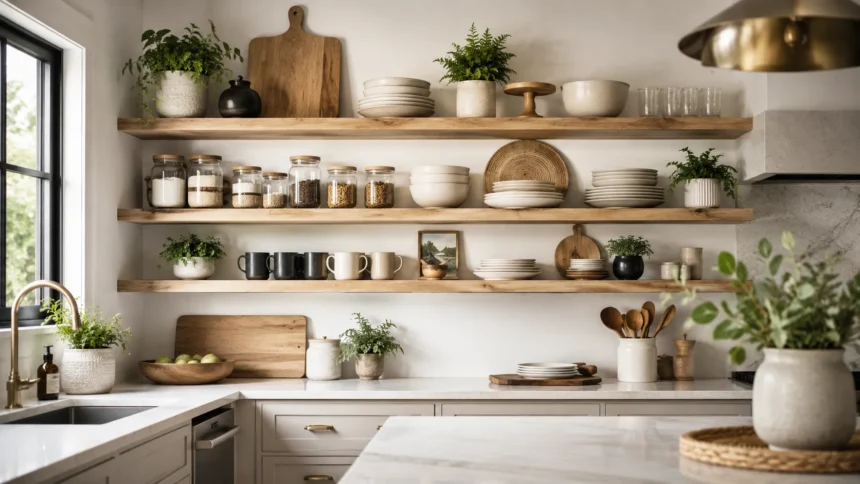
How to Decorate Open Shelves in a Kitchen
Open kitchen shelving can make a space feel lighter, more personal, and more inviting, but it can also look cluttered quickly if everything is placed without a plan. Learning how to decorate open shelves in a kitchen is about creating a balance between beauty and everyday function. The best shelves should look styled while still being practical enough for normal kitchen life.
Open shelves work particularly well because they allow you to display items that would otherwise stay hidden behind cabinet doors. Everyday plates, glasses, bowls, cookbooks, pottery, and decorative accessories can all become part of the kitchen design. When these pieces share similar colors, materials, or shapes, the shelves naturally feel more coordinated.
The key is not to fill every available inch. Good kitchen shelf styling usually includes a mix of useful pieces, decorative objects, and intentional empty space. This breathing room prevents the shelves from looking overcrowded and helps your favorite items stand out instead of competing for attention.
Whether your kitchen is modern, farmhouse, minimalist, rustic, or traditional, open shelving can adapt to the overall style. With thoughtful arrangement, color coordination, layering, and practical organization, you can turn ordinary shelves into a feature that makes the whole kitchen feel more polished.
Start With a Clean and Simple Foundation
Before adding anything decorative, remove everything from your shelves and start with a blank surface. This makes it much easier to decide what actually deserves to be displayed. Wipe down the shelves, check for items you rarely use, and separate functional kitchen essentials from pieces that are mainly decorative.
Next, think about the overall look you want your open kitchen shelves to create. A modern kitchen may benefit from simple white dishes and glassware, while a farmhouse kitchen might look better with pottery, wooden cutting boards, and woven baskets. Choosing a direction first prevents the finished arrangement from feeling random.
Try to limit your main color palette to two or three dominant shades. Neutral tones such as white, cream, beige, black, and natural wood are easy to combine and provide a timeless foundation. You can then introduce smaller accents through plants, artwork, colorful bowls, or seasonal accessories without overwhelming the shelves.
A simple foundation also gives you flexibility. When most of your everyday pieces coordinate, you can easily update the shelves later by changing one or two decorative items. This approach makes open shelving easier to maintain and helps your kitchen stay visually calm even when the shelves are actively used.
Use Everyday Dishes as Part of the Decor
One of the easiest ways to style kitchen shelves is to use the dishes you already reach for every day. Plates, bowls, mugs, and drinking glasses can look surprisingly decorative when they are neatly grouped. Practical items also reduce the need to buy accessories simply to make the shelves look fuller.
Stack plates and bowls in tidy groups rather than spreading them individually across the shelf. Keeping similar shapes together creates order and makes the collection feel intentional. If your dishes are mostly neutral, the repeated colors will create a clean visual rhythm throughout your kitchen open shelving.
Mugs can be lined up beside stacked bowls or arranged in small groups. Clear drinking glasses often look best together because their transparency helps maintain an airy appearance. Avoid placing too many unrelated colors and patterns next to one another unless you intentionally want an eclectic, collected style.
The most frequently used items should usually stay on the lower shelves where they are easy to reach. Decorative items and less frequently used serving pieces can sit higher. This simple organization strategy helps your shelves remain functional while still giving them the carefully styled look you want.
Mix Different Heights for a More Interesting Display
Shelves look more visually appealing when objects vary in height rather than forming one flat horizontal line. Tall pitchers, stacked dishes, framed artwork, cutting boards, and small bowls can create different levels. These height changes give the eye something to move between and make the arrangement feel more dynamic.
Start by placing one or two taller objects toward the back of the shelf. These can act as visual anchors for smaller pieces placed in front. A tall vase next to stacked bowls, for example, creates more depth than several objects that are exactly the same height.
You can also create height by stacking items intentionally. A small decorative bowl placed on top of two cookbooks instantly becomes more noticeable. Similarly, a plant pot placed beside a shorter stack of plates can create a balanced arrangement without requiring many additional accessories.
Be careful not to make every section dramatically different in height. Too much variation can feel chaotic. Instead, repeat a few similar heights across the shelves so the arrangement still feels connected while maintaining enough variety to keep the display interesting.
Add Warmth With Wooden Cutting Boards
Wooden cutting boards are one of the easiest decorative elements to use on open kitchen shelves. They bring warmth, texture, and an organic quality that balances harder materials such as ceramic, glass, and metal. They are also practical, making them ideal for kitchens where functionality matters.
Lean one or two cutting boards vertically against the wall behind smaller objects. Round, rectangular, and handled boards can be combined to create subtle shape variation. Natural wood tones work especially well with white dishes, black accents, greenery, and neutral kitchen shelf decor.
Avoid displaying too many cutting boards at once because a large collection can dominate the shelf. One larger board paired with a smaller board is often enough to create warmth without taking over the arrangement. Their purpose should be to support the overall display rather than become the only visual feature.
Wood can also help soften very modern kitchens. If your space includes white cabinets, stone countertops, stainless steel appliances, or black fixtures, natural wooden accents can make the room feel more comfortable and balanced. This is one reason cutting boards remain popular in both contemporary and farmhouse shelf styling.
Bring in Greenery With Small Plants
Plants can instantly make open shelves feel more lively and welcoming. A small trailing plant, herb pot, or compact leafy plant introduces natural color without overwhelming the kitchen. Greenery also provides contrast against neutral dishes, wooden accessories, and white walls.
Choose plants according to the amount of light your kitchen receives. Shelves close to windows may support herbs or light-loving plants, while lower-light areas may require more adaptable varieties. Artificial greenery can also work when maintaining real plants is impractical, especially on high shelves.
Use simple pots that complement your kitchen’s existing color palette. White ceramic, terracotta, stone-look, or neutral planters usually blend easily with other shelf accessories. A highly decorative planter can also become a focal point, but it should coordinate with the rest of the kitchen.
One or two plants are usually enough for a small shelving area. Too many can make the shelves feel crowded and may reduce practical storage space. Strategic greenery works best when it adds freshness while allowing dishes, glassware, and decorative objects to remain clearly visible.
Style With Cookbooks Without Creating Clutter
Cookbooks are useful, colorful, and naturally appropriate for kitchen shelves. They can add personality while giving you convenient access to recipes. However, a large row of mismatched books can easily make open shelves appear busy, so selective styling is usually more effective.
Choose a few cookbooks with covers or spines that complement your overall color scheme. You can stand them vertically between bookends or stack two or three horizontally. Horizontal stacks are especially useful because you can place a small bowl, candle, or decorative object on top.
Position frequently used cookbooks where they are easy to reach. Books used mainly for decoration can go on higher shelves or in less accessible corners. This allows your shelf arrangement to remain practical rather than becoming a display that looks good but is inconvenient to use.
Avoid filling an entire shelf with books unless that is part of your intended design. Open shelving usually looks better when cookbooks are mixed with dishes, pottery, or greenery. This combination creates visual variety while keeping the kitchen atmosphere relaxed and functional.
Create Balance With Groups of Three
Grouping objects in odd numbers is a simple styling technique that often creates a natural-looking arrangement. Groups of three are particularly effective because they provide enough variety to feel interesting without becoming overcrowded. This principle can work with bowls, jars, pottery, plants, or decorative accessories.
For example, you might combine a small vase, a stack of bowls, and a framed print. The objects do not need to match exactly, but they should share a visual connection through color, material, or style. This creates an arrangement that feels collected rather than randomly assembled.
Vary the heights and shapes within each group. A tall object next to a medium-height piece and a smaller accessory creates a pleasing visual triangle. This is often more attractive than lining up three similarly sized objects next to each other.
Do not apply the rule of three rigidly to every section. Some areas may look better with two objects, while others can handle four or five. The goal is to create visual balance, not to follow a formula so strictly that the shelves start looking overly staged.
Layer Objects to Add Depth
Flat arrangements can make open shelves look unfinished, especially when everything is lined up along the front edge. Layering creates depth by positioning some objects behind others. This makes the display feel more natural and helps you use shelf space more effectively.
Try leaning a framed print, tray, or cutting board against the wall and placing smaller objects in front. The background piece acts as a visual anchor while the foreground objects create dimension. This works particularly well on deeper shelves that otherwise might appear empty behind everyday dishes.
You can also layer plates by placing a larger serving platter vertically behind smaller stacked bowls. This creates an interesting backdrop while keeping useful pieces accessible. The technique works especially well when the colors are coordinated so the layers complement rather than compete with one another.
Avoid layering too many items in a small area because important objects can become hidden. The goal is subtle depth, not maximum storage. Leave enough space around each arrangement so you can still see the individual pieces and remove everyday items without disturbing everything else.
Incorporate Attractive Storage Containers
Open shelves often need to hold practical kitchen items, and attractive containers can make those necessities look more intentional. Glass jars, ceramic canisters, baskets, and matching storage containers can keep ingredients or small accessories organized while contributing to the overall decor.
Clear glass jars work particularly well for attractive pantry staples such as pasta, rice, oats, or dried ingredients. They create a clean, organized appearance while allowing you to see what is inside. Matching jar shapes can also bring consistency to shelves that contain many different objects.
Woven baskets are useful when you want to hide less attractive items. Small packets, kitchen linens, or miscellaneous supplies can be stored inside while the basket itself adds warmth and texture. Natural fibers pair especially well with wood, white ceramics, and neutral kitchen interiors.
Keep practical storage limited to containers that genuinely improve organization. Filling every shelf with jars and baskets can make the display feel more like a pantry than a decorative feature. A few thoughtfully chosen containers usually provide enough storage while preserving the open, spacious look.
Use Artwork for a More Personal Look
Small artwork can give open shelves a more finished and personal appearance. Framed prints, food illustrations, vintage-inspired pieces, or simple abstract artwork can introduce personality without requiring much shelf space. Artwork can also add color to an otherwise neutral kitchen.
Lean frames against the wall rather than hanging them directly above the shelf. This creates a relaxed, layered look and makes it easy to change the artwork whenever you want. Small frames can also sit behind bowls, jars, or plants to create depth.
Choose artwork that complements your kitchen rather than feeling disconnected from it. Botanical illustrations, food-related prints, landscapes, or minimalist artwork often fit naturally into kitchen spaces. However, personal photographs or meaningful pieces can be equally effective when styled carefully.
Avoid adding artwork to every shelf. One or two pieces are usually enough to establish personality without making the display too decorative. Remember that open shelves still need to function as kitchen storage, so decorative pieces should enhance practical items rather than replace them entirely.
Mix Materials for a Designer-Like Finish
A shelf containing only one material can sometimes feel flat. Mixing ceramic, wood, glass, metal, stone, and natural fibers creates depth and texture. The key is to repeat materials across different shelves so the overall arrangement still looks cohesive.
For example, white ceramic bowls can sit beside clear glasses and a wooden cutting board. A small metal accent or woven basket can then add contrast. Because each material reflects light differently, the combination creates a layered look without requiring bright colors.
Try to limit the number of finishes within one small section. Too many materials placed closely together may make the display look visually busy. Instead, distribute them across the shelving area so certain textures repeat naturally from one level to another.
Material mixing is especially helpful in neutral kitchens. When most of the color palette consists of white, beige, gray, or black, texture becomes an important source of visual interest. Wood grain, glazed pottery, glass, woven fibers, and matte finishes can make a neutral kitchen feel rich rather than plain.
Leave Enough Empty Space
One of the most important open shelving ideas is also one of the simplest: do not fill every space. Empty areas allow individual objects to stand out and make the entire arrangement feel more polished. Without breathing room, even beautiful items can begin to look like clutter.
Think of negative space as part of the design rather than wasted storage. A small gap between a stack of dishes and a vase creates visual separation. The empty space helps the eye understand where one arrangement ends and another begins.
If your shelves currently look crowded, remove a few items before buying anything new. Often, editing creates a bigger improvement than adding more decorations. Place rarely used or unattractive items inside cabinets and reserve open shelving for pieces that are functional, visually appealing, or meaningful.
Leaving space also makes shelves easier to use and clean. You can remove plates, glasses, and bowls without moving several decorative objects first. This matters in a working kitchen because the most successful open shelves should remain convenient long after the initial styling is complete.
Keep the Color Palette Consistent
Color consistency is one of the easiest ways to make open shelves look professionally styled. Your dishes and decor do not need to match perfectly, but they should feel like they belong in the same visual family. Repeating colors throughout the arrangement creates cohesion.
Neutral palettes are especially easy to work with. White dishes, natural wood, clear glass, beige pottery, and black accents can create a sophisticated foundation. You can then introduce one softer accent color through plants, artwork, cookbooks, or decorative bowls.
If you love colorful kitchens, choose a controlled palette instead of displaying every color equally. For example, blue pottery can become the dominant accent while white and wood serve as supporting neutrals. Repeating the same blue across several shelves ties the entire arrangement together.
Seasonal colors can also be introduced temporarily. Warm rust and brown tones can work during autumn, while soft greenery or lighter ceramics can freshen shelves in spring. Because the foundation stays consistent, small seasonal changes can update the kitchen without requiring a complete redesign.
Match Your Shelf Decor to Your Kitchen Style
Your open shelving should feel connected to the rest of the kitchen. A farmhouse kitchen may suit ceramic pitchers, wooden boards, vintage-style jars, and baskets. A minimalist kitchen may look better with fewer items, simple shapes, and a restrained neutral palette.
Modern kitchens often benefit from clean stacks of dishes, clear glassware, matte ceramics, and carefully selected decorative objects. Black or metallic accents can complement modern hardware and appliances. Keeping the arrangement streamlined helps preserve the crisp look associated with contemporary design.
Traditional kitchens can handle more decorative detail. Framed artwork, patterned dishes, elegant serving pieces, and warmer tones can create a collected appearance. The shelves should still maintain visual order, but they do not need to be as minimal as those in a contemporary kitchen.
Rather than copying a shelf arrangement exactly from a photograph, adapt the idea to your own space. Consider your cabinet style, countertop material, backsplash, hardware, and existing colors. The most successful open shelving decor feels naturally connected to the kitchen rather than added as a separate styling project.
Style High and Low Shelves Differently
Not every shelf needs to serve the same purpose. Lower shelves are typically easier to reach, so they work well for everyday plates, bowls, mugs, glasses, and frequently used ingredients. Keeping practical essentials low makes the kitchen easier to use.
Higher shelves can hold items that are decorative or used less frequently. Serving bowls, pitchers, vases, artwork, baskets, and larger pottery pieces are good choices. These objects can contribute to the overall design without needing to be moved every day.
Be careful with extremely heavy or fragile objects on high shelves. Even if they look attractive, difficult-to-reach pieces can become unsafe or inconvenient. Use lightweight decorative items at the top whenever possible and keep heavier cookware at a more manageable height.
Thinking about accessibility also helps the shelves look more organized. Instead of mixing everyday items and decorative pieces randomly, give each shelf a clear purpose. This approach creates a natural hierarchy and makes the entire arrangement easier to maintain over time.
Avoid the Most Common Open Shelf Styling Mistakes
One common mistake is overcrowding. When every shelf is completely full, the eye has nowhere to rest and individual objects lose their impact. Removing even 20 to 30 percent of the items can often make the arrangement look significantly more intentional.
Another mistake is displaying too many unrelated colors, patterns, and materials. Variety is useful, but there should still be a visual connection among the objects. Repeating colors or materials across several shelves can help bring together pieces that would otherwise feel mismatched.
Ignoring function can also create problems. Beautifully arranged shelves become frustrating when you must move several decorative objects just to reach a plate. Keep everyday items accessible and avoid creating complicated arrangements in areas you use frequently.
Finally, do not forget maintenance. Open shelves naturally collect more visible dust and cooking residue than closed cabinets. Displaying frequently used items helps because they are regularly washed, while limiting unnecessary decorations makes routine cleaning faster and easier.
How to Keep Open Kitchen Shelves Looking Good Every Day
Once your shelves are styled, maintaining them should not require constant effort. Give frequently used objects a consistent home so they can easily be returned to the same place. Simple routines prevent the arrangement from gradually becoming disorganized.
Try to avoid placing random mail, packaging, grocery items, or small appliances on decorative shelves. These temporary objects can quickly disrupt the visual balance. Having separate storage areas for everyday clutter helps preserve the styled appearance.
Clean the shelves regularly, particularly if they are positioned near the stove. Grease and dust can build up more quickly in cooking areas. Frequently used dishes are generally easier to keep clean because they regularly move between the shelf and dishwasher or sink.
Every few months, review what is displayed and remove anything that no longer feels useful or attractive. Open shelves work best when they evolve with your needs. Small adjustments can refresh the space without requiring a completely new arrangement.
Final Thoughts on Decorating Open Kitchen Shelves
Learning how to decorate open shelves in a kitchen is less about following rigid decorating rules and more about balancing practicality with personality. The strongest arrangements combine everyday dishes, useful storage, natural textures, and a few decorative pieces that make the kitchen feel uniquely yours.
Start with the items you already own before purchasing new decorations. Coordinated dishes, wooden cutting boards, attractive glasses, cookbooks, baskets, and plants can provide nearly everything needed for a beautiful display. Careful arrangement often matters more than expensive accessories.
Remember to use different heights, mix textures, layer a few objects, repeat colors, and leave visible breathing room. These simple kitchen shelving ideas create a polished effect while preventing open shelves from becoming cluttered or overly staged.
Most importantly, design your shelves around the way you actually use your kitchen. Open shelving should make everyday life easier while contributing warmth and character to the room. When beauty and function work together, the shelves become a natural part of the kitchen rather than simply another place to decorate.
Frequently Asked Questions
What Should I Put on Open Shelves in a Kitchen?
Use a combination of everyday dishes, glasses, bowls, cookbooks, wooden cutting boards, plants, baskets, and a few decorative objects. Choose pieces that are attractive but also useful.
How Do I Make Kitchen Open Shelves Look Less Cluttered?
Limit your color palette, group similar objects together, and leave empty space between arrangements. Removing unnecessary pieces is often the fastest way to create a cleaner appearance.
Should Open Kitchen Shelves Match the Cabinets?
They do not have to match exactly, but the materials and colors should complement the cabinets and overall kitchen design. Contrasting wood or metal shelves can also create an intentional feature.
How Do You Style Open Shelves Without Overdecorating?
Start with functional kitchen essentials and add only a few decorative accents. Use plants, artwork, or pottery selectively and allow plenty of negative space around each group.
Are Open Kitchen Shelves Still Practical?
Yes, especially when frequently used dishes and glasses are placed within easy reach. Good organization and regular cleaning make open shelving both attractive and practical for everyday kitchens.