


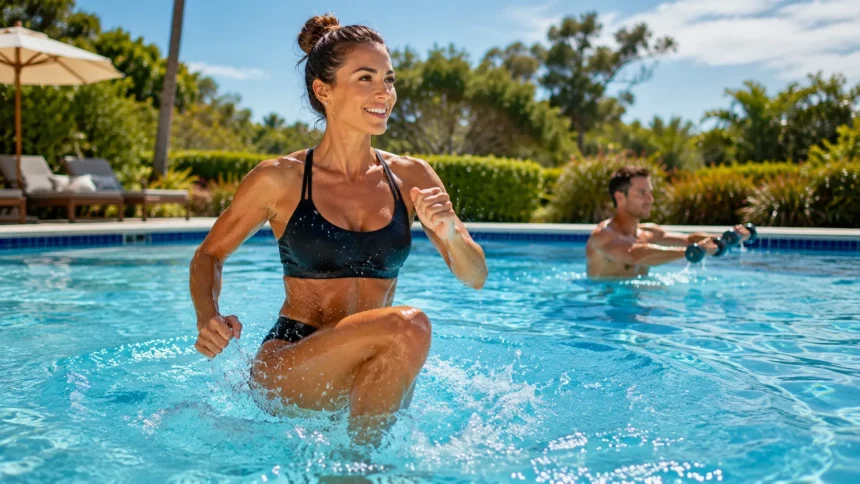
Pool Workouts: 10 Exercises to Get Fit Without the Gym
You do not need a packed gym, heavy weights, or complicated equipment to get an effective workout. A swimming pool can provide resistance in almost every direction, making ordinary movements more challenging while reducing the pounding your joints experience during many land-based exercises. That combination makes pool workouts useful for beginners, regular exercisers, and anyone looking to add variety to a fitness routine.
Water naturally slows movement and creates resistance as your arms and legs push through it. That means walking, jogging, kicking, pressing, and jumping in a pool can challenge multiple muscle groups at once. You can also adjust difficulty simply by moving faster, increasing your range of motion, or working in deeper water where your body must stabilize more actively.
Another advantage of aquatic exercise is versatility. Pool exercises can be used for cardiovascular conditioning, muscular endurance, balance, mobility, and general fitness. Some routines feel similar to traditional water aerobics, while others use swimming movements, intervals, or resistance exercises to create a more athletic full-body workout.
The following 10 exercises can be combined into a practical pool fitness routine without requiring a gym membership. Choose water depth that allows you to maintain control, start gradually, and stop if you experience pain, dizziness, or unusual shortness of breath. If you have a medical condition, recent injury, or significant mobility limitations, get appropriate professional guidance before beginning a new exercise program.
Why Pool Workouts Can Be So Effective
Water provides natural resistance whenever you move through it. Unlike a dumbbell that primarily resists movement in one direction, water can challenge your muscles during pushing, pulling, lifting, and lowering. Increasing your speed usually increases resistance, allowing you to make many pool exercises harder without adding heavy equipment.
Buoyancy also reduces the amount of body weight your joints must support. Depending on water depth, movements such as walking and jogging can feel less jarring than similar exercises on hard ground. This is one reason water-based exercise is frequently used by people who prefer a low-impact workout while still wanting to stay active.
Pool training can also challenge balance and core stability. Water is constantly moving around your body, forcing muscles in your abdomen, hips, and back to help maintain position. Even simple exercises may therefore involve more stabilization than they appear to require from outside the pool.
You can also combine strength and cardiovascular exercise in the same session. Alternating faster movements with controlled resistance exercises keeps the heart rate elevated while different muscle groups work against the water. This makes pool fitness an efficient option when you want a full-body workout without traditional gym machines.
1. Water Walking
Water walking is one of the simplest pool exercises and a good place to begin if you are new to aquatic fitness. Stand in water around waist to chest depth, keep your torso tall, and walk forward with deliberate steps. Allow your heel to contact the pool floor before rolling through the foot instead of walking only on your toes.
Swing your arms naturally as you walk, but push them firmly through the water to create additional resistance. Keep your abdominal muscles gently engaged and avoid leaning excessively forward. Moving slowly with good posture often provides a better starting workout than rushing and losing control of your technique.
Once normal walking feels easy, increase the challenge by taking longer steps or moving your arms more forcefully. You can also walk backward or sideways to recruit muscles differently. Side steps can place greater emphasis on the hips, while backward walking changes the demands placed on the legs.
Try water walking for three to five minutes as a warm-up before harder exercises. It increases movement gradually while giving you time to adjust to the water temperature and depth. For beginners, a longer water-walking session can also serve as a complete low-impact cardio workout on its own.
2. Pool Jogging
Pool jogging increases intensity while maintaining many of the joint-friendly benefits of water exercise. In waist- or chest-deep water, begin jogging in place or traveling slowly across the pool. Lift your knees comfortably and coordinate your arms with your legs just as you would while running on land.
Because water creates resistance, your running speed will naturally be slower. Focus on steady effort rather than trying to match your normal running pace. Keeping your posture upright prevents unnecessary strain and helps your hips, legs, core, and arms contribute effectively to the movement.
You can turn pool jogging into interval training by alternating faster efforts with easier recovery periods. For example, jog strongly for 30 seconds and then walk for 30 to 60 seconds. Repeat several rounds according to your fitness level and how well you maintain good technique.
Deep-water jogging is another option when appropriate flotation equipment and safe pool conditions are available. Without touching the floor, you perform a running motion while remaining upright. This variation can create a demanding cardiovascular challenge while eliminating ground impact, but beginners should become comfortable in the water first.
3. High Knees in the Pool
High knees are a simple way to increase cardiovascular effort while strengthening the muscles that lift and stabilize the hips. Stand upright and alternately raise each knee toward your chest while driving the opposite arm forward. Keep the movement controlled rather than allowing your upper body to collapse toward the knee.
Water resistance makes the upward and downward phases of the exercise more challenging than they may feel on land. Your hip flexors work to raise the legs, while your core helps keep your torso stable against the movement of the surrounding water.
Beginners can perform high knees slowly, placing each foot securely on the pool floor before lifting the other leg. More experienced exercisers can increase speed and turn the movement into a running-style interval. The goal should remain controlled movement rather than uncontrolled splashing.
Try working for 30 to 45 seconds followed by an easier recovery period. High knees combine well with water walking or jogging in a circuit because they raise intensity quickly without requiring additional equipment. They are particularly useful when you want a short burst of pool cardio.
4. Jumping Jacks in Water
Water jumping jacks resemble traditional jumping jacks but feel very different because the water slows your arms and legs. Stand with your feet together and arms near your sides, then move your feet outward while sweeping your arms up or outward through the water.
Return your feet toward the center while bringing your arms back down. Maintain a tall posture and land softly when your feet contact the pool floor. The movement should feel rhythmic and controlled rather than explosive, especially when you are exercising in deeper water.
If jumping feels uncomfortable, perform a low-impact version by stepping one foot outward at a time instead of leaving the floor. Alternate sides while moving both arms through the water. This variation still provides cardiovascular activity and resistance without requiring repeated jumps.
For a more challenging version, increase your pace while maintaining full arm movements. Perform 30 to 60 seconds at a time and recover with easy walking between sets. Water jumping jacks can work the legs, shoulders, arms, and core while adding an energetic element to water aerobics.
5. Pool Squats
Pool squats train the hips, thighs, and glutes while allowing the water to support part of your body weight. Stand with your feet around shoulder width apart and your toes pointing naturally forward or slightly outward. Keep your chest lifted and your weight distributed comfortably through your feet.
Push your hips backward and bend your knees as though you were sitting into a chair. Descend only as far as you can while keeping control and avoiding pain. Then press through your feet and return to a standing position while keeping your knees aligned with your toes.
The water can make squats feel easier during the downward phase because of buoyancy, but it can also create resistance as you move. To increase difficulty, push your arms forward through the water as you squat and pull them back as you stand.
Start with 10 to 15 repetitions and complete two or three sets depending on your fitness level. If you have difficulty balancing, position yourself near the side of the pool for light support. Controlled pool squats can be a useful lower-body component of a joint-friendly exercise routine.
6. Standing Leg Kicks
Standing leg kicks can target the hips and legs while challenging balance. Stand tall near the side of the pool if you need support, then slowly extend one leg forward without leaning backward. Return it under control before repeating with the opposite leg.
You can also perform side kicks by moving one leg outward while keeping your toes facing generally forward. Avoid swinging the leg as high as possible. A smaller controlled movement usually places more useful tension on the muscles than a large movement performed with poor posture.
Backward leg extensions provide another variation. Keeping your torso upright, move one leg behind you while squeezing the glute without excessively arching your lower back. Hold briefly, return to the starting position, and alternate sides.
Perform 10 to 15 repetitions in each direction on each leg. Moving slowly increases the amount of time your muscles work against water resistance. Combining forward, side, and backward kicks creates a simple lower-body pool workout targeting several hip and thigh muscles.
7. Pool Push-Ups
Pool push-ups can strengthen your chest, shoulders, and arms without requiring you to lie on the ground. Face the pool wall and place your hands slightly wider than shoulder width on a secure edge at approximately chest height or wherever you can maintain a safe grip.
Keeping your body aligned, bend your elbows and allow your chest to move gradually toward the wall. Press through your hands to return to the starting position. Avoid allowing your shoulders to rise toward your ears or your lower back to arch excessively.
The exercise becomes easier or harder depending on body position and water depth. Standing closer to the wall generally reduces difficulty, while positioning your feet farther away can make your upper body work harder. Always make sure the pool surface is not slippery.
Aim for 8 to 15 controlled repetitions for two or three sets. Pool push-ups pair well with leg exercises because they bring more upper-body strength work into the routine. They are a simple way to make your pool workout feel more like a balanced full-body session.
8. Water Arm Presses
Water arm presses use the resistance of the water to train your shoulders, chest, back, and arms. Stand in chest-deep water with your elbows slightly bent and your arms extended in front of you. Press your hands outward and backward through the water before returning to the starting position.
Changing the direction of your palms changes how the resistance feels. You can press downward toward your hips, sweep your arms outward to the sides, or push water forward from your chest. Each variation challenges the upper body from a slightly different angle.
Move slowly enough to maintain control but firmly enough to feel resistance. If you simply allow your hands to float through the water, the exercise becomes much easier. Keeping your fingers together can increase the surface area pressing against the water.
Perform each pressing variation for 30 to 45 seconds or complete 10 to 15 repetitions. For greater resistance, some people use aquatic dumbbells or webbed gloves, but they are not necessary for beginners. The water itself can provide plenty of challenge when movements are deliberate.
9. Flutter Kicks
Flutter kicks train the hips, legs, and core while adding an element of swimming-based conditioning. Hold the pool edge securely with your body extended behind you near the surface, then alternate small upward and downward kicks from the hips.
Keep your knees relaxed rather than bending them deeply with every kick. The movement should originate mainly from the hips, with your legs staying relatively long. Rapid kicking from the knees alone can make the exercise less efficient and may cause unnecessary fatigue.
Begin with short intervals of 20 to 30 seconds followed by rest. As your endurance improves, gradually extend the duration. Stronger swimmers can perform flutter kicks using a kickboard, but only if they are comfortable moving safely away from the pool wall.
Avoid holding your breath while kicking. Breathe normally and stop if you become overly fatigued or lose body control. Flutter kicks can elevate your heart rate while strengthening the lower body, making them a useful addition to a cardio pool workout.
10. Pool Mountain Climbers
Pool mountain climbers provide a more advanced cardiovascular and core challenge. Face the pool wall and hold the edge securely with both hands. Lean slightly forward while keeping your body controlled, then alternately drive one knee toward your chest.
Continue alternating knees at a comfortable rhythm. The surrounding water creates resistance against each leg movement, while your arms and core work to maintain a stable body position. Avoid pulling excessively on the wall or allowing your shoulders to collapse forward.
Beginners can perform the movement slowly and focus on alternating controlled knee drives. More experienced exercisers can increase the pace for short intervals, creating a demanding cardiovascular exercise without the same impact associated with fast mountain climbers on land.
Start with 20 to 30 seconds and recover before repeating. Because this exercise can become tiring quickly, technique should take priority over speed. Pool mountain climbers work well near the end of a circuit when you want to add a challenging burst priority over speed. Pool mountain climbers work well near the end of a circuit when you want to add a challenging burst of aquatic cardio.
How to Turn These Exercises Into a Full-Body Pool Workout
Begin with three to five minutes of water walking at an easy pace. Gradually increase your arm movement and walking speed so your body has time to warm up. Follow this with a short period of comfortable pool jogging if you want a slightly more demanding cardiovascular preparation.
Next, choose five to eight exercises from the list and perform each for roughly 30 to 60 seconds or 10 to 15 controlled repetitions. Alternate lower-body movements such as squats and leg kicks with upper-body exercises such as wall push-ups and water presses.
After completing one round, walk slowly for one or two minutes before repeating the circuit. Beginners may complete one or two rounds, while more conditioned exercisers can gradually perform additional rounds or slightly increase their work intervals.
Finish with several minutes of easy walking and gentle movement rather than stopping suddenly after intense exercise. A simple routine built around consistent effort can provide both cardiovascular conditioning and muscular endurance without complicated machines, making the pool a surprisingly versatile fitness environment.
A Simple 30-Minute Pool Workout for Beginners
Spend the first five minutes walking through waist- or chest-deep water at an easy pace. Gradually begin swinging your arms with more purpose and increase your walking speed slightly. The goal is to feel warmer and more mobile without becoming tired before the main workout begins.
For the next ten minutes, alternate one minute of comfortable pool jogging with one minute of an easier exercise such as walking. You can replace jogging with high knees or low-impact jumping jacks if those movements feel more comfortable.
Use the following ten minutes for strength-focused movements. Rotate through squats, standing leg kicks, wall push-ups, water arm presses, and controlled flutter kicks. Perform each exercise for roughly one minute before moving to the next, resting briefly when necessary.
Finish with five minutes of easy water walking. Slow your breathing gradually and allow your heart rate to settle. The exact timing can be adjusted according to your fitness, and beginners should prioritize movement quality rather than trying to complete every interval at maximum intensity.
How to Make Pool Workouts Harder
The easiest way to increase difficulty is to move faster through the water. Water resistance rises as you increase movement speed, which means a faster arm press or knee drive usually demands more muscular effort without needing heavier equipment.
You can also increase your range of motion. Larger controlled arm sweeps or deeper comfortable squats require muscles to work through a greater distance. However, never sacrifice joint comfort or posture simply to make an exercise feel harder.
Longer intervals are another option. If you currently exercise for 30 seconds before resting, gradually progress toward 45 or 60 seconds. You can also shorten recovery periods after your fitness improves instead of immediately adding more complicated exercises.
Aquatic dumbbells, resistance gloves, kickboards, and other pool fitness equipment can provide additional variety. Add equipment only after you can perform the basic movements confidently, because increasing resistance too quickly may cause technique to deteriorate or create unnecessary strain.
How to Make Pool Workouts Easier
Choose shallower water when you want greater stability and more contact with the pool floor. For many beginners, water between waist and chest depth provides a useful combination of buoyancy and control without making balance unnecessarily difficult.
Slow each exercise down and reduce the range of motion when necessary. A smaller squat or slower knee lift can still provide meaningful movement. Fitness improves through consistency, so there is little benefit in pushing through a variation that causes pain or makes you lose balance.
Use the pool wall for light support during standing exercises such as leg kicks and squats. The goal is not to hang heavily from the wall but to give yourself enough stability to focus on controlled movement and proper alignment.
You can also increase recovery time between exercises. Walking slowly through the pool for one or two minutes allows you to remain active without maintaining high intensity continuously. Gradually reduce recovery periods only when the routine starts feeling comfortably manageable.
Are Pool Workouts Good for Weight Loss?
Pool workouts can contribute to weight management because they provide physical activity that uses energy and can improve cardiovascular fitness. Activities such as water jogging, jumping jacks, swimming, and circuit training can become physically demanding when performed consistently.
However, no single type of exercise guarantees weight loss. Changes in body weight depend on many factors, including overall energy intake, activity level, sleep, health, and individual physiology. Pool exercise is best viewed as one part of a sustainable approach to physical activity.
One advantage is that some people find water exercise enjoyable and comfortable enough to perform regularly. An exercise program that you can maintain consistently is usually more useful than a highly intense routine that you quickly stop doing.
Combining pool workouts with walking, resistance training, swimming, or other activities can create a varied weekly routine. If weight loss is your goal, focus on sustainable habits rather than trying to estimate exactly how many calories each individual pool exercise burns.
Can Pool Workouts Build Muscle?
Water resistance can strengthen muscles and improve muscular endurance, particularly for beginners or people returning to regular activity. Every time you push your arms or legs through the water, muscles must work against resistance.
The challenge can be increased by moving faster, creating a larger surface area with your hands, or adding aquatic resistance equipment. Exercises such as water presses, squats, leg kicks, and wall push-ups can therefore become progressively more demanding.
However, traditional resistance training with progressively heavier loads may be more effective when maximizing muscle size or strength is the primary goal. Water workouts usually provide less precise control over resistance than barbells, dumbbells, or weight machines.
For general fitness, pool workouts can still provide valuable strength benefits while combining movement with cardiovascular conditioning. They are especially useful when your priority is developing an enjoyable, low-impact full-body routine rather than pursuing maximal strength.
Are Pool Workouts Good for Your Joints?
Water buoyancy reduces the amount of body weight supported through the legs during many pool exercises. This can make walking, jogging, and other movements feel more comfortable than performing the same activity on a hard surface.
Water also slows movement, which can reduce abrupt impact and make exercises easier to control. This is why aquatic exercise is commonly associated with joint-friendly fitness, although the right exercises and water depth still vary from one person to another.
Low impact does not mean completely risk-free. Rapid twisting, excessive jumping, overuse, or poor technique can still irritate muscles and joints. Stop any movement that causes sharp pain rather than assuming the water automatically makes every exercise safe.
People recovering from surgery, managing significant joint problems, or exercising with a medical condition should follow guidance from an appropriate healthcare or rehabilitation professional. A personalized aquatic program may differ substantially from a general fitness routine.
Pool Workout Safety Tips
Always choose a part of the pool where you can exercise confidently. Beginners should stay within comfortable depth and remain near a stable edge when necessary. Deep-water exercises require stronger swimming ability or appropriate flotation equipment and should not be attempted casually.
Wet surfaces create slipping risks before and after the workout. Walk carefully on the pool deck and use designated steps or ladders when entering and leaving. Avoid running on wet surfaces even if the exercise session itself involves high-intensity movements.
Stay hydrated even though you are surrounded by water. Exercise can still cause fluid loss through sweating, and the cooler environment may make thirst less noticeable than during a similar workout outdoors or in a gym.
Finally, respect your body’s warning signs. Stop exercising if you feel chest pain, faintness, severe breathlessness, confusion, or sudden weakness, and seek appropriate help when necessary. Exercise intensity should build gradually rather than jumping immediately into an exhausting routine.
What Equipment Do You Need for Pool Workouts?
One of the biggest advantages of pool fitness is that you need very little equipment. Many of the exercises in this routine use nothing more than water resistance and the side of the pool, making them accessible for anyone with suitable pool access.
Supportive water shoes can improve traction during exercises performed on the pool floor, particularly if the surface feels slippery. They are optional for many swimmers but may make walking, jogging, and squats feel more secure.
Aquatic dumbbells are made from buoyant foam and create resistance as you push them underwater. Resistance gloves increase the surface area of your hands, while kickboards can be used for swimming drills and lower-body conditioning.
A flotation belt may be useful for deep-water jogging, but it should be selected and used correctly. Beginners do not need to purchase everything at once. Master basic body-weight pool exercises first and add equipment only when it supports a specific fitness goal.
How Often Should You Do Pool Workouts?
The right frequency depends on your current fitness, workout intensity, and other activities you perform during the week. Beginners might start with two or three sessions and pay attention to how their body responds before adding more.
You do not need every pool workout to be intense. One session might focus on cardiovascular intervals, while another emphasizes controlled strength and mobility exercises. Varying effort can make the routine more sustainable and reduce unnecessary fatigue.
Recovery remains important even when exercise is low impact. Your muscles still work against resistance, and increasing volume too quickly can cause soreness or overuse discomfort. Gradual progression allows your body to adapt more comfortably.
Consistency matters more than trying to perform the hardest possible routine immediately. A manageable 20- to 30-minute session completed regularly can provide more long-term value than occasional exhausting workouts that leave you reluctant to return to the pool.
Final Thoughts on Pool Workouts
Pool workouts offer a practical way to improve fitness without relying on a traditional gym. Water provides natural resistance while buoyancy reduces impact, creating an environment where cardio, strength, balance, and mobility exercises can all fit into the same session.
The ten exercises in this guide—including water walking, jogging, high knees, jumping jacks, squats, leg kicks, wall push-ups, arm presses, flutter kicks, and mountain climbers—can be adjusted for different fitness levels. Beginners can move slowly, while experienced exercisers can increase pace and resistance.
You also do not need complicated equipment. The pool itself provides much of the resistance required for an effective workout. As your fitness improves, simple tools such as aquatic dumbbells, kickboards, or resistance gloves can add variety.
The best routine is one you can perform safely and consistently. Start at a manageable intensity, focus on good technique, and gradually increase the challenge. With the right approach, a swimming pool can become an enjoyable full-body workout space without requiring a gym membership.
Frequently Asked Questions
Are pool workouts actually effective?
Yes. Pool workouts can improve cardiovascular fitness, muscular endurance, mobility, and overall activity levels because water creates resistance while reducing impact on the body.
Can I get fit just by exercising in a pool?
Pool exercise can be an effective part of a fitness routine, especially when sessions include both cardio and resistance movements. Your results depend on consistency, intensity, progression, and overall lifestyle.
What is the best pool exercise for beginners?
Water walking is one of the best starting exercises because it is simple, adjustable, and easy to control. Beginners can gradually progress to jogging, squats, and other aquatic exercises.
How long should a pool workout last?
A beginner session can last around 20 to 30 minutes, including warm-up and cool-down. Duration can gradually increase as fitness and comfort in the water improve.
Do pool workouts help reduce belly fat?
Pool workouts can support overall energy expenditure and fitness, but exercises cannot selectively remove fat from one body area. Changes in body fat depend on overall activity, nutrition, and other individual factors.